Activity
Mon
Wed
Fri
Sun
Aug
Sep
Oct
Nov
Dec
Jan
Feb
Mar
Apr
May
Jun
Jul
What is this?
Less
More
Memberships
Seamless-AI
77 members • Free
AI Monetization
621 members • Free
Ai Film Academy™
1.1k members • $49/month
The Award Winning Developer
874 members • $29/month
Automatización de Negocios 🤖✅
1.5k members • Free
Automation Masters
3.8k members • Free
AI Automation Society
429k members • Free
No-Code Nation
3.4k members • Free
Aurora Angel Academy
10 members • Free
2 contributions to Seamless-AI

Jun '25 •
🎧 Seamless-AI Daily Digest - Wednesday, June 11th, 2025
Today's digest spans an impressive range of AI frontiers—from large language models to retrieval-augmented generation and beyond. These aren't isolated advances; they're pieces of a larger puzzle that's reshaping how we think about artificial intelligence. 🚀 Today's Key Insights: - 🔬 Large language models evolving rapidly with new architectures and applications - 🏭 Real-world applications emerging in robotics and automation - 📈 Significant performance improvements across multiple benchmarks - ⚡ Focus on efficiency and optimization for practical deployment 🎯 Listen Now 📥 Download MP3 ⏱️ Duration: ~5 minutes | 🎙️ Format: Professional AI research narration ──────────────────────────────── 💭 Let's Discuss: 1. Which breakthrough do you think will have the most immediate real-world impact? 2. How might advances in large language models transform robotics and automation in the next 2-3 years? 3. What do you see as the biggest remaining challenges in this research area? ──────────────────────────────── 🔥 Why This Matters: These aren't just academic papers—they're blueprints for the AI systems that will shape our world. Understanding these developments today gives you insight into tomorrow's technological landscape. 👇 Your Turn: Which research direction excites you most? Drop your thoughts and let's explore these ideas together! #AIResearch #Innovation #FutureOfAI #MachineLearning #TechTrends

1 like • Jun '25
@Terry Hui Oh, didn't meant the actual audio, just the text of this post, that was most of why for the 'silly'qualifier 😅 We don't have much of a choice, in a perfect world papers on pre-print servers like arXiv would be always good and honest research. But since we live in a world where the "publish or perish" culture is this prominent, a lot of the articles that hit pre-print are just exploratory research that are published because the academic need to keep publishing, so they just make up something that's good enough to be accepted in a conference and hit a pre-print server... and a lot of times it's done in the hopes that paper is just forgotten and never gets too much attention. So in the end, we are stuck with an imperfect system that forces us to do sift thru a lot of straw that were purposefully made to look like a needle, until we do find the needle.
0 likes • Jun '25
@Terry Hui No worries at all! Happy to chat about this. > Do you have a preference on where to source high quality material that is time relevant to us? For practical application, I'd lean towards sources like the blogs and research pages from the major private AI Labs – Google DeepMind, Meta AI, Mistral, Groq, DeepSeek, Qwen, OpenAI, etc. They often highlight work that's closer to real-world use cases or has significant engineering backing. However, my core point was less about the source itself, and more about the fundamental difficulty in evaluating and sorting the sheer volume of research being produced, regardless of where it comes from. Even if you were to focus only on highly reputable, peer-reviewed journals, the problem of sifting remains. Research evaluation is inherently complex; figuring out what's genuinely useful, truly novel, and reliable amidst the flood of papers is hard, even for experts. (The pace and volume, plus pressures within academia, add to this challenge – the significant number of retracted papers across all disciplines each year is one symptom of the strain on evaluation processes.) So, my comment was aimed at the process: A preprint server isn't necessarily a *bad* source, but for practical application, it requires a lot more effort and critical filtering than sources that have already gone through more stringent (though still imperfect) review or demonstrate clear real-world focus. It's harder to separate the actual needles from the straw (which, yes, is sometimes presented convincingly). I'm not saying we can't use automation to help find and filter potentially interesting things on a regular basis. It's absolutely possible to build systems that do a better job than a simple scrape and summary. But it's crucial to understand that this task isn't as simple as it might seem. A quick scrape and single pass through a summarization tool, no matter how good the tool, often struggles with that deeper level of assessment – determining
Jun '25 •
❌ ChatGPT Issues and Your Favorite Alternative
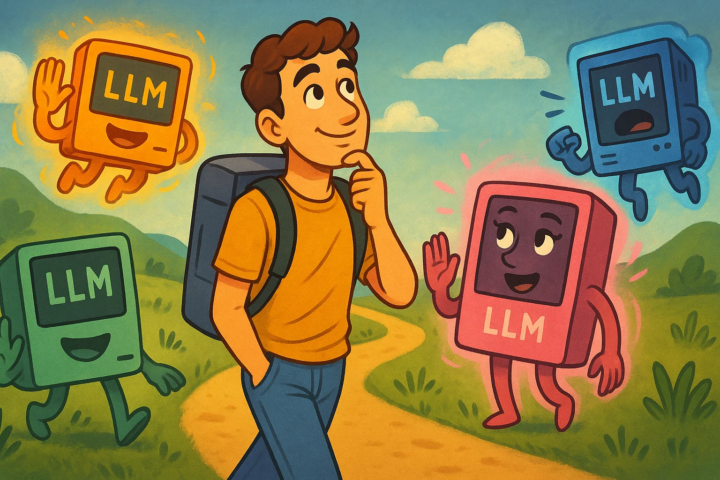
Is ChatGPT unusually, intolerably slow today for anyone else? It's been extremely slow and constantly crashing for me today. Despite how progressive I feel about AI, my dependency on it in moments where I'm lacking in skill or clarity doesn't feel great, and I can only imagine what it feels like for larger companies and businesses that rely heavily on it. I used up all my o3 credits and it switched me to 4o-mini, wondering if that has anything to do with it. I don't use 4o-mini often. What LLM alternatives do you all prefer? I tried Claude Sonnet 4 recently and it was solid, but I'll have to try it more to get a better feel for its performance and use cases. I also tried Gemini as an alternative and I can't say I'm too impressed. Not being able to upload screenshots definitely hinders my workflow with AI, but maybe I'm just too spoiled with ChatGPT 😅 Let me know what you all think and share your alternative LLM preferences and use cases down below! I need some compelling arguments on switching from ChatGPT, or even combination use cases, that would be very interesting.
Poll
4 members have voted
1 like • Jun '25
> Despite how progressive I feel about AI, my dependency on it in moments where I'm lacking in skill or clarity doesn't feel great, and I can only imagine what it feels like for larger companies and businesses that rely heavily on it. Your dependency on AI is not a flaw. Humans rely on things, be it AI, electricity, or even a pencil. You have no reason to "not feel great" over it. If I'm somewhere and have an article to write, have paper but no pencil or pen, then I can't write. Granted, I would not recommend anybody to rely on a big-tech solution without having a very clear contingency plan. I mean, one can build their business and life around it, but then should not be surprised if, or more likely when, that big-tech pulls the rug under their feet. Think of it like Facebook, YouTube, or any platform people have built business around. One day they change the rules and then a lot of people lose their edge or their whole business. Relying specifically on a single platform that is closed-source is probably not a good idea. Relying on AI itself, there is nothing wrong with that. You are just adapting faster. Now that's out of the way, your broader question on the alternatives: I believe people should be fairly familiar with all the big foundational models, both closed-source and open-source. Even if they can't run an open model on their machines, they should try them out either on their official site, when available, or through platforms like Poe, Hugging Face chat, Open Router, etc. LLMs are a very peculiar type of tech, and they don't work the same as one would imagine. Even now that they are more "compatible," the way you interact with one might yield vastly different results with another, and they are not easy to predict. There is a LOT of hype around some models, but the result one gets from them is vastly variable. It depends on how the human interacting with the model approaches what they are doing. It's not just about what you are trying to achieve, but more often than not it's
1-2 of 2