Activity
Mon
Wed
Fri
Sun
Aug
Sep
Oct
Nov
Dec
Jan
Feb
Mar
Apr
May
Jun
What is this?
Less
More
Memberships
AI Avengers Lab
2.4k members • Free
Automated Marketer
4.3k members • Free
Google Ads Dropshipping (Free)
7.2k members • Free
Storebuild.ai - By Zendrop
4.2k members • Free
1C
1% Cashflow Blueprint.
12 members • Free
Automations Hub®
106 members • Free
Strength Purpose Legacy
46 members • Free
AI Bits and Pieces
800 members • Free
The RoboNuggets Network (free)
55k members • Free
313 contributions to AI Automation Society

3h •
how does a new tool change anything
I've been thinking, why do new tools or tech stacks excite everyone. I mean you can build the best thing and if you can't market properly or understand sales and how to sell your product it's of no use. I had this AI for real estate idea built on n8n and Vapi and have since shut myself away from tool news (e.g. Claude code) to help me concentrate on knowing how to actually SELL what i have. do i have a wrong idea here?

0 likes • 2h
@Gideon Austin I think you're focusing on the right thing. Tools come and go, but understanding your customer's problem and knowing how to sell the solution will always be the bigger advantage. The best product still needs distribution.
4h •
Most Businesses Don't Have an Email Problem... They Have a Follow-Up Problem.
One of the biggest mistakes I see is businesses collecting leads and then... doing nothing with them. Someone fills out a form. Books a consultation. Downloads a guide. And then silence. This is where GoHighLevel Email Campaigns become a game changer. Instead of manually following up, you can build automated email sequences that: Welcome new leads instantly Educate prospects about your services Nurture leads over time Send appointment confirmations and reminders Re-engage inactive contacts Build trust before asking for the sale The goal isn't to send more emails. The goal is to send the right email at the right time. When paired with workflows, CRM pipelines, and SMS, GoHighLevel creates a complete follow-up system that works even while you're offline. Businesses don't lose customers because they have a bad product... They lose them because someone else followed up first. How are you currently following up with your leads, manually or through automation?
0 likes • 3h
@Jason Elam Well said. That's exactly how I approach it too. The automation should reflect the customer's journey, not just fire off emails on a schedule. When each touchpoint has a clear purpose and the right human handoff, the system feels personal instead of automated.
7d •
From self doubt to delivering a full AI Receptionist built on Vapi here's what we built
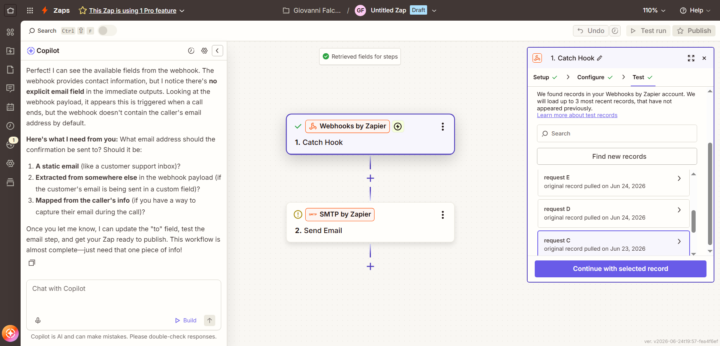
A few months ago I was doubting whether I could really make this work. Lost projects. Slow months. Wondering if I was cut out for this. I kept going anyway. Kept building. Kept learning. Last week I delivered a complete AI Receptionist for Cinco Farm a wedding and event venue in Miami, Florida. Meet Giselle. 🌸 She's the AI receptionist I built on Vapi and here's what she does: 1 Answers every call with: "Thank you for calling Cinco Farm. This is Giselle at the guest concierge line, how can I help you plan your beautiful event today?" 2 Fully bilingual English & Spanish Detects the caller's language in real time and switches instantly. No delay. 3 Answers questions about: - Pricing and packages - Venue information and capacity - Services and event types - Tours and availability 3 Books venue tours through Google Calendar 4 Captures leads, call transcripts, and summaries automatically 5 Sends internal email notifications via Zapier + SMTP the moment a call ends 6 Voicemail fallback for complex requests Tech stack: Vapi (voice AI) Claude Haiku 4.5 (AI model) Deepgram Nova 2 (transcription) 11labs Jessica voice (warm, elegant) Zapier (automation) Google Calendar (booking) SMTP (email notifications) Average latency: ~1,400ms Average cost: ~$0.13/min Client was thrilled. System is live and handling real calls right now. Next step: automated SMS once Twilio A2P registration is approved. If you're building AI receptionists or exploring Vapi for client projects, drop a comment or DM me. What's the most interesting use case you've seen for voice AI so far?
0 likes • 7d
@Sameera Rodrigo Thanks! I haven't built a production voice agent with Claude or Codex yet. I've mainly used Vapi because it handles the telephony and orchestration side really well. That said, I'm definitely curious about the Claude/Codex approach. Have you built something similar with either of them? I'd love to hear how you structured it.
0 likes • 4h
@Dhaval Patel Absolutely! Happy to help. I'll send you a DM so we can discuss your business requirements and see the best way to structure the system for your use case.

2d •
If you use a coding agent, have it prove its work instead of describing it
The new shot-scraper 1.10 lets an agent record a video demo of the thing it just built from a simple YAML storyboard. Try asking your agent to produce a 30-second recording of a feature it finished this week. Watching the demo catches problems a text summary hides. shot-scraper video source: https://aititus.com/news
0 likes • 2d
@Titus Blair Love this idea. A video demo is a much stronger validation than a text summary, it forces the agent to prove the feature actually works end to end. That's a great way to catch edge cases before shipping.
4d •
The right mindset shift that makes GHL AI Receptionist actually work for clients
After building AI receptionist systems for service businesses, I noticed something. The technology isn't the hard part. The mindset is. Most business owners hear "AI receptionist" and their first thought is: "Will it sound robotic?" "What if it says the wrong thing?" "My customers want to talk to a real person." And that resistance kills the conversation before it starts. The shift that works: Stop selling the AI. Start selling the outcome. The right conversation isn't: "I want to set up an AI that answers your calls." It's: "Right now, what happens when a customer calls you at 9PM on a Friday?" That question does the work. Because the business owner already knows the answer, voicemail, missed opportunity, customer calls the competitor. Once they say it out loud, the solution sells itself. GoHighLevel makes this even easier because everything lives in one place, the AI, the calendar, the CRM, the follow-up workflows. There's nothing to stitch together. The business owner doesn't need to understand the technology. They just need to see what happens when nobody answers, and understand that it doesn't have to be that way. That's the mindset shift. Sell the missed call. Not the AI. What objections are you running into when pitching AI receptionist systems to clients?
0 likes • 4d
@Thanh Dinh That's a really important point. I position it as an extension of the team, not a replacement. The goal is to capture the calls they're already missing, answer routine questions, qualify leads, and seamlessly hand off anything outside its scope. Showing those guardrails early builds trust much faster than talking about AI capabilities.
1 like • 4d
@Daniela Castillo Exactly. Once the business owner clearly sees the problem, missed calls, slow responses, lost bookings, the conversation naturally shifts to finding the right solution instead of questioning the technology.
1-10 of 313

@chad-samuel-1098
I help service businesses never miss a lead
using AI receptionists & automation.
HVAC | Plumbing | Dental | DM me "DEMO"
Active 48m ago
Joined Sep 8, 2025
Powered by