Activity
Mon
Wed
Fri
Sun
Jun
Jul
Aug
Sep
Oct
Nov
Dec
Jan
Feb
Mar
Apr
May
What is this?
Less
More
Memberships
Carl Munson's Portugal Club
267 members • Free
75 contributions to Carl Munson's Portugal Club

10d •
"Carl, here are some pics from our weekend adventure on the N222"
Grateful thanks as ever to @John Heimbach and Pam for sharing another of their great experiences in Portugal (-: Côa Valley Archaeological Park

1 like • 10d
The Coa Valley Rock carvings are most older than the rocks they’re on. The museum shouldn’t be missed.
1 like • 10d
I’m a motoista! Yes the N222 is a great road, going West in a car is great. The only way I’d ever do it it on a moto is going East and even then only the upper reaches. Too much traffic and not enough road. Just my opinion🥴

Jan '24 •
Criminal facts in Portugal
Because there is crime in Portugal (it's not a paradise...), I'll place some ocasional news about the subject here. Seven people were convicted to prison (7Y9M to 16 years) for a total of 36 robberies. They robbed houses, with old folks inside, and businesses, perpetrated in the districts of Coimbra and Aveiro in early 2022.https://www.jn.pt/3644566357/sete-dos-15-arguidos-do-caso-teia-dourada-condenados-a-prisao/
1 like • 24d
@António Ferreira The PSP are like the Canadian Mounties, a two year investigation! RCMP Moto “ We always get our man” note: moto was made before women could vote😂😂
0 likes • 19d
@António Ferreira I have owned many large dogs in my life. We walk all kinds of dogs each week for the local dog rescue. I usually walk the difficult dogs, many untrained and sometimes biters. I have been bitten a few times. But I would never, never trust a pitbull that I didn’t bring up myself from a pup. All dogs are trainable, particularly from puppy phase. But pitbulls are risky at best. They are banned in many countries for good reason. M

27d •
New Data on Residency Permits
Thought this might be interesting for the group. 🇵🇹 New data shows Portugal emitted the most residence permits in the entire EU. 1.2 million in 2024 alone, which is over 10% of the entire population, far ahead of countries 6-8x larger like France or Germany. Adjusted for this, GDP per capita growth has been 0.8%/yr since 2019. 🔗 Duarte
1 like • 25d
Amazing that they cleared that many in. We entered finally at the end of 2022. We made more than 10k phone contacts with AIMA. It didn’t get much easier in 2023, which in most cases is when you started the process to get in in 2024!
Jan 1 •
The 'Bygrave Bonus' (mirthful memery & daily* fun from Central Portugal)
@Kate Bygrave's marvellous memes, now in a single handy thread! *seasonal service 😉

2 likes • Apr 1
I’d move
0 likes • 25d
@Carl Munson Grrrrrrrrrrrrrrrrrr
Mar 31 •
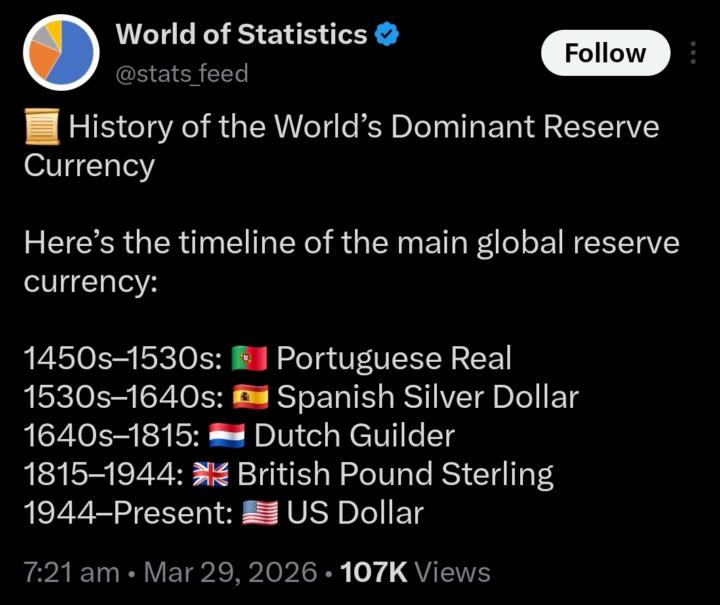
What will be the next global reserve currency? And what was the FIRST?!
While the US dollar remains the dominant global reserve currency, its share is slowly declining, with a potential shift toward a multipolar system rather than a single successor. The Chinese yuan (renminbi) is considered a top contender to increase its share, with predictions suggesting it could become a significant reserve asset within five years as China opens its bond markets. Current Reserve Status (2025): - US Dollar: ~56.77% (down from 58.52% in 2022). - Euro: ~20.25% (down from 20.37% in 2022). - Japanese Yen: ~5.78% (up from 5.54% in 2022). - Pound Sterling: ~4.41% (down from 4.90% in 2022).
Poll
4 members have voted
2 likes • Mar 31
As a citizen of the UK, Canada & the US, and someone who has worked on many continents. I’ve often wondered would I invest in this place. I’ve considered who would be the next global leader when the US Empire falls. It doesn’t have long left I think, it’s about 150 yrs left under normal regimes, but it’s not normal anymore) But why is the US $ still quite strong and still the basis for many economies. I believe the major one is its backing security, Gold. I worked in gold mining, I know how hard it is to produce an ounce of the stuff. The US has over 8000tonnes of the stuff. Nearly 3 times more than #2 Germany. Who by the way store much of their gold in the US, but it doesn’t count in the 8k. I had hope a while ago that the next global currency would be the Euro, the 3 biggest hoarders in Europe almost match the US, altogether they far exceed the US. China and Russia each only hold about a third of the US holdings. As for Russia as the next leader, it will never happen. The talk of the Yuan being the global currency doesn’t make sense. China has historically and still does to some extent, manipulate the value of the Yuan. If the current administration of the US continues down this path if internal destruction, you will see more and more US $ coming back as people want out. This will further lower its value. It’s not the same as a Stock Buy Back! If the economy in the US can struggle through the next 3 years. ( a blip in an empires time) I think a battered US $ will prevail. I don’t have an awful lot longer on this planet, so I made a plan late last to year to get us through the next 3 yrs, and hopefully I’ll live to see a $/€ parity again.😂 Just my humble opinion, I’d love to hear others!
1-10 of 75

@michael-e-catharine-whitby-6157
Sailsmen, motocyclistas, hikers and drinkers of fine wines hic!
Active 6d ago
Joined Mar 30, 2023
ISFJ
Figueiro dos Vinhos