Activity
Mon
Wed
Fri
Sun
Oct
Nov
Dec
Jan
Feb
Mar
Apr
May
Jun
Jul
Aug
Sep
What is this?
Less
More
Future Proof
100 members • Free
InnerDevelopment@Work
519 members • Free
7 contributions to InnerDevelopment@Work

May 8 •
Birth, Life and our Mother
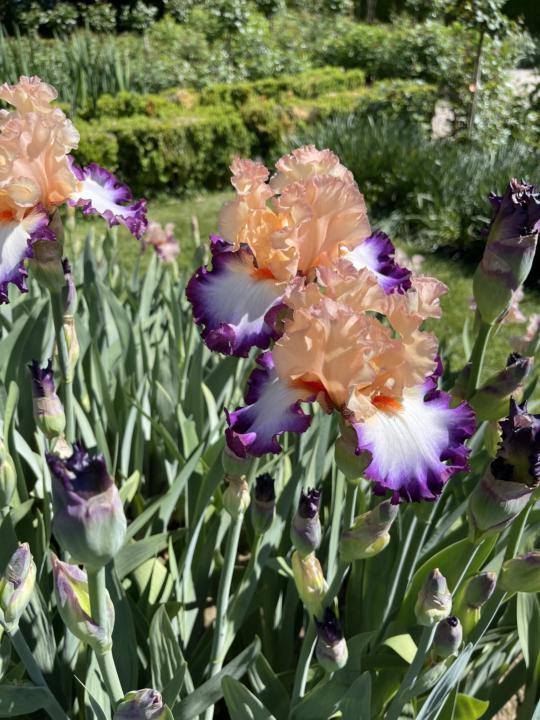
To our blessed Mothers for bringing each of us into this life - Happy Mother’s Day My Mom taught me respect, and generosity.Mine is alive and living in Ottawa, Canada. I’m thankful to technology that facilitates our regular chats… even when we don’t see things the same way, that’s ok. Where does your Mother live? What did she teach you?
2 likes • May 10
Mom was a great example of caring for family while being truly herself, and taking good care of herself physically through good nutrition & exercise. I find these words especially poignant today -- “Parents rarely let go of their children, yet children often let go of them. They move on. They move away. The moments that used to define them are covered by moments of their own accomplishments. It is not until much later, that children understand; their stories and all their accomplishments, sit atop the stories of their mothers and fathers, stones upon stones, beneath the water of their lives.” —Mitch Albom
Mar 6 •
Soil Health, Human Health & Planetary Well-Being: Pathways for Regenerative Economies
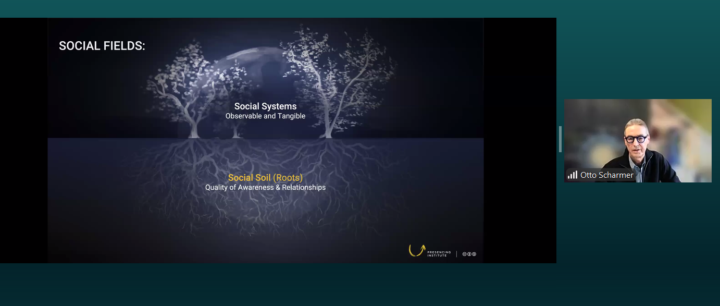
Being a part of the Presencing Institute community since it's very beginning, and have used TheoryU in the design of many gatherings that I have hosted and facilitated. I joined the first of five global gatherings yesterday. They hosted a 90-minute session with over 700 participants weaving together stories, music, breakout conversations, and collective reflection to explore the living connections between regenerative agriculture, human health, and new economic possibilities. I'm sharing a few of the images and phrases that stuck with me: Planting new seeds for new ways From extraction to regeneration Agriculture is culture Native bees are almost extinct Fall in love with the problem Both special guests were touched by a calling and curiosity to do something different with their lives. Despite their fear they allowed themselves to feel into it, to take risks because they had a strong belief in the importance of their ideas, and the impact they could have on people and the planet. They decided to experiment with what they were curious about and each took small steps with purpose, being brave enough to take the next step without having the answers. Christa was activated by soil, farming and community. Zuzanna by creating caring farmer communities. Christa went on to say that she surrendered to the process. Special Guests: Christa Barfield, Zuzanna Zielińska
2 likes • Mar 6
I'm deeply touched by your commentary, @Nadene Canning The 5 points you outlined speak to a meaningful shift toward forward-looking thinking and practice. Thank you!
Mar 1 •
No thought, no problem
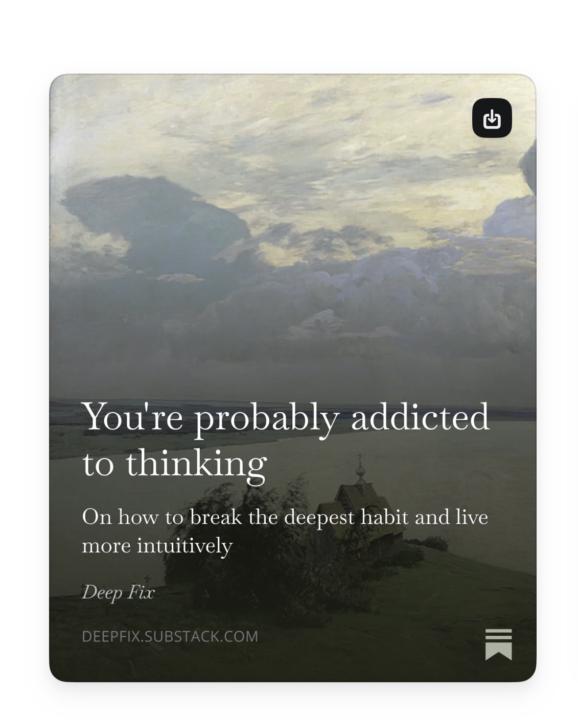
A long essay on addictions — and thinking is one of them! « This really does go all the way down. The addiction to thinking is, at root, an addiction to wanting things to be different from how they are. The fuel is always some version of: this moment isn’t enough. The machinery of mind grabs a thought, hoping it will resolve the tension. Alas, it never does. So it grabs another, and another, and the body is left holding whatever you were trying not to feel. » Thank you @Mary Martin https://open.substack.com/pub/deepfix/p/youre-probably-addicted-to-thinking?utm_campaign=post&utm_medium=web All Reflections welcomed dear community ☺️
0 likes • Mar 1
Thanks for posting this, @Nadene Canning. I find such sustenance in this article and hope others will too.
Oct '25 •
A few insights from Day 1
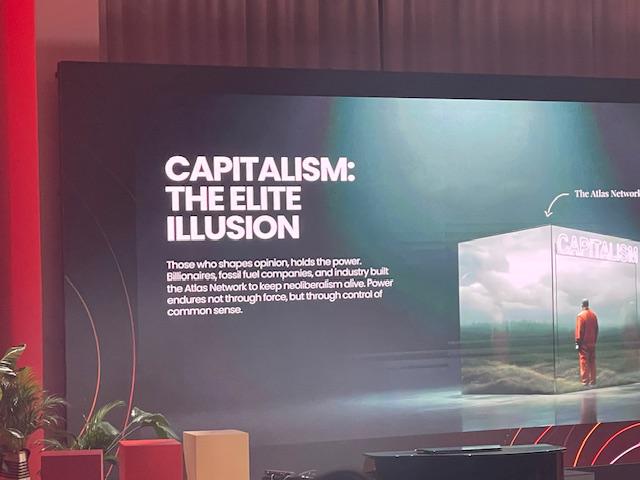
There are SO many reasons to LOVE the Summit; meeting all the amazing practitioners, listening to the speakers stories of challenges and transformation, watching and listening to the beauty of the performing artists. I took over 40 photos today of insights and want to share 2 that were very thought provoking from one of the morning speakers; Kasper Benjamin Bjorkskov. He's the founder of No Objectives, a non profit research and design agency "on a mission to turn minority insights into majority actions". I share 2 of the slides he discussed around capitalism and why we the people need to step into our agency to create change, because actions shape our values. 🐦 Action is why we created InnerDevelopment@Work! Kirstin Dunlop (CEO of Climate KIC) in conversation with Christiana Figueras (Diplomat and one of the architects of the historic Paris Climate Agreement) spoke of the most difficult decision she took of changing the direction of the company towards holding space for new ways of doing and being to emerge with coalitions and having to sit with the extreme discomfort of the not knowing. Another discussion that I appreciated immensely was between Imam Dr. Muhammad Nurayn Ashafa and Rev. Dr. James Movel Wuye, who went from being mortal enemies to lifelong friends. They shared their story of death and destruction and how they realized that only through forgiveness ( a "new" competency) could they heal themselves and their communities 👉I could easily continue, however prefer to call upon our community members who either watched online, or where present in Stockholm to share what resonated for you. P. S. I was handed a new badge today from the Office of Kindness 🤗
1 like • Oct '25
Thanks so much for sharing such rich insights here -- so many thoughtful perspectives
Jun '25 •
🌱 How Might We Rekindle a Sense of “Enough” in a World That Constantly Tells Us We Need More?
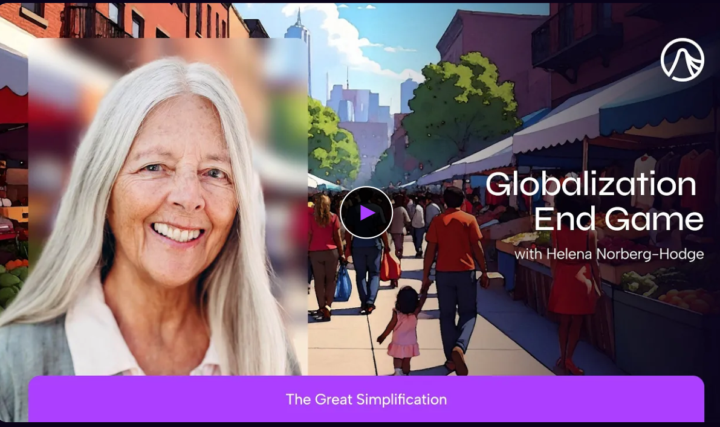
This question speaks directly to our inner development—to how we perceive the world, make choices, and align our actions with what truly matters. It invites us to slow down, reflect on our values, and question the cultural story of endless growth and consumption. I am deeply inspired by a recent episode of The Great Simplification, where Helena Norberg-Hodge, a pioneer in the localization movement, speaks with Nate Hagens about the deeper systemic forces behind our global crises. Together, they explore how economic globalization has contributed to environmental destruction, social disconnection, and cultural loss—and how a shift toward more localized, relational, and regenerative economies might be a vital step forward. At its core, this shift isn’t just political or economic—it’s personal and developmental. It calls on us to cultivate: - Critical thinking – to see through the dominant narratives of progress and growth. - Compassion and empathy – to recognize the lived impact of these systems on people and the planet. - Inner compass and courage – to make different choices, even when they go against the mainstream. - Connectedness – to rediscover our place in local communities, in nature, and in shared purpose. 👉 Helena puts it plainly: “We are being sold a worldview that takes us further and further away from nature and from each other. It’s time to wake up to who is really benefitting—and imagine a different path rooted in reconnection.” 💬 How does this land for you? What does enough mean in your life or work? And what inner capacities do we need to build to help shape more localized, life-supporting systems? 🦉Her DAILY practice of the FIVE R's gave me a ton of energy and optimism. What about You? Let’s open the conversation Sending you all much love, compassion and compelling conversation. https://www.thegreatsimplification.com/episode/181-helena-norberg-hodge Full transcript here: https://www.thegreatsimplification.com/wp-content/uploads/2025/06/TGS-182-Helena-Norberg-Hodge-Transcript.pdf
5 likes • Jun '25
Thanks, Nadene. I appreciate Norberg-Hodge's viewpoint, especially having lived long enough to recall a time when my childhood was largely based on a local economy. Food and clothing were bought as needed, not as wanted. Purchases were from local shops, not big chain stores or superstores. In a town of 30,000 people, my parents knew and valued the shopkeepers. It gave me an excellent foundation for life via an appreciation of local folks and their businesses, which felt like services to the community. Yet I think I'd feel the crunch of reverting to that way of life now -- it'd take some adjustment however I'm pretty sure I'd get there. I'm glad for Helena Norberg-Hodge's outline of the Five R’s—Respect, Reconnect, Recount, Revalue, and Resist*—as principles for guiding us toward more localized, sustainable, and connected ways of living. * Respect - Reflect on what you consume and its source Reconnect - Spend time in nature and with community Recount - Share or write down meaningful stories Revalue - Choose depth and locality over speed and scale Resist - Push back against overconsumption and distraction
1 like • Jun '25
respect & reconnect are equal favorites for me
1-7 of 7
@mary-martin-3287
Elder, expat, coach, traveler, nature lover.
Meaning-of-life adventurer.
Active 8h ago
Joined Mar 12, 2025
France
Powered by