Activity
Mon
Wed
Fri
Sun
Dec
Jan
Feb
Mar
Apr
May
Jun
Jul
Aug
Sep
Oct
Nov
What is this?
Less
More
Maker Zero: Claude Code, AI
47.9k
Free
AI Automation Society Plus
3.1k
4.9
$129/m
AI Automation Society
485.6k
Free
AI for Non-Techies
627
1.0
$67/m
AI Automation Agency Hub
338.1k
Free
6 contributions to AI Automation Society

💎
Aug 14 •
🚀New Video: I Made Codex and Claude Code Build the Same App. One Clearly Won.
I gave Claude Code and Codex the exact same prompt to build a production-ready Typeform alternative, then compared the products, costs, speed, agent usage, and testing. Claude Code built the more usable app in a fraction of the time, while Codex went much deeper on architecture and reliability. This experiment made it much clearer where each tool fits in my workflow and why the way you prompt them matters.

8 likes • Aug 15
Brilliant, really useful!
Jul 7 •
Client GDPR data + Claude Code: where do you actually store it?
Quick one for anyone here running an AI automation or consultancy business on Claude Code. I am asking from the strict end of the spectrum. I am UK based, so I fall under UK GDPR, the law that governs how you handle people's personal data (client staff names, contact details, employee records, anything that identifies a living person). It carries real penalties and it also cares about where the data physically sits. I suspect members in the US, where there is no single equivalent law, may approach this quite differently, and I would value that contrast. The problem I set out to solve: client documents that carry personal data or commercially sensitive material must never end up in a GitHub repo, not even a private one. I wanted them physically separated from anything git can touch. Here is how I have set it up: - Git repos, all private: the OS code, skills, commands, templates and tooling. The internal machinery only. - OneDrive, never touched by git: every client engagement folder lives in a separate tree that sits outside all my repos. - The part I think matters most: the separation comes from location, not a .gitignore rule. Because the client folders live outside the repo tree entirely, there is no path for git add to reach them, so a stray commit physically cannot sweep them up. A .gitignore rule felt weaker to me, one typo and it fails quietly. The lesson that got me here the hard way: any repo that hosts or serves a client deliverable, for example through Vercel or Netlify, has to stay private too. An unguessable URL is not access control on a public repo. So my questions to the room: 1. Has anyone solved this a different way, and does location based separation match how you would do it? 2. What am I missing on the GDPR side specifically? I am thinking data residency, processor terms, and backup or sync tools quietly re-copying the data back into scope. 3. For those outside the EU/UK, how much of this do you even have to think about? I suspect the bar is different and I would like to understand where.
1
0
May 23 •
From Civil Engineering to AI Consultancy — My Intro
Hi all, Mike here, based in Cumbria, England. I spent 20 years delivering major civil engineering and infrastructure projects before making a deliberate pivot into AI consultancy. I set up ClearBuild Consulting earlier this year, focused on practical AI implementation and independent AI audit services for UK SMEs. Three clients on board already with a couple more in the pipeline, so the momentum is building nicely. Been following Nate's channel for a while and rate it highly as one of the more honest, practical resources out there. Looking forward to connecting with like minded people!
1 like • May 23
@Meet Soni thanks, good to connect with someone in the same space. The AI audit service has been the standout for me, structured process, clear deliverable, and clients can see the value immediately. What are you focusing on?
💎
May 22 •
🚀New Video: The AI Offer You Can Sell Tomorrow Morning
Most people trying to start an AI business jump straight to pitching retainers or projects and end up frozen. The move is to sell one-on-one hours helping business owners set up their AI Operating System. This video walks through that offer, why it works in 2026, and a 7-step plan to land your first clients.
1 like • May 23
@Mehinewe Kedewouli @Rick Claspy same here, let's do it. Liked both your comments, return the favour and we'll all get there quicker!
4 likes • May 23
@Patrick Ejeke valid concern, but in practice it is less of a barrier than you'd expect. The AI OS setup does not need sensitive data to be useful. You are mostly working with workflows, communication patterns, and tools the business already uses openly. For anything genuinely sensitive, you simply scope it out or work with anonymised examples. Clients are usually more concerned about complexity than confidentiality once you frame it correctly.
💎
May 20 •
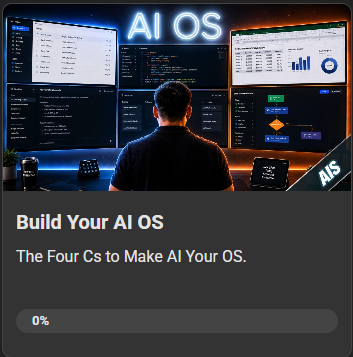
💻New AIS Course: Build Your AI OS
Just dropped a new course in the classroom and I'm pretty pumped about this one. It's the full step-by-step on building your own AI OS. Same exact setup I use every day to run the YouTube channel, the community, and my team. 8 lessons, all my templates and prompts, plus a free GitHub repo so you can skip the boring setup and just start building. To unlock it in the classroom, you just need to hit level 3 in the community. Honestly pretty easy: - Drop an intro post if you haven't yet - Engage with a few other members in the threads - Help somebody out who's stuck on something That's pretty much it. Get to level 3 and the whole thing opens up. See you in there. - Nate
3 likes • May 22
Thanks Nate! Brilliant
1-6 of 6

@michael-anderson-8540
Senior Civil Engineering Project Manager, now founder of Clear Build Consulting delivering AI Audits and solutions for SMBs
Active 7h ago
Joined May 13, 2026
Powered by