Activity
Mon
Wed
Fri
Sun
Jun
Jul
Aug
Sep
Oct
Nov
Dec
Jan
Feb
Mar
Apr
May
What is this?
Less
More
Owned by Lévis
Memberships
AI + Automation Lab
965 members • Free
Sophia Emergence
18 members • Free
V1B1N Tribe 🌸🧜♀️🍉🦋🔆🕺💕
671 members • Free
🌟 COSMIC KITTEH 💜💙 🐈⬛️
44 members • Free
LoveNow988 ❤️ 11 11🐇
54 members • Free
GOOSIFY 🍎🐛🦋🌈⭐️🩷
13k members • Free
Sam Gill Unlimited
11 members • Free
🎮 OnlyLANs Gaming Group
132 members • $4/month
Michelle McMillionairess Skool
79 members • Free
50 contributions to Crystal Appreciation Society

🔥
3d •
Snitches get stitches
If crystals could talk, which one in your collection would absolutely snitch?


5 likes • 3d
Crystal Ball!
🔥
7d •
Crystal Spotlight - Apophyllite
I was first introduced to Apophyllite while studying to become a Reiki Master. I was told that it was an amazing stone for healing and cleansing work. Apophyllite has a way of catching the eye immediately. The sparkle on the surface almost looks wet or icy, and when light hits it just right, it can feel like the crystal is almost glowing from within. A lot of people are drawn to it during periods where they’re trying to clear mental clutter, reconnect spiritually, or create more peace in their environment. This is one of those minerals that tends to change the feeling of a room very quickly. Many people place it near beds, meditation spaces, healing tables, or anywhere that feels emotionally heavy or overstimulated. There’s a very “open window after a storm” feeling to Apophyllite. Fresh air. Clarity. A sense of spaciousness in the mind and body. Physical Overview Apophyllite is a hydrated potassium calcium silicate mineral that commonly forms in volcanic rock cavities alongside minerals like Stilbite, Heulandite, and Chalcedony. It often grows in beautiful geometric formations with sharply defined pyramid-like crystal points and highly reflective faces. Most Apophyllite on the market comes from India, especially the Deccan Traps region, though it can also be found in Iceland, Brazil, Canada, Germany, and parts of the United States. It is usually colorless or white, though green, peach, yellow, and even faint pink forms can occur depending on trace mineral inclusions. The crystal has a hardness of about 4.5 - 5 on the Mohs scale, making it softer than Quartz and somewhat delicate. Large clusters can chip or cleave fairly easily if dropped. One of the easiest ways to recognize Apophyllite is the brilliant reflective flash it gives off under light. The surfaces can almost look mirror-like. And, unlike quartz crystals Apophyllite crystals have only 4 sides, and are topped with pyramid-shaped points. Quartz crystals are 6-sided. Historical Usage Apophyllite was historically valued more for its beauty and unique structure than for widespread practical use. Mineral collectors and early geologists were fascinated by its crystal habit and reflective surfaces. In more recent decades, it became extremely popular within energy work and meditation communities because of the calm, uplifting atmosphere many people associate with it.

3 likes • 7d
Look raw.. is it?
🔥
12d •
What Am I?
ANSWER REVEALED IN COMMENTS BELOW --------------------------------------------------------------------- MATERIAL: I am a lithium-rich mica. DESCRIPTION: I am typically lilac to purple with a flaky, layered structure and a pearly sheen. I am quite soft. FORMATION: I form in granite pegmatites alongside other lithium-bearing minerals. METAPHYSICAL USES: I am known for calming the nervous system and easing emotional overwhelm.
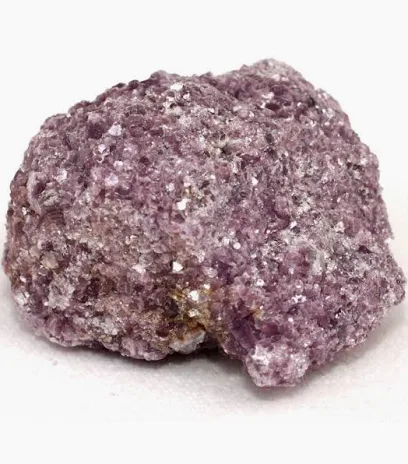
3 likes • 12d
PURPLE! :P
🔥
Mar 30 •
One of these things...
ANSWER REVEALED IN THE COMMENTS BELOW. ------------------------------------------ ... is not like the other. Which is it and why? One of these things is not like the other…
Poll
11 members have voted

2 likes • Mar 30
My mind say this is not naturally made... But chimique.
🔥
Mar 30 •
What Am I? #8
ANSWER REVEALED BELOW IN COMMENTS -------------------------------------- MATERIAL: I am a feldspar mineral, but I’m often mislabeled as something I’m technically not. I often grow with Black Tourmaline. DESCRIPTION: I appear white to translucent, but I display flashes of blue and sometimes full-spectrum color that move across my surface when light hits me. My hardness is around 6–6.5. FORMATION: I form in igneous environments, where slow cooling allows internal layers to develop and create my light-reflecting effect. METAPHYSICAL USES: I am said to enhance intuition and inner awareness while also offering a subtle layer of energetic protection and grounding.
4 likes • Mar 30
mmmhhhhhh....... no idea!
1-10 of 50
@bonbonne556
Bonjour, mes intérêts sont les IA, le Quantique et la Métaphysique.
Active 47m ago
Joined Dec 9, 2025
INFJ
Sherbrooke