Activity
Mon
Wed
Fri
Sun
Jun
Jul
Aug
Sep
Oct
Nov
Dec
Jan
Feb
Mar
Apr
What is this?
Less
More
Owned by Bernadette
Neurological Pilates & Gentle Neuro-Movement
Memberships
20 contributions to the movement clinic

Feb 25 •
Using the Multiple Sclerosis (MS)-friendly approach on a Pilates Reformer
Using the Multiple Sclerosis (MS)-friendly approach on a Pilates Reformer can be very powerful for neurological stimulation, because it combines movement, balance, resistance, and focused breath — all of which help “wake up” brain-body communication. Here’s how the reformer can help spark the brain safely: 🧠 Why the Reformer Supports Neurological Activation - Proprioception & feedback: Springs and straps give constant sensory input, helping the brain reconnect with muscles and joint positioning. - Cross-patterning movements: Coordinating arms and legs together stimulates neural pathways and cognitive engagement. - Slow, controlled tempo: Encourages neuroplasticity — the brain relearning efficient movement patterns. - Breath + rhythm: Regulates the nervous system and can reduce fatigue or spasticity. ✨ Effective Reformer Strategies for MS - Supine footwork with light springs to build safe neural awareness. - Arm work in straps to integrate core + upper-body coordination. - Seated or supported balance exercises to challenge vestibular input. - Gentle spinal mobility to improve circulation and sensory signaling. ⚠️ Important Safety Notes - Avoid overheating — MS symptoms can worsen with heat. - Keep resistance moderate; fatigue management is key. - Focus on quality over intensity. - Work with a trainer familiar with neurological conditions when possible.
0
0
Feb 4 •
🧠 Working Out with a Neurological Condition
🧠 Working Out with a Neurological Condition Movement can look different when you’re living with a neurological condition — and that’s okay. Working out doesn’t have to be fast, intense, or exhausting to be effective. With the right pacing, clear guidance, and supportive environment, movement can help build stability, coordination, posture, and body awareness. This is about moving with your nervous system, not pushing against it. Educational, non-medical, and focused on meeting your body where it is. You deserve access to movement that feels safe, respectful, and sustainable.
0
0

Jan 26 •
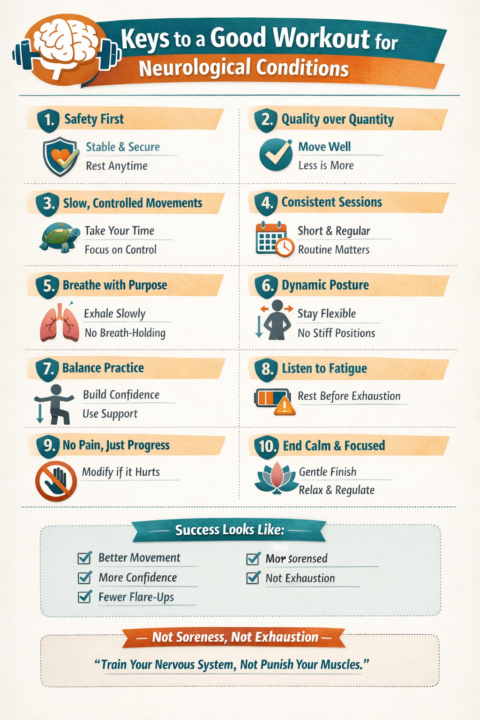
Keys to a Good Workout for People with Neurological Conditions
https://themovementclinicoc.com/2026/01/26/keys-to-a-good-workout-for-people-with-neurological-conditions/
1
0
Jan 26 •
Why Spinal Hygiene Matters
Why Spinal Hygiene Matters Neurological conditions can affect muscle tone, balance, coordination, fatigue, and pain. Good spinal hygiene helps to: - Reduce stiffness and muscle guarding - Improve balance and body awareness - Support breathing and nervous system regulation - Decrease pain and fatigue - Preserve mobility and function Core Principles 1. Neutral, Not Rigid - Think "stacked but relaxed" - Head over rib cage, rib cage over pelvis - Avoid locking joints or holding tension 2. Movement Is Medicine - Gentle spinal movement throughout the day is essential - Small, slow movements are better than big or forced ones 3. Less Range, More Control - Stay in a comfortable, pain-free range - If symptoms increase, reduce speed or range 4. Breathe to Support the Spine - Allow ribs to expand gently - Lengthen the exhale to calm the nervous system - Never force the breath Daily Spinal Hygiene Routine Morning – Wake Up the Spine (3–5 minutes) - Gentle pelvic tilts (lying on your back) - Easy spinal rotations (knees side to side) - Slow rib breathing Midday – Reset & Decompress (2–4 minutes) - Seated spinal flexion and extension - Small neck movements (nods, turns) - Change position often Evening – Calm & Release (5–10 minutes) - Side-lying or supported spinal movement - Long, slow exhales - Comfortable resting positions Sitting & Daily Positioning Tips - Keep feet supported on the floor - Sit on your sitting bones, not your tailbone - Use back support if helpful - Change position every 20–30 minutes Sleeping Support - Side-lying with a pillow between knees, or - On your back with a pillow under knees - Avoid extreme positions for long periods Helpful Reminders - Move gently and often - Comfort comes before correction - Fatigue is a signal to rest, not push - Your nervous system learns through repetition This handout is for educational purposes only and is not a substitute for medical care. Always follow guidance from your healthcare provider.
1
0
1-10 of 20

Active 52d ago
Joined Dec 15, 2025
Gilbert, Arizona