Activity
Mon
Wed
Fri
Sun
Aug
Sep
Oct
Nov
Dec
Jan
Feb
Mar
Apr
May
Jun
Jul
What is this?
Less
More
Memberships
Guitar Club
841 members • Free
Guitar Lab
136 members • $2,000/year
5 contributions to Guitar Club
1 like • May '25
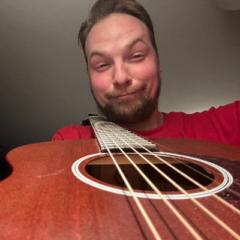
cold finger challenge. Triumphant!
May '25 •
Audio Hijack subsitute for Windows
What have people found to work well on windows for audio rippin' software. Really want to learn this piano number on guitar and sing it. https://www.youtube.com/watch?v=cujuwEkh3OY Which is a neat piano version of their own song. https://www.youtube.com/watch?v=ixcDlQ8O9R0
0
0
Mar '25 •
Guitar Pro
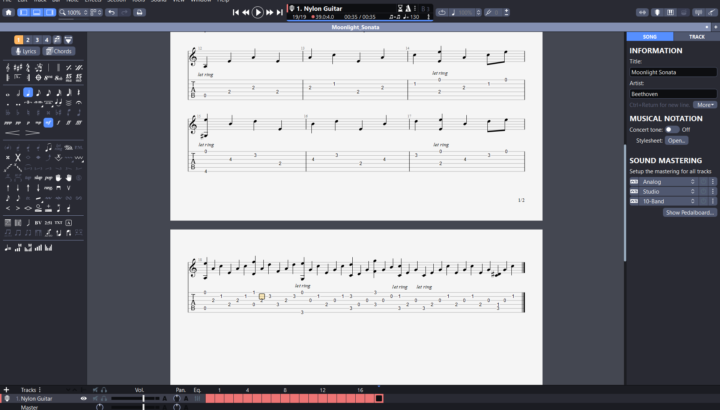
Got a page through making this tab but just into the second page and it's acting like there's a formatting issue. It stops playing in the 18th measure and it's also not automatically going to the next line. This a common thing to run into? Perpexity Ai said try checking the anacrusis or 'pickup bar' option under the bar part of the right click options. That didn't change anything.
1 like • Mar '25
@Dave Belcher do you suggest 12/8 because it will line up better? I notice that it's like more of a 1 2 3 count song in each part conceptually. Like chords change within that count, after 3 string pluckins. Perplexity AI said this. I'm a little confused but it sort of makes sense. Beethoven's Moonlight Sonata is written in cut time (2/2) for the first movement. This time signature is represented by a C with a vertical line through it, also known as alla breve . While the piece contains triplets throughout the accompaniment, which might suggest a 12/8 time signature, Beethoven chose to notate it in cut time for several reasons: 1. The melody is best expressed in 4/4 (or 2/2 in this case) 2. It emphasizes a two-beat metric accent pattern rather than a four-beat pattern 3. It's easier to read and interpret for performers The time signatures for all three movements are as follows: 1. First movement: Cut time (2/2) with the tempo marking Adagio sostenuto 2. Second movement: 3/4 time 3. Third movement: 4/4 time It's worth noting that despite the cut time signature, the first movement's slow tempo (Adagio sostenuto) gives it a feeling of 4/4 time at half the pace . This unique combination of time signature and tempo contributes to the piece's distinctive character and lasting appeal.
0 likes • Mar '25
@Dave Belcher I'm seeing now the headache of the time signature. I forgot one part and went back in to add it and I found out it's impossible to cleanly cut and paste notes unless the amount of notes are divisible squarely by the measures. Perplexity AI said there's no way around this and I have to manually put in everything after that again. That's insane! Have you found any tricks when you run into this problem?
Mar '25 •
Earercizing w/ visuals clues
I’ve tabbed most this out but I’m struggling at :20 seconds. Sounds like that chord at :19 might descend one fret but his hands seem to do something else. From my ear the :19 chord sounds like 6 7 5 4 on the A D G B strings respectively. What’s happening at :20? https://youtu.be/3PAwf1LxJrg?si=YLV48q5Yg6l3V_Ew
1 like • Mar '25
@Ari Lyle not so much music theory. I don’t really know theory yet. I reached out to a local guitar teacher for a basic classic guitar ergonomics question and he started me in theory Bc that’s his jam. I’m cursory familiar with basics of theory, but because I’ve been playing off and on for almost 20 years by mostly just learning what I like, my knowledge is compartmentalized. This has been fun for the guitar teacher though bc sometimes he’ll show me one fundamental or pneumonic and it will break a load of knowledge dam down and I’ll reconcile the 2 worlds. It has helped a little by knowing the basic bar chords because if you find the bass note or the melody and then try the different bar chords it can, as Sam says, confirm the chord from there. But if it’s not a typical bar chord then it’s back to square one with the ear.
1 like • Mar '25
@Ari Lyle another reason I want to learn theory is that I’ve found that I repeatedly make similar chord movements and I wanted to get a better handle on what that key is and ways to jazzify it a little more. The contortionist, periphery, and Between the buried and me bands have inspired me to get into different chord progressions. Some common chord progressions like 13 bar blues grosses me out once I understand it more mathematically it can help other areas.

Oct '24 •
👋 START HERE
Welcome to my Guitar Club! 🎸 Tab Videos are here ⚙️ Technique course is here 🎶 Arranging / Ear stuff is here To start, you simply MUST introduce yourself by commenting below with thing you want to improve at the most ... Tremolo? Scales? A piece? Arranging? Your ear? Lemmi know! Then, book your free 1 on 1 onboarding call with me! It's a quick zoom chat where I can give you some personalized advice and go deeper into your struggles and goals.
0 likes • Feb '25
1. World of Warcraft embarrassingly is my favorite game of all time just based on time played, Classic servers. I actually stopped playing video games for years and then when I started again I found no reason to play anything but WoW. If I'm going to burn time gaming it's on that bottomless time devourer. Second to that for time wasting is Scything my hay field for soil health, 3rd is fixing crap and trying to do something productive for my family. 2. Someone said playing too fast. That is a great answer. I'm always trying to slow myself back down to minimize mistakes as to not solidify bad nique. Otherwise right now I almost vomit when other strings ring out while I'm noodling up and down the fret board so that's just top of mind and I'll probably fix it once I know what to do about it. 3. I don't even know the name of it. I would know it if I heard it. I used to work in a grocery store (Wegmans) and the playlist was short enough to where you would hear the same song about 3 times in a day. That's a certain kind of cruel and unusual for someone who is always listening for something novel to happen musically.
1-5 of 5
@benjamin-janssen-3241
Drawn toward finding ways to play piano, synth, or orchestra stuff on guitar. Working on Nique and fretboard navigation.
Active 17h ago
Joined Feb 21, 2025
Auburn New York
Powered by