Activity
Mon
Wed
Fri
Sun
Oct
Nov
Dec
Jan
Feb
Mar
Apr
May
Jun
Jul
Aug
Sep
What is this?
Less
More
Future Producer Society
81 members • Free
4 contributions to Future Producer Society

19d •
AI Music: Education → Trust → Partnership
There's a lot of fear around AI in music right now. And I understand it. Artists, producers and songwriters hear AI and immediately think: Is this going to replace me? But I think we're missing part of the conversation. We've been here before. When sampling became a major part of hip-hop, people called it stealing. They questioned whether it was musicianship. Nobody completely understood who should own what, who should get paid, how publishing should be divided or how samples should be cleared. Eventually, the business caught up with the technology. Licensing systems developed. Rights were cleared. Original creators got paid. And sampling introduced entire generations to artists and catalogs they may never have discovered otherwise. AI isn't sampling. The technology and rights issues are different. But there's an important lesson there: New technology creates fear when creators don't understand how they fit into the new ecosystem. That's why I believe the conversation around AI music needs to focus on three things: EDUCATION Creators need to understand what these tools actually do, how they're trained, what they're capable of and where the technology is headed. TRUST Companies need to provide clear answers about ownership, compensation, publishing, copyright, voice, likeness, data and how creators participate economically. PARTNERSHIP This may be the most important part. Artists shouldn't simply be brought onto platforms after everything has already been decided. Creators should have a voice in building the platforms. The people making these technologies need feedback from the people who actually make music. And creators need people inside these companies who understand both sides: creativity AND business, technology AND rights. That's how we get better products. That's how we develop better business models. And that's how creators potentially participate in new revenue opportunities instead of simply watching another part of the industry develop around them.


0 likes • 18d
Very wise advice. It's easy to have an extreme reaction to a.i., but just like everything else in life, there's always a middle way.
Jun 30 •
ISRC Explained: What Every Producer Needs to Know About the Most Important Code Attached to Your Music
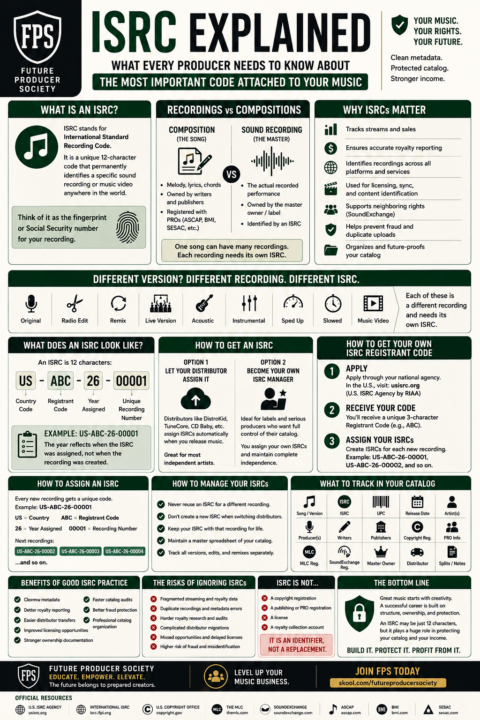
If you've ever distributed a song through DistroKid, TuneCore, CD Baby, Symphonic, or another distributor, you've probably noticed something called an ISRC. Most producers see it, accept it, and move on. The problem is that very few creators actually understand what an ISRC is, why it matters, or how it affects their ability to collect royalties, organize their catalog, and prove ownership of their recordings. In today's AI-driven music industry, understanding metadata is no longer optional. Your music is competing in an ecosystem where millions of tracks are uploaded every month, and every recording needs a digital identity that follows it wherever it goes. That's exactly what an ISRC does. What Is an ISRC? ISRC stands for International Standard Recording Code. Think of it as the fingerprint or Social Security number for a sound recording. Every commercially released recording receives its own unique ISRC that permanently identifies that recording anywhere it appears in the world. Whether your music is streamed on Spotify, sold on Apple Music, licensed for television, uploaded to YouTube, or distributed to dozens of digital platforms, the ISRC is one of the primary identifiers that tells the industry exactly which recording is being used. One of the biggest misconceptions among independent artists is believing an ISRC identifies the song itself. It doesn't. It identifies the recording. That's an important distinction. Songs and Recordings Are Not the Same Thing Imagine you write a song called Never Looking Back. That song is the composition. Now imagine you create: - The original studio version - An acoustic version - A live version - A remix - An instrumental - A radio edit - A sped-up version - A slowed version They're all based on the same composition. But they are different recordings. Each recording should have its own ISRC because each one represents a unique master recording. This is why you'll often hear music professionals refer to "the composition side" and "the master side."
1 like • Jul 1
That infographic is SO dense with useful info, thanks Jug. You could sell laminated "cheat sheets" like that!
May 16 •
130s
I want to bring back big booty miami bass...this is the vibe I'm going for. Also the fact that it cuts off at the end on purpose LOL..

May 9 •
Native Instruments Just Got Acquired: Here's What It Means for Producers
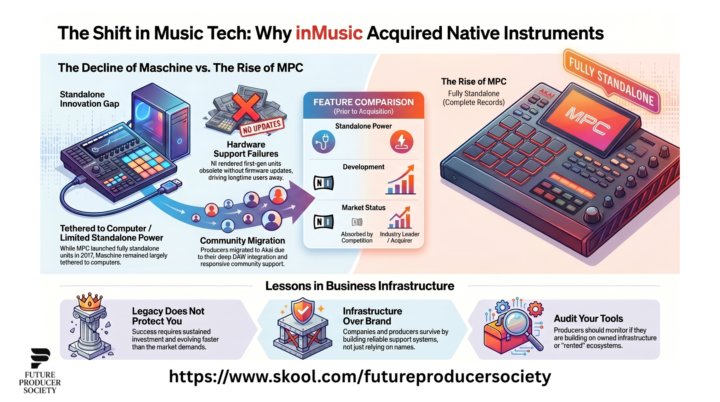
WHAT HAPPENED Native Instruments, (the company behind Maschine, Komplete, and Traktor) just signed a definitive agreement to be acquired by inMusic. If that name doesn't ring a bell immediately, their portfolio will. inMusic owns Akai Professional, Moog Music, Denon DJ, Numark, Rane, and M-Audio. They now own the MPC ecosystem AND the Maschine ecosystem under one roof. I CALLED THIS I've been saying this for years. When a hardware company stops innovating fast enough, they don't survive ,they get absorbed. I watched it happen in real time. My first generation Maschine unit was rendered completely useless when I upgraded my CPU. No firmware update. No support. No path forward. That was over ten years ago. That's not a bug, that's a strategy failure. When you stop serving the people who built your brand, you lose the brand. WHY THIS HAPPENED Native Instruments spent years as one of the most dominant forces in music production software and hardware. But while the MPC was evolving into a standalone production powerhouse with continuous firmware updates, Maschine stagnated. The hardware fell behind. The software ecosystem got bloated. The community started migrating. Meanwhile inMusic kept investing in the MPC line — standalone operation, continuous updates, deeper DAW integration. The market made its decision before the acquisition papers were ever signed. WHAT THIS MEANS FOR PRODUCERS The brands will continue operating — NI, iZotope, Plugin Alliance, Brainworx all stay intact for now. But the consolidation of Maschine and MPC under one parent company is a massive shift in the hardware production landscape. A few things to watch: - Will inMusic unify the NKS and MPC ecosystems into something bigger? - Does Maschine get the firmware investment it's been missing? - How does this affect pricing and competition in the hardware market? - What happens to the NI software ecosystem long term? THE BIGGER LESSON This isn't just a music tech story. It's a business story every producer needs to understand. The companies that survive in this industry are the ones that keep serving their community with innovation. The moment you start coasting on your legacy, someone else is already building what your customers actually need. That's true for hardware companies. It's true for labels. And it's true for producers who aren't building their business infrastructure while they're still relevant.
Poll
8 members have voted
0 likes • May 9
I had a maschine mk3 that bricked itself through USB drivers somehow!?
1-4 of 4

@ashkon-hemmati-3032
If you fake it til you make it, you've only made it with the fakers. Stage name is DJ Puntenel.
Active 18d ago
Joined Feb 13, 2026
INFJ
Denver, CO
Powered by