Activity
Mon
Wed
Fri
Sun
Dec
Jan
Feb
Mar
Apr
May
Jun
Jul
Aug
Sep
Oct
Nov
What is this?
Less
More
Owned by Alex
The place with clear frameworks on building motivation, confidence and emotional regulation to bring dog's performance to their full potential.
Available only for VIP members
Grow With Evelyn
3.4k
5.0
$29/m
Synthesizer
47.4k
Free
The Facebook Ads Clinic
7.5k
5.0
Free
Fiducia Skool Tool
657
Free
Skool Gameplan
2.4k
Free
Dog Training Community
935
Free
ClassMates
1k
$9/m
92 contributions to Karate 4 Dogs
6h •
Offlead dogs NOT ruining your walks anymore!
thank you @Liz Lillington for sending those! Nothing makes me happier that when advise is put into practice and real life :) We also got the links for anyone wanting one. Mine would say most likely KARATE 4 DOGS lol unmbrella https://www.amazon.co.uk/dp/B0D4VBT8YL?ref=cm_sw_r_cso_wa_apin_dp_0Y2HW28T02BR0CG35PVF&ref_=cm_sw_r_cso_wa_apin_dp_0Y2HW28T02BR0CG35PVF&social_share=cm_sw_r_cso_wa_apin_dp_0Y2HW28T02BR0CG35PVF&newPreview=2&th=1 letters https://www.amazon.co.uk/dp/B0HDYLBJ3W?ref=cm_sw_r_cso_wa_apin_dp_JDHZY612DH7SGQN3QCVE&ref_=cm_sw_r_cso_wa_apin_dp_JDHZY612DH7SGQN3QCVE&social_share=cm_sw_r_cso_wa_apin_dp_JDHZY612DH7SGQN3QCVE&newPreview=2&th=1

5d •
Consent in dog training: can your dog really say “yes” to ....? - Live + Q&A
Consent in dog training: can your dog really say “yes”? A recent social media post about consent in dog training got me thinking. My approach is quite different from some of the views shared, and I’d like to unpack it with you. We talk about giving dogs a choice. But what does that actually mean when we’re dealing with reactivity, a vet examination, or someone wanting to stroke your dog? And if the dog says “no”… what happens next? I want to do live presentation and discussion on consent in dog training, particularly when working with reactive dogs. We’ll cover: - Can a dog consciously consent to an interaction—for example, a veterinary examination, meeting another dog or person, or being petted? - How the dog can tell us if they agreeing to the interaction or not? - In which situations would I ask for the dog’s consent, and in which situations I wouldn’t. I’ll prepare some slides and explain my approach, with time for your questions and discussion. The session will be available to members and the top five on the leaderboard. It will be recorded, and if you can’t attend live, you can leave your questions beforehand. You can vote below on day/time 👇(UK time)
Poll
7 members have voted

1 like • 4d
options time/date added to the post 🫡
0 likes • 6h
Tuesday has WON! see you then! Cannot make it? post your questions, videos etc. for breakdown :)
Oct 6 •
THIS GROUP IS CHANGING FOREVER.
And I mean that in a good way 😂 I’ve been thinking a lot about what I actually want this community to become. I don’t want it to be another group where people join, download a course, disappear and never speak again. I want to build a place where we actually train, learn, experiment and get better together. So… a few big changes are coming 👇 1. NEW MEMBERSHIP — $25/MONTH The main membership is dropping from $46 to $25/month. And this is probably as low as it will ever be. If you ever considered subscribing that probably the best moment. I’m also going to close free access for now. I want to focus on building a smaller but much more active learning community around people who actually want to use what is inside. If you’re already a Premium member paying $46 and you want to move to the lower tier, Skool will not change your subscription automatically. I already dm’d you with options! So check your dms! 2. VIP — $46/MONTH (from $86) For people who want more direct access to me. Again that’s not going to be cheaper. This will include additional content, feedback and a 1-to-1 call with me. If you’re already on this level, just message me whenever you want to schedule your call. 3. CHALLENGES ARE COMING Some of you have done my challenges before. Historically, they were sold separately for around $100. Going forward, I want to run part of challenges inside the membership. Actual training. Homework. Progress. Something that gives you a reason to open Skool and train your dog rather than just collect another video course 😂 4. MONTHLY LIVE WEBINARS I’m planning roughly one live webinar every month, with the topic chosen by you. Play. Reactivity. Confidence. Heelwork. Motivation. Behaviour. Whatever you guys actually want me to cover. 5. REACTIVITY MENTORSHIP FOR DOG TRAINERS This one is still being built, but I’ll plant the seed now. I already have two trainers interested and I’m looking for another one or two people for the first version of my Reactivity Mentorship.
1 like • Oct 9
@Sharon Cunningham amazing! thank you for feedback! glad to have you here!
0 likes • 4d
Little update - I removed free membership from our community. Now there is 7 day free trial available instead and 3 tiers of membership. However if you have joined before, of course you keep your access (and resources) and you are on standard tier 😊
15d •
On HOLD - daily life, training and sport:
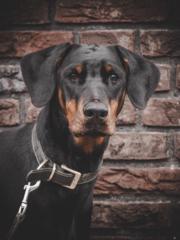
I have used this succesfully with practically all my dogs, even as predation substitute, and also teach my clients. My current dog has different ideas about it, she's more food-driven than object- or toy-driven, so I'm happy to get some fresh ideas for my approach. Thank you Alex. Videos are not serious training, just fooling around with purpose after training 😉

0 likes • 6d
@Petra Oltheten there actually 2 vids :)
1 like • 6d
Couple of tips - for more passion in holding - I prefer much controlled hold- with chin rest as that becomes also a cue to hold (practical when we need our dog close) - 2 toys are not necessarily helping. It is pushing the game into more interactive side - we want to make it bit more about the object. I would downgrade to 1 most of the time. - parading is great! but I would lead activity that by holding/guiding with the lead attached to the collar rather than holding the toy's handle. Tension on the handle means competition/fight -tug. You can hold both but the tension should be more on the lead, then you can pop with the handle every now and then to make the hold stronger. - the longer it takes to win the toy the more valuable it becomes. Every now and then I make the tug part more intensive/longer after that I let the dog to parade with the win rather than instantly come back for more. - if my dog drops the toy I instantly attempt to steal it from them. If I throw I also pretend that I'm after it. If I succeed I tease and hide and take a break from play. Not holding/dropping = squirrel runs away, and you loose it. So the framework would be: Activate (like you do) -> Tug -> chin rest and hold -> tug -> Win and parade -> as the dog is parading make the lead shorter till dog is next to you -> grab the handle and tug again -> then repeat. finish always on teasing and hiding :) Hope that helps!
18d •
The power of teaching your dog to HOLD - daily life, training and sport
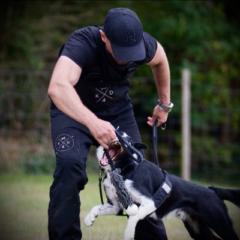
One of the most useful skills I teach through play is also one of the quietest: holding an object with a strong, calm grip. I first learned its value in protection training. Between bites, we ask the dog to hold the sleeve calmly. This gives them a chance to rest without losing drive, settle their grip, and contain all that energy in a static behaviour. The dog is still engaged. Still motivated. Just able to be still. That got me thinking: could I take those same feelings and transfer them to holding a dumbbell? From bite work to a better retrieve In retrieve training, we want a confident, steady hold. But sometimes the process creates pressure and uncertainty. Instead of holding calmly, the dog chews, chomps, grips loosely, or drops the object. The criteria vary between sports, but a reliable hold matters across many of them. I started adapting what I had learned in protection training, adding more structure and a few tweaks to help dogs struggling with their retrieve. And then I thought: why wait until there’s a problem? If I can teach a dog to enjoy holding a toy during play—with a strong, calm grip—then I can transfer both the skill AND the feelings to a retrieve object. My dog Fufik really brought this home. His hold for the Mondioring retrieve was horrendous. At one point, I honestly thought we would never get it. Using this approach, the retrieve became one of the strongest exercises in our training. After that, I started teaching the hold this way to my coaching clients across different sports. Then the benefits started showing up outside training We lived in the countryside, but Fufik travelled with me to busy places and big cities across Europe. I noticed that holding his toy helped him stay calmer and more contained when the environment became overwhelming. He had something familiar, enjoyable, and well practised to do. A little like a child holding their favourite teddy bear: that’s an analogy, but it captures what I was seeing. Something familiar that seemed to help him feel more secure in an unfamiliar situation.

0 likes • 15d
@Petra Oltheten 🫡🙌
1 like • 15d
@Piotr S mamy thanks 🙏 more cool stuff is coming 🫡
1-10 of 92
Active 3h ago
Joined Nov 14, 2025
Powered by