Activity
Mon
Wed
Fri
Sun
Aug
Sep
Oct
Nov
Dec
Jan
Feb
Mar
Apr
May
Jun
Jul
What is this?
Less
More
Memberships
The AI Advantage
126.4k members • Free
AI Automation Society
419.7k members • Free
AI Automation Agency Hub
328.1k members • Free
AI Automation (A-Z)
163.6k members • Free
28 contributions to The AI Advantage

3d •
if you think AI is just about saving time on admin...
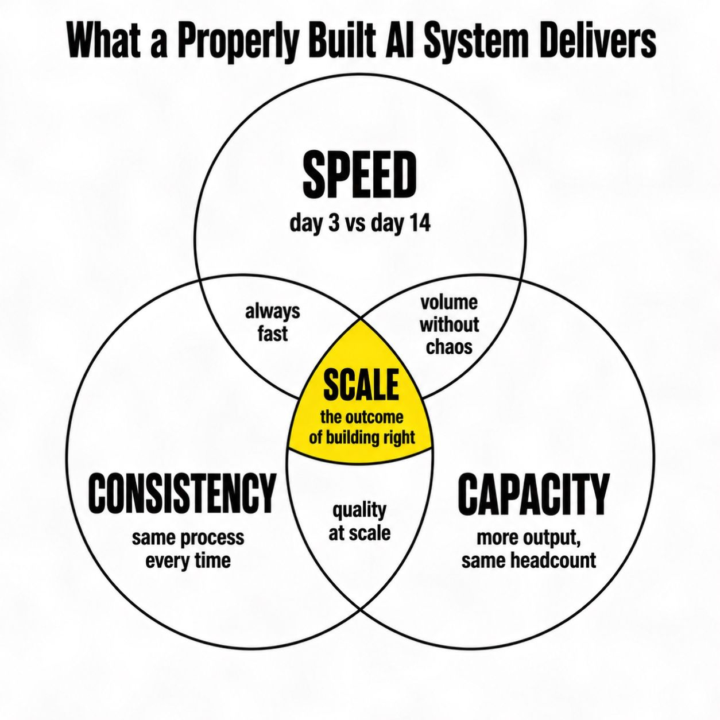
if you think AI is just about saving time on admin... you're missing the bigger picture. the businesses pulling ahead built 3 things. speed. new hire starts monday. most businesses spend 2 weeks getting them up to speed. with AI handling onboarding — documented, structured, automatic — same person is productive by day 3. every single hire. consistency. → same follow-up after every quote → same update during every job → same invoice the day work is done doesn't matter who's working. doesn't matter how busy it gets. the process has no off days. capacity. 40% more jobs than last year. same team. same hours. because the admin that used to eat 15 hours a week now runs on its own. put all three together and one word comes to mind - SCALE. the businesses building this now will be impossible to compete with in 3 years
17d •
Three months after automating one task, owners make a decision they couldn't have made before.
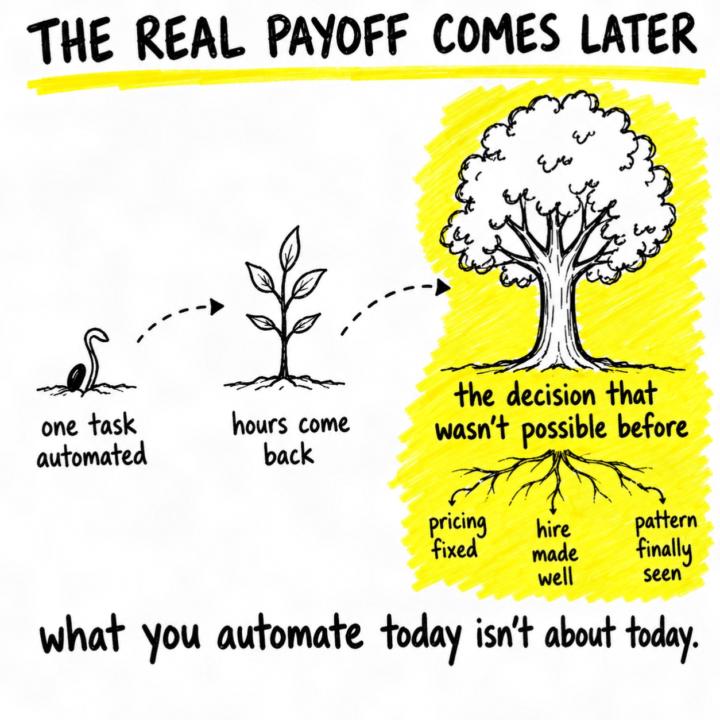
Three months after automating one task, owners make a decision they couldn't have made before. Week one, nothing feels different. The hours are back. The habit of filling them with something else isn't broken yet. That's the part most owners don't expect. The real shift happens later. Quietly. Usually without anyone noticing in the moment. An owner finally looks at pricing properly. Realises they've been underpriced for two years. Another notices a pattern in client churn they never had time to see. Another makes a hiring decision they would have rushed three months earlier. None of those decisions came from the automation itself. They came from the space it created. That's the part that never shows up in a report about hours saved. Most owners measure AI by week one. The ones getting the most from it are still discovering what changed by month three. The task you automate today isn't really about today. It's about the decision you'll be in a better position to make later.
18d •
The biggest benefit of AI in a small business isn't the time saved.
The biggest benefit of AI in a small business isn't the time saved. It's what owners do with that time once they get it back. Most conversations about AI focus on hours. 10 hours a week. 20 hours a month. Numbers that sound impressive on their own. But hours saved is not the actual win. The win is what happens next. One owner used the time to finally write the strategy he'd been putting off for 2 years. Another used it to take his daughter to school every morning instead of every other Friday. Another spent it on the one client relationship that was about to walk, and kept them instead. None of that shows up in a report about hours saved. That's where the real value of AI lives. Not in the time itself. In what becomes possible once the time exists. Most business owners have been so busy for so long that they've forgotten what they'd actually do with a free afternoon. The first few weeks after automating something, most owners don't know what to do with the space. Then they remember. The idea they shelved 3 years ago because there was never time, it's moving again. What would you do with your next free afternoon?

19d •
The task that bores you the most is probably the one costing you the most hours.
The task that bores you the most is probably the one costing you the most hours. Most business owners assume the expensive problems in their business are the complicated ones. They're not. The expensive problems are the boring ones nobody wants to look at. - The task you put off until Friday afternoon. - The report you build the same way every single week. - The follow-up you mean to send but keep forgetting. - The invoice that sits there because chasing it feels tedious. None of these feel urgent. That's exactly why they cost the most. A task that's exciting gets done quickly because you want to do it. A task that bores you gets delayed, rushed, or skipped entirely, and the cost of that compounds quietly in the background for months. Here's a simple way to find it. Think about the task you avoid the most. The one you'd rather do anything else than start. That feeling isn't laziness. That's your brain telling you this task has no real thinking in it. It's the same steps, every time, with nothing new to solve. That is precisely the work that should never need a person. The interesting part of your business will never feel boring enough to ignore. The boring part is hiding in plain sight, and it's usually the first thing worth fixing. What's the task you've been avoiding the longest?

20d •
Most business owners think AI is too complicated for their business.
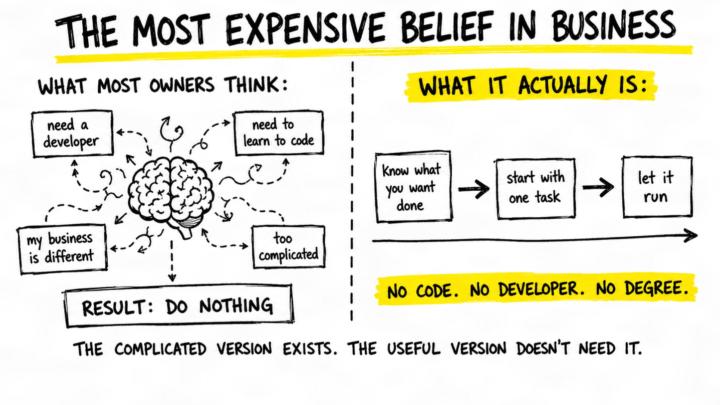
Most business owners think AI is too complicated for their business. That belief is the most expensive one they hold. Every week I speak to owners who say the same thing. "I'm not technical." "My business is different." "I wouldn't even know where to start." I understand why they feel that way. The internet is full of developers talking to developers. Jargon everywhere. Tools that look like they need a degree to operate. But here is what I actually see when we start working with someone. The business owner who said they were not technical is running 6 automations 90 days later and checking them less than once a week. The one who said their business was different has the same 3 types of manual work every other business has. The one who did not know where to start now has a Monday morning that looks nothing like it used to. You do not need to understand how any of it works. You just need to know what you want done. The owners getting the most back from AI are not the most technical people in the room. They are the ones who decided to start somewhere instead of waiting until they understood everything. The complicated version of AI exists. The version that saves you 20 hours a week does not require it. What is the one thing in your business you have been putting off because it felt too complicated?
1-10 of 28

@alex-naskidashvili-5764
Partner at @ Systems Dept. | Building AI Automations, Workflows and Systems
Active 9h ago
Joined Feb 7, 2026
Remote
Powered by