Activity
Mon
Wed
Fri
Sun
Aug
Sep
Oct
Nov
Dec
Jan
Feb
Mar
Apr
May
Jun
Jul
What is this?
Less
More
Owned by Debra
Makers ready to ditch beginner sewing: learn industry methods to create better-fitting clothes you're proud to say “I made this!” ✂️
Memberships
Client Growth Lab
60 members • Free
Grow With Evelyn
3.5k members • $7/month
Focus & Finish
17 members • $5/month
🔮The Sanctuary✨🌙
32 members • Free
The Build Lab
153 members • $27/month
Machine Knitting Hub
23 members • Free
Skool Made Simple
82 members • Free
Panda for Skool CRM +
428 members • $36/month
The Cold Coffee Club
487 members • Free
22 contributions to The Atelier Hub

🔥
5d •
Welcoming Our New Sewing Members 🪡🧵
@Ashley Morgan @Nasma Begum @Ecom solomon Godwin Welcome Welcome to The Atelier Hub A sewing group different to all the others, we discuss ALL sewing disciplines, history, technical and much more. Building in real time, very excited to have you all here! Do introduce yourself, and any questions, pop them into the hub as we're here to help 🤗 Claire Amelia ps. corsetry month history chats was fun! Can't wait to share what's next up, we may get measuring...

🔥
2 likes • 5d
We,come!!
🔥
19d •
16th Century Corsets, Bodies, Stays From The Tudor Era
🪡 The Origins of Corsetry: 16th Century Bodies & Early Stays 🪡 When many people think of corsets, they picture the dramatic hourglass silhouettes of the Victorian era. The reality is that the story begins much earlier. During the 16th century, structured garments known as "a pair of bodies" began appearing throughout European courts. These early foundations were not designed to create tiny waists or exaggerated curves. Instead, they were created to provide support, improve posture, and help achieve the fashionable silhouette of the period. One of the most surprising aspects of these garments is the shape they created. Unlike later corsets, the goal was a smooth, elongated cone shape through the torso. The bust was flattened rather than lifted, and the waist was not dramatically reduced. Structure and stability were the priorities. The materials used would also be familiar to anyone interested in historical sewing: 🌿 Reed 🌿 Cane 🌿 Rope 🌿 Buckram 🪡 Linen 🪡 Wool 🪡 Silk for wealthier households Rather than relying on steel, makers stitched natural materials into channels to create rigidity and support. Every garment was carefully constructed by hand, requiring skill, patience and an understanding of both materials and the body. What makes these early bodies so important is their influence on everything that followed. Without them, there would be no: ✨ 17th-century stays ✨ Georgian corsetry ✨ Victorian corsets ✨ Edwardian foundations ✨ Modern corsetry They represent the beginning of a centuries-long journey into garment structure and engineering. I'd love to hear from you: 🪡 What surprised you most about these early garments? 🪡 Did you know corsets originally created a cone-shaped silhouette rather than an hourglass? 🪡 Have you ever made a pair of bodies, stays or a historically inspired garment? 🪡 Which period of corsetry would you most like to explore next? Share your thoughts, questions and favourite historical examples below. Let's continue uncovering the hidden foundations of dress together.

🔥
1 like • 18d
And whale baleen for boning
🔥
19d •
Holiday & Cleaning Mode, What's Been Happening ⛱️😁🪄🧵💫
I've been in ultimate holiday and then cleaning mode the last few weeks, and took my foot off the pedal a wee bit. It's been bliss in many ways as I've had chance to look at what I've been up to, and where I want to continue moving forward for The Atelier Hub sewers 🪡 Whilst enjoying much needed family time, our first long holiday as a family of 5, 3 little ones between 3 and 8, we made some awesome memories but my oh my the relentless cleaning and motherhood duties 🤭🫡🧹 Whilst I have also been secretly, tinkering and building in the background 😜 and have some plans I'm cooking up, so do stay tuned for what's coming. Tomorrow I get back onto my 🧵 sewing machine, and I look forward to sharing with you 🫶💫 Do share where you have been up to, any happy sewing plans or makes, fun memories or wins you would like to celebrate with the hub? Please holla below 👇 Sending smiles, Claire Amelia 🌱🌻🪡🧵 We're celebrating today, Happy Father's Day to all ✨

🔥
1 like • 19d
Welcome back! Holidays are fun with kids, but not restful until they grow up 😆
🔥
27d •
Welcome Our New Members To The Atelier Hub 🪡🧵
Celebrating you guys, welcome welcome. @Diana Casey @Sherry Todd I started this group not too long ago, less than 2 months and I've been building in real time, which has been fun! With lots of new things happening in the background, I can't wait to share with you all, and you guys organically finding the sewing hub, it's exciting times! Please do give our latest members a warm welcome and do introduce yourselves on our Welcome Post that is pinned 🫶 Sending smiles, Claire Amelia 🪄🪡🧵

🔥
1 like • 27d
Hi @Diana Casey and @Sherry Todd
🔥
29d •
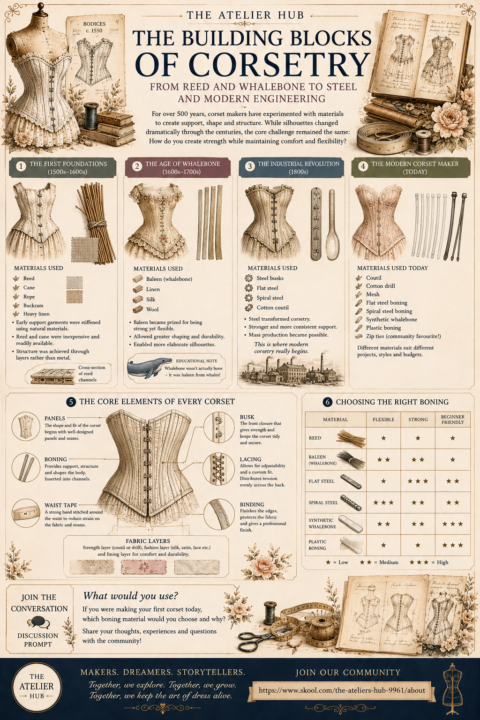
🪡 The Building Blocks of Corsetry 🪡
When we look at a finished corset, it's easy to focus on the silhouette. What often goes unnoticed is the incredible amount of engineering hidden beneath the surface. For centuries, makers have searched for ways to create garments that were both supportive and wearable. Early stays relied on reed, cane and layers of stiffened fabric. Later, baleen (commonly known as whalebone) revolutionised structured garments by offering flexibility alongside strength. The Industrial Revolution introduced steel busks and steel boning, transforming corsetry yet again and paving the way for many of the techniques we still use today. Modern corset makers now have access to an extraordinary range of materials: ✨ Flat steel ✨ Spiral steel ✨ Plastic boning ✨ Coutil ✨ Cotton drill ✨ Mesh foundations ✨ Modern support fabrics and findings Yet despite all these changes, the fundamental components remain remarkably similar: • Panels that create shape • Boning that provides support • Busks that add stability • Lacing systems that allow adjustment • Waist tape that reinforces the garment • Binding and finishing that ensure longevity The materials may evolve, but the principles of structure, fit and craftsmanship remain at the heart of corsetry. I'd love to hear from our members: 🪡 Have you ever made a corset, stay or structured bodice? 🪡 What boning materials have you worked with? 🪡 If you were making your first corset today, what materials would you choose and why? 🪡 Is there a particular historical corset period that fascinates you? Share your thoughts, experiences, photographs and questions below. Let's learn from one another and explore the hidden architecture of dress together. Claire Amelia 🪄🧵
🔥
1 like • 29d
I've not worked with the spiral boning but it looks amazing! Is it hard to cut to length, or do you have to buy set lengths?
1-10 of 22
🔥
@debra-verrall-3773
Sewing skills, measurable progress, and clothes you actually want to wear. 35 yrs industry experience, obsessed with great fit and finishes.
Active 9m ago
Joined Apr 20, 2026
Upper Caboolture, Australia