Activity
Mon
Wed
Fri
Sun
Aug
Sep
Oct
Nov
Dec
Jan
Feb
Mar
Apr
May
Jun
Jul
What is this?
Less
More
Memberships
Crust & Crumb Academy
1.1k members • Free
38 contributions to Crust & Crumb Academy
10d •
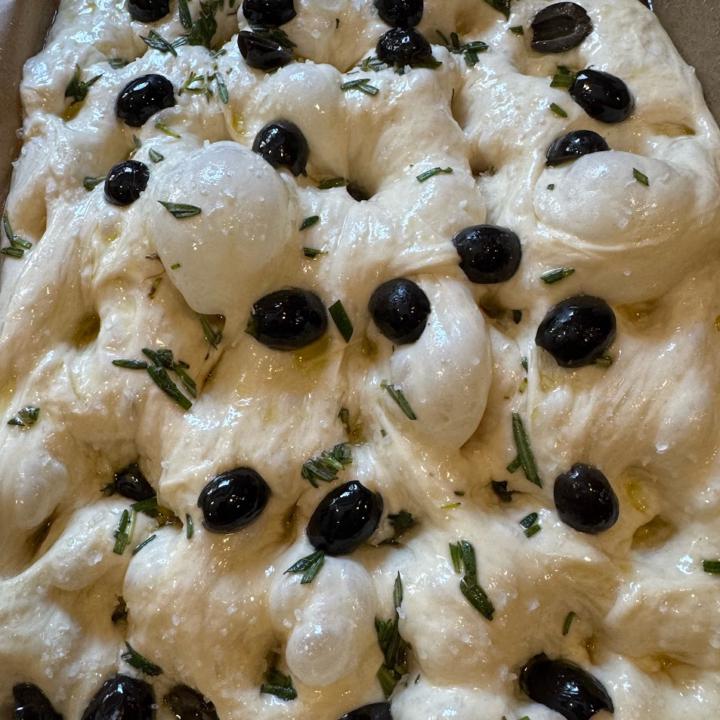
Focaccia
It’s the 4th of July and the forecast is for 104°F outside. The garden is full of fresh herbs. That means it’s time for Focaccia. This is a same-day recipe. Started at 6AM and out of the oven at 9AM, before the heat of the day. It’s great for a ‘Caprese Focaccia Sandwich’ with balsamic glaze. 9×13-inch (23×33cm) baking tray Total dough: 947 grams; Total flour : 500 grams; Water 80%; Instant yeast 1.4%; Honey 2%; Salt 2%; and Olive oil 4%. Ingredients: * 500g strong bread flour * 400ml warm water * 7g instant yeast (1½ tsp) * 10g honey (2 tsp) * 10g salt * 20g olive oil (1½ tbsp) * Toppings: Olive oil, fresh rosemary, halved olives or cherry tomatoes & flaky sea salt. Methods: 1. Mix the lukewarm water, honey, and yeast. Add the flour and mix until no dry flour remains. Add the salt and olive oil, then mix just until combined. Cover and rest for 30 minutes. 2. Stretch + fold every 30 mins (x3). 3. Generously oil a 9×13-inch (23×33cm) baking tray. Gently transfer the dough into the pan without punching out the air. Let it relax naturally instead of forcing it into the corners. Cover and let it rise for 1½–2 hours, or until doubled and very puffy. 4. Drizzle generously with olive oil. Coat the rosemary and halved olives in olive oil before placing them on top so they don’t burn. Using well-oiled fingertips, gently press dimples all over the dough without deflating it. Sprinkle with flaky sea salt. 5. Bake at 450°F (232°C) for 20–25 mins until golden. Tips: Keep your hands wet or lightly oiled while handling the dough, be gentle to preserve the bubbles, and don’t be shy with the olive oil, it creates that crispy, golden crust.
2 likes • 8d
@Jen Dolan I have had 3 from this loaf so far :)
1 like • 7d
@Jen Dolan Sounds great. Enjoy!!
18d •
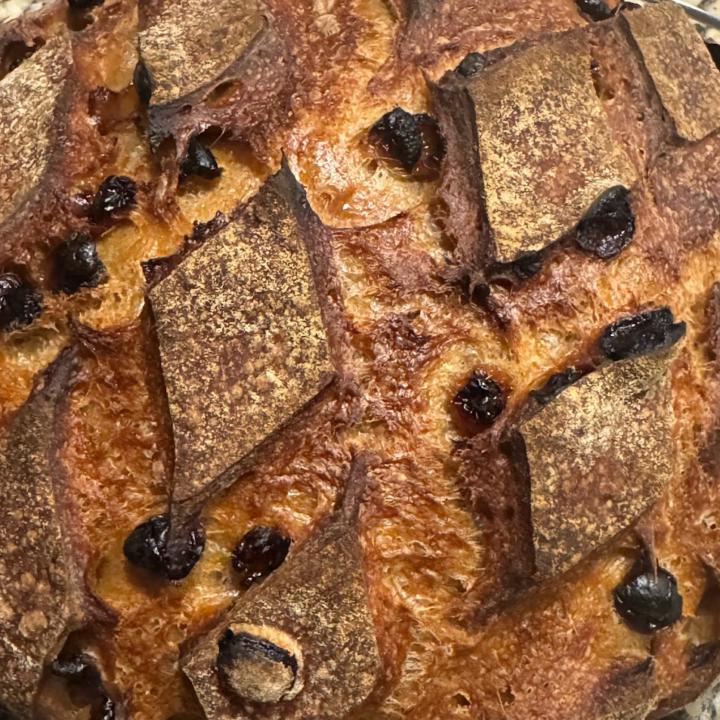
Molasses Rum-Raisin Sourdough Boule
THE CAPTAIN'S BOUNTY A Molasses Rum-Raisin Sourdough Boule Handcrafted Sourdough from the Galley Our ship sailed the 7 seas, gathering sultanas from the Ottoman Empire region and rum and molasses from the Caribbean. The Loot: A Whole wheat sourdough boule built with dark molasses and premium sultanas heavily marooned in dark rum. The Craft: Before rum hits the barrel, it begins as molasses. This artisan loaf reunites them both. A crosshatch diamond crust protects a soft, boozy treasure deep inside the crumb. Warning: May cause an immediate urge to set sail. 1010 g Total weight, 500 g flour: 80% bread flour, 20% whole wheat flour, 72% Water, 2% salt, 10% Molasses, 18% Sultanas. Made with 20% sourdough levain. Method: 1. Make levain the night before, 1-7-7 2. Soak Sultanas in Dark Rum overnight 3. Mix all except soaked sultanas; 45 min rest 4. 3 S&Fs @ 45 min. Intervals 5. Add drained Sultans on 2nd S&F 6. Bulk fermented at 78°F to 70% increase in volume 7. Shape 8. Placed in a banneton and refrigerated overnight 9. Preheat oven and Dutch oven to 500°F 10. Bake covered for 20 minutes @ 450°F, then reduced to 425°F and bake uncovered for 15-20 min.
2 likes • 17d
@Judy Lyle Thank you
1 like • 16d
@Henry Hunter It’s in the pictures. 2nd one in
24d •
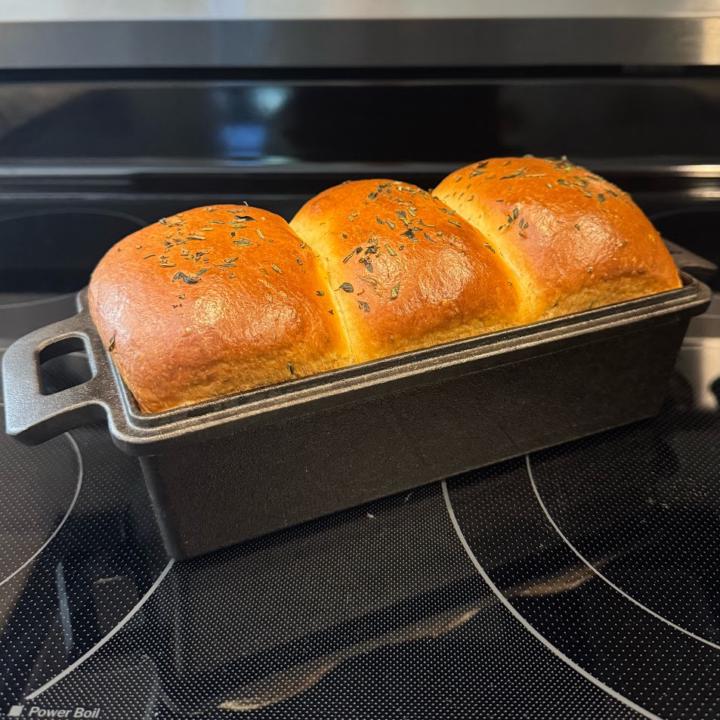
Wild Herb Brioche
Gaelic Celtic Bread Challenge A ritual bread year, one loaf each month One loaf for each turning of the year, using modern methods to honor ancient ways. Each bake is inspired by: - An Irish mythological deity, spirit, or persona - A solar or lunar threshold - The agricultural and hearth traditions that shaped Irish foodways Bread is where grain, fire, water, and time meet, and that meeting lies at the heart of the Celtic year. My June bake honors: Áine and the Summer Solstice Midsummer marks the solar climax of the year, the longest day, when the sun stands at its peak strength before beginning its slow decline. This bake reflects three core themes: - Solar Power: A rich, golden dough shaped into a unifying form. - Protection: Rosemary and thyme, long associated with safeguarding the home and spirit, are bloomed in the tangzhong, carrying their oils into every crumb. - Abundance: Milk, butter, and eggs reflect the fullness of early summer, when the land gives freely and the herd is strong. Áine’s Midsummer Hearth Loaf (Wild Herb Brioche) Formula: Scaled to fit a 9 x 4.5 x 2.75 inch Cast Iron loaf pan Total dough: 800 g Total flour: 320 g Hydration: 69% (including eggs) - 100% AP Flour (320 g) - 38% Milk (122 g) - 50% Butter (160 g) - 14% Sugar (45 g) - 42% Egg (135 g) - 2% Instant yeast (6 g) - 2% salt (6 g) - 0.6% Rosemary: (2 g) - 0.8% Lemon Thyme: (3 g) METHOD: Using a planetary mixer and a Brod & Taylor proofing box @ 26°C (78°F) 1. Tangzhong: Whisk 25g flour, 75g milk, and the herbs in a pan over medium heat until a thick paste forms at 150°F. Cover and cool to room temp. 2. Make dough: In the bowl of a stand mixer, combine the tangzhong, the rest of the cold milk, and cold eggs. Add the rest of the flour, salt, sugar, and yeast. Mix on speed 1 until ingredients are combined, then on speed 2 for 10 minutes. 3. Emulsify: On speed 2, drop soft (20–22°C/68–71.5°F) butter cubes in gradually, over about 90 seconds to 2 minutes, giving the dough a chance to mix most of the butter in. 4. Mixing Part 2: Mix on speed 2 for 15-20 minutes, scraping down the sides of the bowl as needed, until it passes a windowpane test. 5. Proofing: Cover and let rise to a 60% increase (1-1.5 hours). 6. Shaping: Divide into 3 equal portions, roll into balls, and place on a parchment paper-lined pan; cover and refrigerate overnight. The next morning, reshape each piece into a ball and place in a well-greased 9x5 pan 7. Final Rise: Cover and proof until the dough is roughly 1 inch above the pan rim (2-2.5 hrs). 8. Brush with egg wash and sprinkle with herbs. 9. Bake at 375°F (190°C) for 20 minutes and at 350°F (175°C) for 20 minutes with a foil cover.
1 like • 24d
@Judy Lyle Thanks
2 likes • 24d
@Colleen Vergara Thanks
Jun 13 •
Blueberry and Lemon Scones
Blueberry and Lemon Scones This is my favorite scone recipe. Just in time for blueberry season. They only take 45 minutes! Ingredients: - 125 g / 4½ oz butter, frozen - 1¼ tsp baking powder - ¼ tsp salt - 350 g / 12 oz self-raising flour or 350 g AP flour + 3 tsp baking powder - 50 g sugar - 2 tbsp lemon juice - Zest of 1 lemon - 150 g blueberries - 1 medium egg - 190 ml buttermilk - 24 blueberries, to decorate (optional) Oven temperature: 220°C / 440°F Method: 1. Preheat the oven and line a large baking tray with parchment paper. 2. In a large mixing bowl, combine the self-raising flour, baking powder, salt and sugar. 3. Grate in the frozen butter and rub into the flour until the mixture resembles rough breadcrumbs. 4. Add the lemon zest and lemon juice and mix to combine. 5. Add the blueberries and fold in gently. 6. Mix the buttermilk and egg together. Add to the dry ingredients a little at a time, starting with 3/4 of it, mixing with a fork until a soft dough forms. 7. Pat the dough into a round approximately 2.5 inches / 6.5 cm thick. 8. Using a sharp, floured knife, cut into eight triangles. 9. Place the scones on the prepared baking tray, leaving space between each one. 10. Brush the tops lightly with buttermilk and push in a few extra blueberries on top. 11. Sprinkle with demerara sugar for a crunchy finish. 12. Bake for 15 to 20 minutes, until risen and golden.

3 likes • 29d
@Candi Brown-McGriff Dried blueberries that I soak and a few fresh pushed into the top before baking.
Jun 6 •
Yeasted Sandwich Bread
Over the past few weeks I have been comparing the same basic recipe. Wk-1: A lean sourdough bread baked in a 9x5 loaf pan Total flour: 453g; 90% Bread flour & 10% Whole Wheat flour 75% water, 2% Salt, 20% Starter Wk-2: An enriched sourdough sandwich bread baked in a 9x5 loaf pan Total flour: 453g; 90% Bread flour & 10% Whole Wheat flour 68% water, 2% Salt, 6% Butter, 6% Honey, and 20% Starter Wk-3: An enriched, yeasted sandwich bread baked in a standard 8.5 x 4.5 x 2.75 loaf pan Total flour: 453g; 90% Bread flour & 10% Whole Wheat flour 68% water, 2% Salt, 6% Butter, 6% Honey, and 1% instant yeast This week I will make the same enriched sandwich bread as last week, except it will be leavened with instant yeast. This bread comes together in about 3 hours. If you want the sourdough tang, you can make a hybrid using last week's ingredients, add 1 ½ tsps of instant yeast, and follow this week's method. In a week or two I will add more fat to the basic recipe and it will be called a Brioche. Yeasted Sandwich Bread Ingredients: - Bread flour - 408 g - Whole wheat flour - 45 g - Water - 308 g - Salt - 9 g - Butter - 27 g - Honey - 27 g - Instant yeast - 5 g Method: 1. Mix all on #1 using a stand mixer 2. Knead on #2 for 12-13 min. using a stand mixer. Add the melted butter slowly after 8 min. To ensure the gluten is developed before you add the fat. 3. Bulk proof until "Doubled"; fully proofed 4. Shape and place in a standard 8.5 x 4.5 x 2.75 loaf pan 5. 2nd proof until 1 inch above the rim of the tin 6. Brush with melted butter and bake at 350°F for 35 to 40 minutes. Use a 2nd tin as a cover for the first 15 min.

1 like • Jun 6
@Henry Hunter a standard 8.5 x 4.5 x 2.75 loaf pan
1 like • Jun 7
@JoAnn Amato Thank you
1-10 of 38
@timothy-mcquaid-3820
Group 'Expert' in the 'Baking Great Bread at Home' Facebook group.
'Baking my way through retirement one loaf at a time.'
Active 6h ago
Joined Jan 4, 2026
Londonderry, NH, USA