Activity
Mon
Wed
Fri
Sun
Aug
Sep
Oct
Nov
Dec
Jan
Feb
Mar
Apr
May
Jun
Jul
What is this?
Less
More
Memberships
RC3 Leadership Lab
193 members • $5/month
10 contributions to RC3 Leadership Lab


1 like • 6d
Humility in leadership, to me, is the disciplined willingness to look in the mirror before looking out the window. It is not weakness. It is not soft leadership. It is not performative self-deprecation. It is the ability to say: “I may have contributed to this condition.” “I may not have prepared this person well enough.” “I may have assumed alignment where there was only silence.” “I may have delegated responsibility without actually developing capability.” That matters because leaders do not just manage tasks. They create conditions. The story about Dennis is powerful, but I also have to be honest: there is not enough meat on that bone for me to fully judge what happened. I do not know Dennis, Greg, the expectations, the work environment, the support system, or what conversations did or did not happen after day one. But that uncertainty is part of the leadership lesson for me. Humility means resisting the urge to build a complete conclusion from incomplete information. It means recognizing that a person leaving without conversation is rarely just “a person problem.” It may be a leadership signal. It may be a development failure. It may be a trust issue. It may be a mismatch. It may be something else entirely. But the humble leader asks the harder question first: “What did I miss?” In high-risk work, I see humility as one of the most practical leadership traits there is. A leader without humility will eventually normalize silence. People stop correcting them. They stop challenging them. They stop bringing forward the weak signals. And when that happens, the leader may still believe they are in control, but the organization has already started hiding the truth from them. That is dangerous. Humility is what allows a leader to remain teachable, correctable, and reachable. It keeps ego from becoming a barrier between the leader and the truth of the work. For me, humility sounds like this: “Tell me what I am not seeing.” “Where did I make this harder than it needed to be?”
6d •
Currently between opportunities...
I am currently between “opportunities.” That is the polite professional phrase we often use when we are not sitting inside a formal job title. But I have found this season to be far more than a pause between positions. It has become a mirror. A mirror for what I believe. A mirror for what I have learned. A mirror for what I still need to develop. A mirror for whether I can actually practice the leadership concepts I have spent decades studying, teaching, challenging, and trying to live. During this time, I have been building out a consultancy with real intention. Not as a hobby. Not as a fallback plan. Not as a placeholder until the next role appears. As a serious body of work. In a relatively short period of time, that work has grown into two retained client relationships, both on monthly retainers exceeding $15,000 per month. That is encouraging. But the money is not the real point. It just shows that with intention; milestones can be reached. The real point is that the work has forced me to clarify what I believe leadership actually requires when the room gets quiet, when the title is not carrying the weight for you, and when there is no organization wrapped around you providing structure, momentum, or validation. At the same time, I have been writing my first books. That has been its own form of leadership development. Writing forces a person to stop hiding behind experience. It asks: What do you really believe? Can you explain it clearly? Can you defend it without overcomplicating it? Can you make it useful to someone else? Can you look honestly at your own journey and admit where the lessons came from? My first book is scheduled to be published on July 6th. Book two is in the works! I am excited about that. Not because it is a finish line, but because it feels like a marker on the journey. A point where years of experience, failure, reflection, frustration, observation, mentoring, and hard-earned belief finally become something that can be shared with others.
2 likes • 6d
@Russell Cross III There is so much room to breath between chapters.
6d •
Always willing to jump in...
I love working on unique leadership challenges — especially the ones that do not fit neatly into a policy, checklist, or classroom answer. If my particular brand of leadership thinking, practical field experience, and dry humor suits your journey, please feel free to reach out. Sometimes the right conversation, at the right moment, with the right amount of candor, can move the work forward.
1 like • 6d
@Russell Cross III We do what is required to continue momentum otherwise its like running a marathon on a treadmill...once your done you get off and find yourself right where you started. I hate treadmills.

22d •
Your Purpose Will Follow You
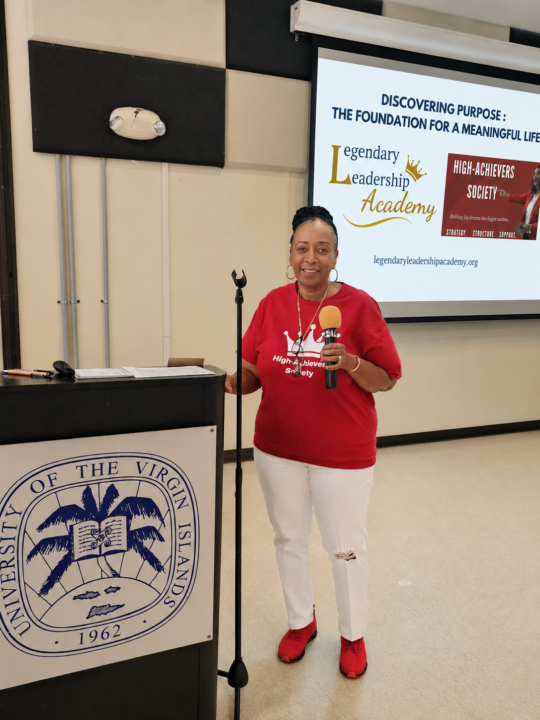
My goal was simply to go on vacation🌴☀️, and taking a break from social media and Skool (which explains my absence). What I did not expect was that I would find myself standing in front of a room, speaking on one of the things that means the most to me, helping people discover their purpose. It reminded me of something important. Your purpose follows you. You may step away from your routine, your business, or even social media, but purpose has a way of showing up wherever you are. Leaders understand this. We do not always go looking for opportunities. Sometimes opportunities find us. When there is a need, leaders show up. When people are searching for direction, leaders serve. When a door opens, leaders step through it. This picture was taken at the University of the Virgin Islands, where I had the privilege of speaking on "Discovering Purpose: The Foundation for a Meaningful Life." A reminder that God can use us anywhere. Anyone ever find their leadership skills come into play when least suspected, whether solicited and not?
0 likes • 6d
June, I love this. I see this as service in its cleanest form — service to others, but also service to yourself by staying connected to the work that gives you meaning. Your post reminded me of the Care for Life program I have had the privilege of teaching to Engineering students at Columbia University in New York. Every time I teach it, I am reminded that purpose does not have to be forced into people. Sometimes it simply needs to be invited, challenged, and given room to show itself. It is always inspiring to watch students consider those concepts, test them against their own lives, and then begin using them in their own way as they evolve through their academics and into their blossoming careers. I agree with you completely — purpose does follow us. And when we are clear enough to recognize it, those unexpected leadership moments often become the most meaningful ones.

🔥
Jun 5 •
Famous & Notable Duos
Notable leadership duos often rely on complementary skills, deep mutual trust, and a shared vision to drive massive success. Whether building global empires or shaping historical movements, these partnerships generally feature one visionary paired with a strong operational or cultural counterpart Famous and notable duos span across pop culture, entertainment, history, and literature, defined by their chemistry, contrasting personalities, or immense creative output. Exploring these pairs is a great way to see how distinct archetypes play off one another. How many can you think of, please post your favorites!
2 likes • 6d
Fleet Admiral Chester W. Nimitz and Admiral Raymond A. Spruance Most people know Nimitz. Far fewer people really understand the leadership value of Spruance. To me, this is a powerful Navy duo because it was not built on noise, ego, or theatrics. Nimitz carried the immense strategic burden of command across the Pacific. Spruance brought calm operational judgment, discipline, restraint, and precision at moments when the wrong decision could have changed the course of history. What I respect about this duo is the trust. Nimitz did not need Spruance to be a personality. He needed him to be right, steady, disciplined, and clear under pressure. Spruance was not the loudest leader. He was not the most flamboyant. But he was exactly the kind of leader serious command requires — measured, thoughtful, hard to rattle, and deeply trusted when the stakes were enormous. For me, that is one of the great leadership lessons from the Navy: The strongest duo is not always the visionary and the showman. Sometimes it is the commander and the disciplined executor — one setting the strategic direction, the other converting it into calm, decisive action under pressure. That kind of partnership does not just win attention. It wins outcomes.
1-10 of 10

@david-watts-1410
https://www.linkedin.com/in/david-watts1?utm_source=share_via&utm_content=profile&utm_medium=member_ios
Active 5d ago
Joined Jun 28, 2026