Activity
Mon
Wed
Fri
Sun
Jun
Jul
Aug
Sep
Oct
Nov
Dec
Jan
Feb
Mar
Apr
May
What is this?
Less
More
Owned by Gail
A Community for Rebels Over 50 Rebuilding Purpose, Confidence, and Income — Without the Social Media Noise. Modern skills. New freedom. No stress.
Memberships
Pathway to Profits
652 members • Free
Your First $5k Club w/ARLAN
28.3k members • Free
BYOB: Bring Your Own Business™
1.2k members • Free
Millionaire Women Collective
9.9k members • Free
Fulltime Freedom
6.3k members • Free
The AI Advantage
121.3k members • Free
Prompt-Shop-in-a-Box
1.4k members • $99
Tech-Lite Business Builders
219 members • Free
50+ TikTok Growth Mastery
330 members • $20/m
22 contributions to Tech-Lite Business Builders

6d •
answer this question
Answer this question in the comments: "𝗜𝗻𝘀𝗶𝗱𝗲 𝘁𝗵𝗶𝘀 community, 𝘄𝗲 𝗮𝗿𝗲 𝘁𝗵𝗲 𝗺𝗲𝗺𝗯𝗲𝗿𝘀 𝘄𝗵𝗼 ___."

1 like • 6d
Don't quit!
10d •
I would love your thoughts about this video?
I made this video on Notebook LM. The info came form a video from Mike Gowan who is from the Legacy Builder program. What are your thoughts?

2 likes • 10d
I love NotebookLM and I like these videos - could be my age! LOL I created a few as well - going to try them out on YouTube....
Mar 18 •
She had to stop this offer
Unfortunately Arlan had to stop this offer because of the people abusing the system and sending bots and fake accounts. I will never understand why people ruin things that are set up for good things to happen. The community is a great one and you are still able to get commissions if people upgrade. I thought it was a great idea and incentive but the scammers broke it Dont miss this easy $5 referral for people who join this free community What if you could earn $5 every time someone joins a free community… and you don’t have to sell anything? Inside Your First $5k Club w/ARLAN, you can share your referral link and get $5 when someone joins the community through your link. THAT IS IT! Yes… the community is completely free to join, and you still get rewarded for referring new members. 💸
0 likes • Mar 18
I love her training and freebies!
Feb 18 •
Revolution Series
@Jenelle Livet the AI video series with Raven is amazing! What tool did you use to create that?
1 like • Feb 19
In your classroom you have a training called THE REVOLUTION HAS BEGUN! how did you create these videos?
Feb 3 •
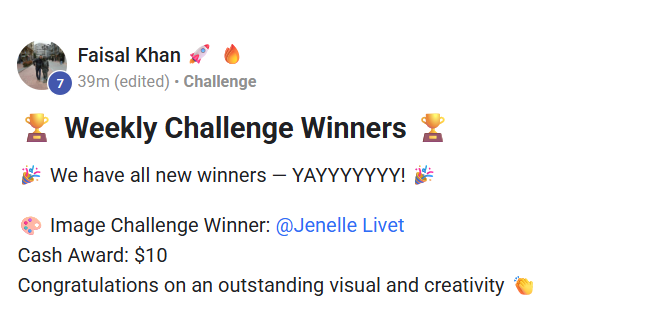
I won another weekly challenge
I jump in these then forget about them. I get a notification and I say to myself Winner Winner dino nugget dinner. This challenge was to create a scroll stopper image to be used as a poster. Heres what I did. I put the requirements into chatgpt and then told it to create me a prompt. I also asked it to create am image. This actual image was created by artspace which is a little better image creator for now
1 like • Feb 3
Amazing image - love it!
1-10 of 22
@gail-johnson-6362
💥 Veteran + Digital Rebel Grannie. Helping 50+ rebels learn AI and \ or build the business they’ve longed for—simple, bold, freedom-based.
Active 2d ago
Joined Oct 23, 2025