Activity
Mon
Wed
Fri
Sun
Aug
Sep
Oct
Nov
Dec
Jan
Feb
Mar
Apr
May
Jun
Jul
What is this?
Less
More
Memberships
The Atelier Hub
35 members • Free
Catherine's Sewing Room
894 members • Free
13 contributions to The Atelier Hub

🔥
8d •
🪡 19th Century Corsets – Innovation, Craftsmanship & the Victorian Silhouette
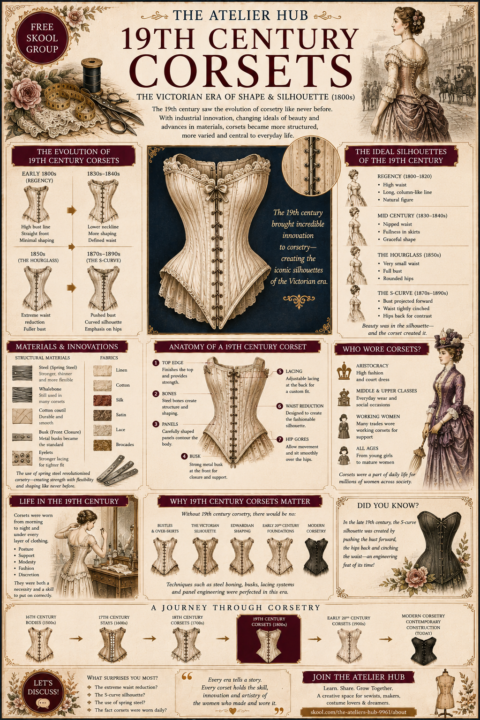
As we continue our journey through the history of corsetry, we've reached perhaps the most recognisable era of them all the 19th century. When many people hear the word corset, this is often the image that comes to mind. Yet the Victorian corset was far from static. Throughout the 1800s, it evolved dramatically alongside fashion, technology and society itself. The century began with the elegant, high-waisted Regency silhouette, where corsets were relatively short and lightly structured. As fashions changed, so did the corset. By the mid-century, waistlines returned to their natural position, skirts became fuller, and corsets grew longer, offering increased shaping and support. One of the greatest developments of the Victorian era was the introduction of industrial manufacturing. Advances in metalworking transformed corsetry, introducing stronger steel busks and more reliable steel boning. These innovations allowed corsets to become both more supportive and more comfortable, while maintaining the fashionable silhouettes of the day. During this period, makers commonly worked with: 🪡 Cotton coutil and tightly woven cottons for strength 🪡 Linen and fine cotton linings 🪡 Flat and spiral steel boning 🪡 Steel busks for secure front closures 🪡 Hand-worked and later machine-set eyelets 🪡 Silk, satin, brocade and decorative trims for fashionable finishes The Victorian corset was also an extraordinary feat of pattern engineering. Carefully shaped panels, precise seam placement and graduated boning worked together to support the body while distributing tension evenly throughout the garment. It's important to remember that not every Victorian corset was designed for dramatic waist reduction. Everyday corsets were worn by women from many walks of life, providing support beneath clothing and helping garments fit as intended. Like modern bras or structured undergarments, they were practical foundation garments as much as they were fashionable ones. Many techniques used by modern corset makers continue to build upon Victorian innovations. From panel shaping and boning placement to busk installation and precision fitting, the craftsmanship of the 19th century still influences couture, bridal wear, historical costume and contemporary corsetry today.

1 like • 7d
@Claire Amelia I agree. Proper shaping of the garment is much more flattering. I've often done 2 fittings with and without spandex. I had one bride wear it. Everyone else said no.
🔥
29d •
🪡 The Building Blocks of Corsetry 🪡
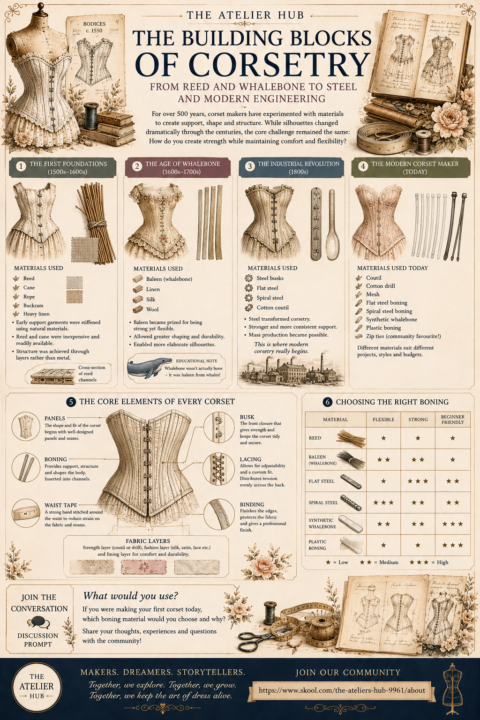
When we look at a finished corset, it's easy to focus on the silhouette. What often goes unnoticed is the incredible amount of engineering hidden beneath the surface. For centuries, makers have searched for ways to create garments that were both supportive and wearable. Early stays relied on reed, cane and layers of stiffened fabric. Later, baleen (commonly known as whalebone) revolutionised structured garments by offering flexibility alongside strength. The Industrial Revolution introduced steel busks and steel boning, transforming corsetry yet again and paving the way for many of the techniques we still use today. Modern corset makers now have access to an extraordinary range of materials: ✨ Flat steel ✨ Spiral steel ✨ Plastic boning ✨ Coutil ✨ Cotton drill ✨ Mesh foundations ✨ Modern support fabrics and findings Yet despite all these changes, the fundamental components remain remarkably similar: • Panels that create shape • Boning that provides support • Busks that add stability • Lacing systems that allow adjustment • Waist tape that reinforces the garment • Binding and finishing that ensure longevity The materials may evolve, but the principles of structure, fit and craftsmanship remain at the heart of corsetry. I'd love to hear from our members: 🪡 Have you ever made a corset, stay or structured bodice? 🪡 What boning materials have you worked with? 🪡 If you were making your first corset today, what materials would you choose and why? 🪡 Is there a particular historical corset period that fascinates you? Share your thoughts, experiences, photographs and questions below. Let's learn from one another and explore the hidden architecture of dress together. Claire Amelia 🪄🧵
1 like • 24d
I remember steel boning from a 50's gown I remade. Other than that, it's all been the plastic currently used in bridal and prom gowns. I have worked with different types of plastic boning: textured, smooth, very narrow, sew-through, and needle-breaking!
🔥
Jun 2 •
Closing Off May's Accountability Sewing 🪡
In May, we discussed each week what sewing projects we've been working on. Time to divulge, keep us guys updated and share your projects. Let's hear what you have all been up to; @Valerie The French Sewing Bee you discussed making swimming costumes, did you complete and get the pictures sent off? @Debra Verrall has been busy with her own skool sewing group preparing sew a longs, how did they go Debra? Would love to hear. @Jane Harbison busy filming sewing grandpa shirts, did you complete the filming? If so, please do share with the other sewers in the group 'Discipline Deep Dives'. @Nancy Poekert has been sewing with fleece, how did the repairs and jackets come along? @Christy Steiger dared to play with bias cut, relining and altering. Was your daughter happy with the outcome? @Jan Appleton did you manage to get on your sewing machine in the month of May? Please share your wins. A small snippet of some of the fabulous sewers in The Atelier Hub. To all hub members, let's hear how your sewing has gone the past month of May, before I enquire what you're up to next 🪡 Sending smiles, Claire Amelia 🧵🥰

2 likes • Jun 6
@Claire Amelia The green and brown men's tool tote bags are waxed canvas. The waterproof camo bag with the orange ripstop lining is a car tote with outer and inner pockets. That's my latest version. Waxed canvas is easy to sew, but you need to keep your needle clean. I use the most expensive kind cured with bee's wax. It feels and smells so good!
0 likes • Jun 8
@Claire Amelia Waxed canvas can be heavy and warm, so maybe a short full apron or a half apron? It has to have deep pockets for me!
🔥
Jun 6 •
Corsetry Inside The Atelier Hub - Let's Learn The Sewing Discipline 🪡
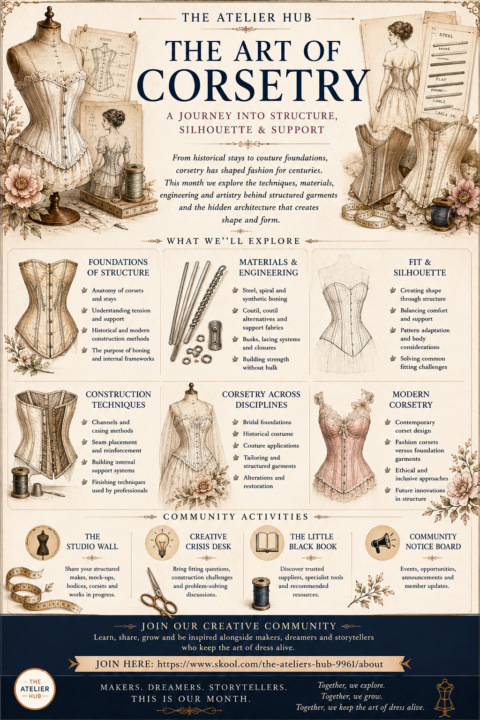
✨ Welcome to Corsetry Month in The Atelier Hub ✨ This month, we're exploring the fascinating world of corsetry, the hidden architecture behind some of fashion's most beautiful silhouettes. From historical stays and Victorian corsets to bridal foundations, couture construction and modern structured garments, we'll be uncovering the techniques, materials and craftsmanship that give garments their shape, support and strength. Whether you're a dressmaker, tailor, costumer, bridal maker, alterations specialist, or simply curious about how structure transforms a design, there's something here for you. Throughout the month we'll be exploring: 🪡 The foundations of corset construction 🪡 Boning, support fabrics and materials 🪡 Fitting and shaping techniques 🪡 Internal garment architecture 🪡 Historical and contemporary corsetry 🪡 Structured garments across every discipline As always, our community spaces will be open for sharing, learning and collaboration: ✨ The Studio Wall – Share your makes, works in progress and discoveries ✨ Creative Crisis Desk – Bring your fitting and construction challenges ✨ The Little Black Book – Discover trusted suppliers, tools and resources ✨ Community Notice Board – Updates, opportunities and events Whether you've made dozens of corsets or you've never inserted a single piece of boning, you're warmly invited to join the conversation. Tell me below, what are you most excited to learn about corsetry? 👇 Sending smiles on this wet Yorkshire day, Claire Amelia 🧵🪄
1 like • Jun 6
I love the look of corsets, and I worked with several of them. I've made a few corset style tops for ballet dancers, though those do have narrow straps. The style is so feminine and accents the best of the female torso. I remember 1950s bathing suits having a similar structure. Making corsets is detailed, but not as hard as it looks. Also, I love Jan Appleton's comment about women's status being affected by corsets. We can say the same about high heels, I think. Interesting that these two styles go together.
🔥
Jun 4 •
New Updates Coming Very Soon - Quick Update 🪡❤️🔥
I've been tinkering around in the background, whilst building The Atelier Hub in real time, and I can't believe how fast the time is going and what I have been learning, building and imagining. This space is for all sewing disciplines, and last month we touched on Historical Fashion, June has a new discipline coming !! (announcing that next woo woo) For now, the classroom is hidden as I build lots of lovely learnings for all us lovely sewers. So, I thought, to ask, is there 1 sewing discipline you would LOVE to deep dive into in the near future? Drop your sewing discipline in comments, what you would love to engage with and learn more about 🪡👇
Poll
6 members have voted

2 likes • Jun 4
I want to explore upcycling clothing in a mature, finished way. Not the raw edge, sloppy lacey stuff I'm seeing, but really styled, classy clothing. I've got a few garments to play around with. One thing I'm considering is upcycling a denim jacket with printed (or painted) designs. Or maybe with satin stitched, original appliqué. Long ago, I was an art major, and I have a nice collection of linoleum block designs. I do NOT want to see another upcycled, cropped man's shirt with the button placket on backwards, for example.
1-10 of 13

@christy-steiger-5151
I've been sewing since I was 5. Last year, I closed my alterations business, and I'm looking forward to sewing just for myself and my family.
Active 24h ago
Joined Apr 21, 2026