Activity
Mon
Wed
Fri
Sun
Aug
Sep
Oct
Nov
Dec
Jan
Feb
Mar
Apr
May
Jun
Jul
What is this?
Less
More
Owned by Duy
Science-backed sports nutrition for active people. Cut through the BS, fuel your training properly, and perform better. Join now.
Memberships
Samin's Free AI Resource Hub
18.3k members • Free
🔥 Creators Connected 🔗
34 members • Free
GOOSIFY: Skool Made Fun
13.1k members • Free
GenHQ - Creative AI Education
1.6k members • $127/m
AI Automation Agency Hub
329k members • Free
Motion Creators
268 members • $197
DaVinci Resolve for Beginners!
16.8k members • Free
NextGen AI
46.4k members • Free
AI Automation Society Plus
3.8k members • $99/month
52 contributions to AI Automation Society

💎
⭐
5d •
Who's pumped??
Last day to buy your AIS Live tickets! We brought together real AI business owners to show you guys what they actually sell and how they do it. July 11th and 12th (this weekend) and completely virtual. Get your ticket HERE


2 likes • 5d
3pm-past midnight in the UK but will be there both days!
💎
⭐
13d •
Congrats to our June graduates! #AISChallenge🎉
Huge shoutout to everyone who finished the 7-Day Challenge this month and got certified. Seven days, zero to your own executive assistant in Claude Code. Step by step, from nothing to shipped. These 46 members put in the reps and walked away with a working assistant they built themselves: Larry Crane, Al Mulrooney, Hassan Eid, Brandon Claeys, Marc-Antoine Siewe, Neelima Rani, Javier Yranzo, Elmuntasir Mukhier, Cristian Victoria, Alberto Galdames, Harena Juan Rabarijaona, Greg Faysash, Logan Clegg, Paul Forster, Estefania Tidwell, Vuk Simić, Iain Littlejohn, Mark Moran, Julius Waggoner, Michael Wijaya, Ilias Kirbashev, Leviticus Kinchen, Duy Nguyen, Vina Egg, Žiga Kalan, David Richardson, Lesetša Mutchinya, Abrie van Wijk, Firoz Shaikh, Farel Viaho, Alberto Camacho, Tito Burga, Chad, Peter Lukacsi, Sanjana N, Ayhan Bulut, Jerry, Hamza Sajjad, Tim van Kollenburg, Elias B., Ismoiljon Farhodov, Tim Metzner, Java Hardge, Philippe, Papa, Robin Pinchard If you haven't started yet, the challenge is completely free and it's right here: https://www.skool.com/ai-automation-society/classroom/dda699b7?md=08b046f630344596b864d1cd4304bda0 One lesson, one build, each day. By the end you'll have your own Claude Code assistant up and running. See you in the next cohort. - Nate

1 like • 13d
so many new graduates this month (including myself 😂)
14d •
How I used the knowledge I gained from completing the 7-day challenge with a real client
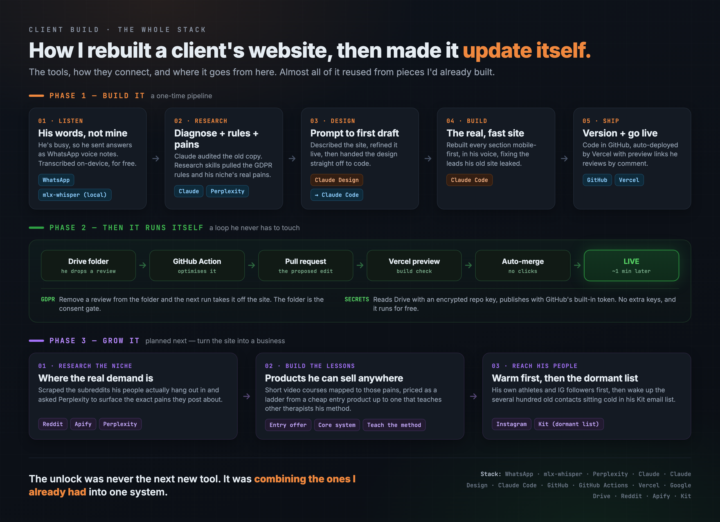
Hey everyone, just wanted to share a small win for me this week. So mostly everyone who's a desk worker spends a lot of time sitting in front of a screen, and for the past year or so I've been going to a mobility coach who's been treating me for months, doing assisted stretching and mobility work. Also, because I'm an athlete on the side, I run a lot and do a lot of resistance training too, so my body takes a beating either way. One thing I noticed for months is that this coach had a very old Squarespace template which isn't exactly built for mobile. The text doesn't flow very well and the copy isn't very well written either. When he opened his business he bought a Squarespace domain and was using one of their templates. He's not very tech savvy and gets overwhelmed easily. He's very good at what he does obviously, but the website was kind of working against him. During one of my sessions with him a few months ago, I told him I could offer my services and rebuild his website as a proper paid engagement. He said yes, and he's on a monthly retainer with me now. But the part I actually want to talk about is how a project like this pulls together a whole pile of things I'd built up separately over the past year into one system, all pointed at one outcome. That combining is the bit I find genuinely satisfying. The website itself is almost the least interesting part of it. The first thing I did wasn't even design. I asked Claude to read through his existing website and tell me why it wasn't pulling the right people in. Where the copy was vague, where it hid what he actually sells, why someone landing on it wouldn't immediately know if they were in the right place. You want to understand what's broken before you start rebuilding. Then I interviewed him, and this is where a real person is different from a project brief. He's flat out all day, back to back with clients, barely on his phone, and like I said he gets overwhelmed easily. He was never going to sit and type me paragraphs. So he just sent me voice notes on WhatsApp between sessions. I transcribed them locally using mlx-whisper, which is basically Whisper running straight on my Mac, so it's free and none of his words leave my machine. That gave me his actual words, the way he talks about his own method, which went straight into the copy. The site ended up sounding like him because it literally is him, just tidied up.
0 likes • 13d
@Ahmad Khan thanks!
0 likes • 13d
@Gage Dorris cheers :)

Apr 26 •
Day 2 Built
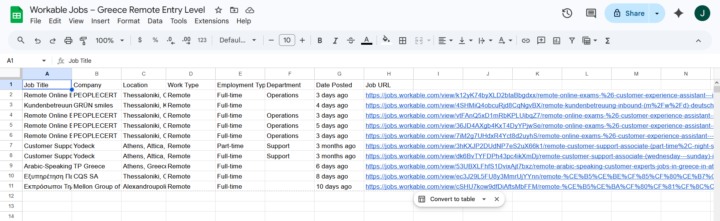
Hi everyone, this is my day 2 built. I was able to successfully scrape 10 jobs from a website. One thing I learned was that you can tell Claude to save everything globally so that it can just fetch it when I start another project. I can use the web scraping tool on a client if we were to ever have our first meeting, so that I would know about his business and I could expand on what he might need and where I can help the client.
0 likes • 14d
Excellent, you won't believe how a thing this simple can prove so useful later down the road

14d •
Day 1: newsletter build #AISChallenge
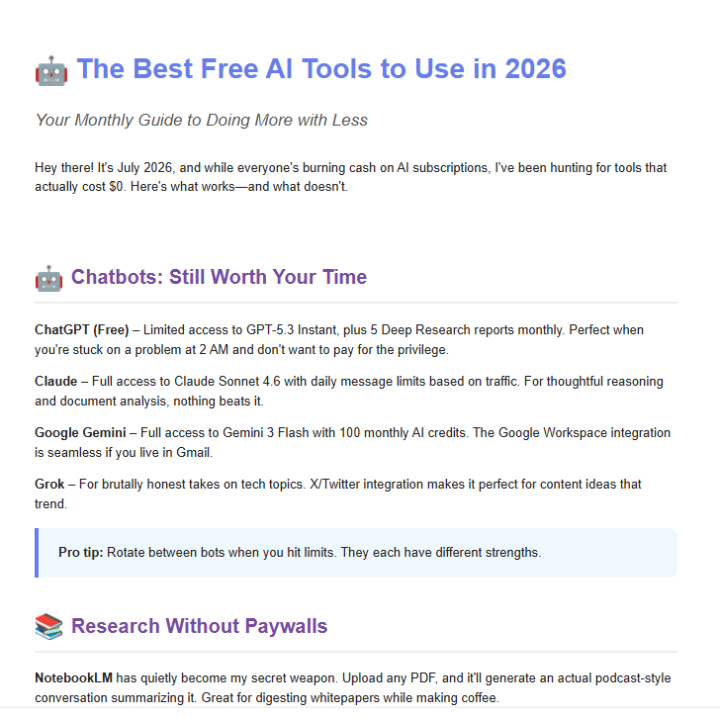
hi everyone i just finished building my newsletter from day 1 of the #AISChallenge. i learned a lot during this workflow creation how to set up api and how to work with claude, as a beginner im sure there could've been things i would like to improve, but still it was a rewarding experience and felt pretty happy after everything clicked and worked. if i would build this from scratch i would probably give him a specific font or colour since i didnt give him any brand assets since i havent created any. I’d really appreciate any feedback or suggestions on how I can make the newsletter better, personalised more or just how to make it more engaging every advice is very appreciated thank you😀 #AISChallenge.
2 likes • 14d
That's a very good start. How much of the newsletter did you write yourself? How was the search done? And what did you find the most challenging in this project?
1-10 of 52

@duy-nguyen-8446
Engineer-turned HYROX athlete & AI tinkerer. Level 4 Nutrition PT. Eat simple, fuel smarter, stay consistent.
Active 2h ago
Joined Jan 15, 2026
INFJ
Cambridge, UK
Powered by