Activity
Mon
Wed
Fri
Sun
Sep
Oct
Nov
Dec
Jan
Feb
Mar
Apr
May
Jun
Jul
Aug
What is this?
Less
More
Memberships
Mortgage Note Mastermind
48 members • Free
Note Investor Network
2.1k members • Free
9 contributions to Note Investor Network

Feb 17 •
Hidden Costs of NPN 2nds
This year's Cash Flow Expo introduced me to many knowledgeable investors in the note space--one them being DJ Olojo. His lecture titled "The Good, the Bad, and the Ugly of Second Position Notes: Risky on Paper, Powerful in Practice" included a case study on one of his successful note purchases in which a "small" $2,565 note with a $14,442 UPB on a $69,000 property wound up costing him $19,981.29. As a novice looking to start in this space, the true "cost" of investment had me thinking: 1) Which fees play a major role in making "small" junior liens not so small and, if so, are there ways to eliminate this cost? 2) Is there a way to factor in outsized costs when calculating return assumptions prior to bidding? 3) Should reports of some investors earning 3-10 times their original investment with junior notes be viewed as outliers?

5 likes • Feb 22
Excellent question @Jeremiah Evans and super helpful summary @Shaun Hunt !

Feb 18 •
Why would I buy a 2nd? Isn't that too risky compared to a 1st?
That hesitation is common, but experienced investors often prefer 2nd liens (Junior Liens) precisely because the risk profile is misunderstood. While Second Liens are subordinate in priority, they offer “asymmetrical return opportunities” where the potential profits often outweigh the risks when bought correctly. Here is why you would buy a Second Lien instead of a First, and how the risks compare: 🟢 The “Senior Shield” (Risk Mitigation) The biggest fear with Second Liens is being wiped out by a foreclosure. However, the First Lien holder actually acts as your first line of defense. *️⃣ Taxes & Insurance: In 80%+ of residential first mortgages, the Senior Lender escrows for property taxes and insurance. This means the First Lien holder is paying the taxes to protect their interest, which inadvertently protects your interest as the Second Lien holder from being wiped out by a tax sale. *️⃣ The Canary in the Coal Mine: If you buy a non-performing Second Lien behind a Performing First Lien, you have massive security. If the borrower is paying their First mortgage every month, it signals they intend to stay in the home. They are unlikely to let the house go to foreclosure, meaning your Second Lien is safe from being wiped out. 🟢 Better Collateral, Lower Price Second Liens allow you to control better real estate for less money. *️⃣ Higher Property Value: First Liens on the secondary market are often secured by lower-value assets (averaging ~$96,000 in a recent portfolio we sold). Second Liens are often secured by higher-value homes (averaging ~$347,000). *️⃣ Borrower Quality: Borrowers who qualified for two mortgages generally had better credit and higher income profiles initially. They tend to have more “pride of ownership” and take better care of the property than borrowers with low-value First Liens. *️⃣ Diversification: Because Second Liens trade at deeper discounts (often 60% of UPB or less), you can buy a diversified portfolio Second Liens for the price of one or two First Liens. This spreads your risk; if one deal goes bad, the others cover it.
6 likes • Feb 21
Fantastic overview and hugely helpful- Thanks Robert!
Feb 3 •
BREAKING NEWS: Court throws out “zombie second” lawsuit (HELOC)
Zombie mortgages have been all over the news lately. We saw articles from NPR, Bloomberg & more The takeaway is typically the same: when a borrower gets hit with a foreclosure action including a payoff balance inflated with massive past due interest on a charged-off loan they haven't received a monthly statement on in years... they are legitimately upset (and sometimes fight back). That's why we advise that you work with homeowners, get win-win deals done and use foreclosure as a last resort. That being said - a new precedent was set last week: Newrez beats zombie seconds suit over decades-old HELOC debt What happened: - A homeowner sued Newrez / Shellpoint and Bank of New York Mellon over a long-dormant second mortgage. - She said it was unfair to restart collection and add interest after years without monthly statements. - A federal judge dismissed the case. The court said the borrower used the wrong law to make her argument. Why the case failed: - Missing statements are a Truth in Lending (TILA) issue. - The borrower sued under FDCPA instead. - Courts say you can’t use FDCPA to enforce TILA rules. - She also didn’t clearly show who was required to send statements over the years. Why this matters: - Servicers can restart old second liens if they follow the rules. - “Zombie second” cases are not automatic wins for borrowers. - Courts are focusing on technical legal details, not emotions. What this means for note investors: - More old second liens may come back to life. - Paperwork and servicing history matter more than headlines. - Bankruptcy history and notice timing are key risks to underwrite. Bottom line: Long-dormant seconds are not dead. The law still favors the paper - if it’s handled correctly.
1 like • Feb 13
@Roslind Ray Seems like an excellent and reasonable strategy.
Jan 3 •
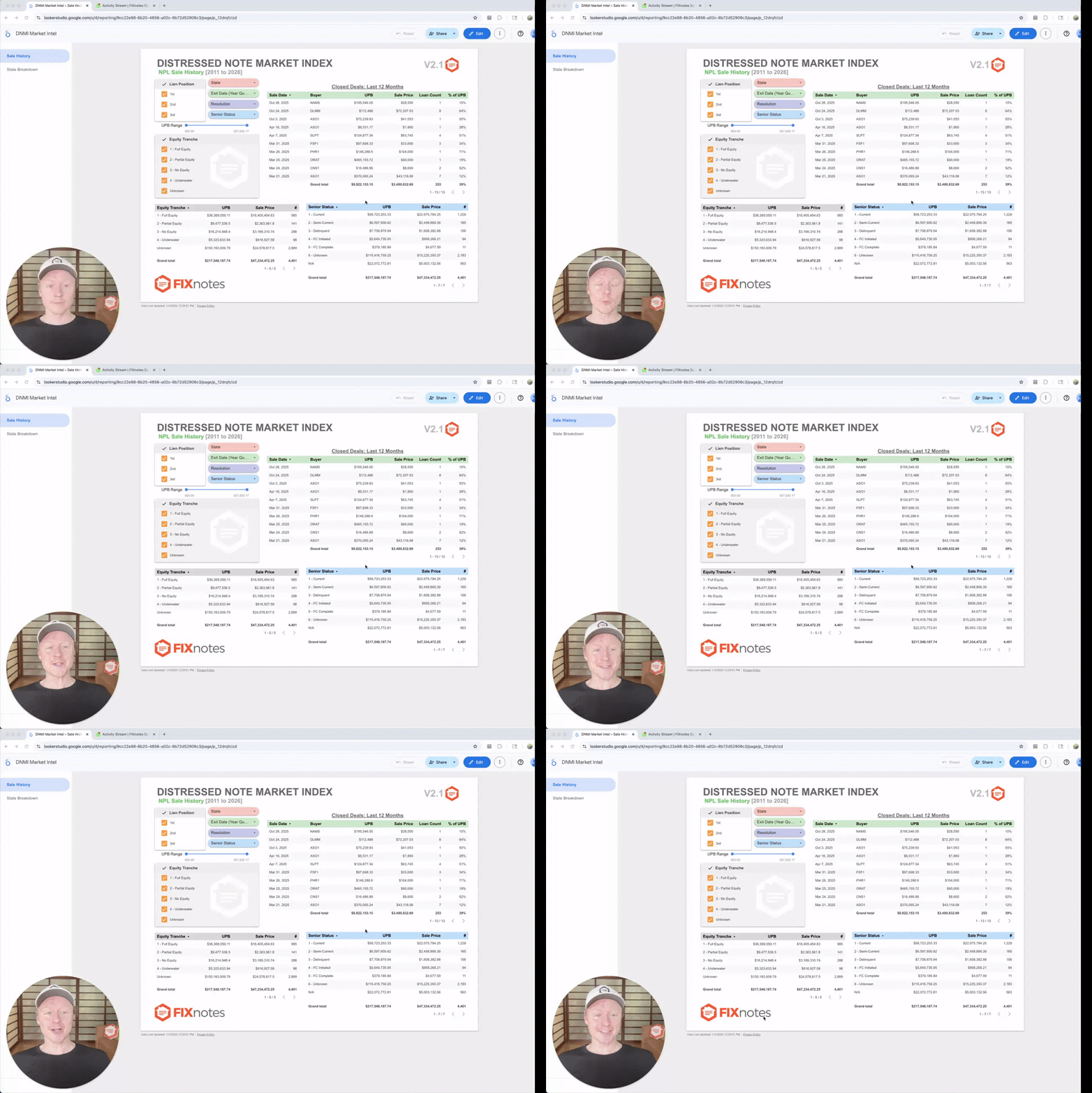
Demo of the Distressed Note Market Index (DNMI)
We just published a new tool for VIP members and above (Accelerator clients get everything). It's called the Distressed Note Market Index, or DNMI for short. This powerful tool lets you slice & dice data from 15 years of non-performing loan sale. You can see exactly what NPLs sold for based on: - state - equity - UPB range - senior status - resolution progress - total portfolio size (bulk/retail) - & more 👉 Upgrade & access it here w/ our other Professional Tools Watch the demo to learn more 👇
5 likes • Jan 4
Very handy resource!
3 likes • Jan 11
@Robert Hytha Not just yet but I'll certainly let you know of any ideas.
Oct '25 •
Introduce Yourself Here!
Let's get things started off right with a post about you & your goals in the industry. Make a reply below and tell us: - What's your professional background - How you heard about note investing - Why you'd like to learn - Where you're looking to go with your business Then like & respond to one of your new colleagues post to start earning points to move up the leaderboard (and get a chance to win our monthly contest).
4 likes • Dec '25
@Robert Hytha Wanted to follow up and offer an overview of my first npn purchase, as mentioned earlier, in hope that there are some learning/teaching points for discussion. This deal was back in 2018, and I had become interested in npn's after doing a course with Scott Carson. I enjoyed his course and learned a lot and was eager to get my feet wet. I formed my LLC and scoured some tapes from various brokers and eventually found a cherry pick opportunity for an sfr in Saint Louis, MO. The note was a CFD and the home was a small, older but attractive brick home with nice front porch, 3/2 with garage in back, and on a reasonably attractive street. The UPB was approx $32K and the FMV was around $45-$50K based on comps. ..I made a bid and we ultimately closed at 40% upb, or about $13K. I was excited and we started the diligence period. We obtained the collateral file and pulled O&E reports and things seemed to be in order. However, the owners were a couple who operated their own hair salon. ..We also reviewed their credit reports and ultimately learned that the husband had recently passed away in an accident, and so the wife was on her own. ...That's obviously a tough situation, and maybe should have been a red flag, but the actual monthly payment wasn't that high and the arrears weren't too bad, and my approach is patient and compassionate, so I was optimistic we could work with her. We had the loan boarded with Madison Management and they were very helpful and sent the borrower welcome letter and conducted the reach out. ...Initially things seemed promising as borrower was communicative. We wanted to be compassionate, and with Madison's help, we wrote off some of the arrears and restructured the note to reduce the payment and bring her current. ...Again, my wife and I were optimistic about the workout and hoped to let it perform and season for awhile. Unfortunately, after a couple months, borrower had problems and payments became late and partials. ...So, again, given borrower's personal circumstances, we wanted to try again to work with her, so we executed a second restructure in hopes she could make it work. Unfortunately, problems cropped up again within just a few months, and we began to realize things weren't going to be easy. So, given that we had CFD, we had a strong position and we worked with an attorney to firmly make that clear to the borrower. Unfortunately, she just wasn't able to perform. ..So, after about a year, we were ultimately able to negotiate with her through Madison and the attorney, and able to offer enough in a "cash for keys" deal to allow her to get settled elsewhere. ...That was a seeming success, but we had also used a Forced Place insurance policy and had a roof claim due to hail in the meantime, so that was an additional complication. ...Anyway, we ultimately used a local Preservation company to clean out the home and then listed it with local broker. ...We finally sold it a couple months later for about $35K, and my expenses had totaled up to about $25K, so after commission, we had a modest gain. The road was obviously bumpy but we believe we did everything we could to work with the borrower.
5 likes • Dec '25
@Bobby White Way to get back in the saddle Bobby...setbacks are only an opportunity to improve and will never keep a determined man(or woman) down!
1-9 of 9

@andrew-bogie-4364
Post career military and owned a few residential and a commercial rentals. Also dabbled with performing and NPN's and interested in learning more.
Active 127d ago
Joined Dec 10, 2025
Oxnard, Ca
Powered by