Activity
Mon
Wed
Fri
Sun
Aug
Sep
Oct
Nov
Dec
Jan
Feb
Mar
Apr
May
Jun
Jul
What is this?
Less
More
Memberships
Chase AI Community
72.5k members • Free
Automatable Free
19.3k members • Free
AI Bits and Pieces
814 members • Free
Business Builders Club
8k members • $33/month
AI Automation Society Plus
3.8k members • $99/month
AE
Automate Everything
139 members • $1/year
The Upwork Playbook (Free)
235 members • Free
Ai Titus
917 members • Free
Agentic Foundations
9k members • Free
57 contributions to AI Bits and Pieces

🔥
1d •
📬 AI Controls My Inbox: I Told It Once, It Forgot, Never Again
My Claude Cowork inbox triage reads a fresh task file every run. No memory of yesterday, by design, so the reports never drift. This week, that design had a cost. Two calendar items looked like accidental duplicates. - One was two event registration links landing as separate calendar entries. - The other was two client meetings back to back, one of them titled PLACEHOLDER. I confirmed both, in chat: stating, "all four were real, nothing to merge or delete." The next morning, the same two questions came back. Same wording. As if I'd never answered. The challenge was that if I gave it memory of the chats it would stop the repeat questions, but it would also break the fresh-read design that keeps the reports from drifting in the first place. So the fix was simpler: Write the confirmed exceptions into the task file itself, as a standing list it checks before asking anything. How it works now, step by step: - I confirm something, in chat, once - That confirmation gets written into the task file as a standing exception - Every future run checks that list first, before flagging anything - If it matches, the item is reported as settled, not raised as a question Cowork can: ☑️ Read a fresh task file every run ☑️ Check any exception already written into it ☑️ Skip anything already settled Cowork cannot: ❌ Remember what I told it yesterday ❌ Learn a new exception on its own

1 like • 17h
Thanks for sharing. Saved for future reference.
🔥
3d •
🎤 Speaking to 125 Small Businesses with NFL Great Led to an AI OS Deal
🏈 My friend @Herman Moore called me, former NFL wide receiver, Detroit Lions. "I'm speaking tomorrow to 125 small business owners. Want to join me and talk about AI?" One day's notice. I built one slide with five points. My strategy, let the room decide which ones we went deep on based on body language and reaction. No fixed script, just reading the energy and following it. Herman worked that stage right alongside me. Great public speaker, no surprise there given his career. We had an easy back-and-forth in front of the audience. 25 minutes on stage. Plain English, no hype. Here's what those 25 minutes turned into: - 12 post talk conversations - 5 leads - 2 solid appointments Results: 1. The Deal: AI OS. A 50-hour build. Not a prototype, not a pilot. A real system going into a real business. 2. The Opportunity: AI Executive Coaching. One business wants me in the room at the executive level as a fractional CAIO, not as a vendor they call when something breaks. 3. The Second Opportunity: Enterprise AI Enablement. AI opportunity mapping, then AI education for their front office professionals. Now here is the important part. I didn't walk in with just a polished pitch. I walked in with the practical AI knowledge that I get from AI Bits and Pieces, and advanced development knowledge from AIS+, and AI for Life where I learn to build complex and trending AI solutions. This is where I: try new things, explore advanced ideas, learn from other professional builder, sharpen the saw, ...and stay ready for that moment you may not expect. If it sounds like a full time plus job... it is. However, this is what enables me to walk in with one slide, a friend who trusted me enough to hand me a mic, and 125 people willing to listen for 25 minutes.
3 likes • 2d
Fantastic reminder that opportunities come from showing up prepared. One conversation can truly change the trajectory of your business. Congratulations on the great results!
2 likes • 2d
@Matthew Sutherland You look great man!
🔥
4d •
📬 AI Controls My Inbox: The Prompts That Fixed It (Claude Cowork)
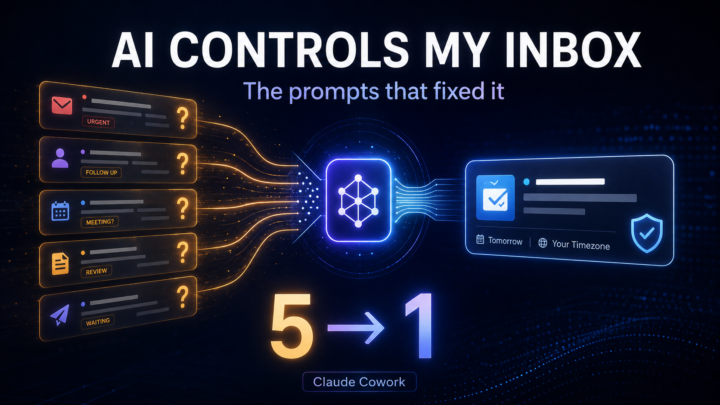
I promised @Kyle Covan my next post would be the specific prompts strategies that I used to make my Inbox triage more efficient. Not the philosophy. The actual strategies. 📝 What actually changed for the better this week: - It (Cowork) stopped asking me things it already knew the answer to - When a question was genuinely open, it started handing back a ready answer instead of just a flag - The one narrow auto-accept rule finally got tested by something trying to slip past it Here's how each one played out: 📝 It stopped asking things it already knew. Early runs, it asked "should I create a follow-up note?" for a contact. The same report already showed a meeting booked with that person, two lines up. It had the answer. It asked anyway. Fix: before flagging anything, re-check it against my sent email and meetings first. Five questions became one. 📝 Flagging it isn't finishing it. A Skool contact wanted a meeting time. His only clue was "morning or night." Turned out that meant Jakarta, eleven hours ahead. Fix: don't just flag it as open. Pull my calendar, check the timezone, hand back ready-to-paste times. Three options came back, both timezones shown, nothing left for me to calculate. 📝 The narrow rule finally got a real test. The auto-accept rule only fires on one exact domain. Everything else gets flagged, no guessing. On 7/12, a meeting came in from a different organizer doing the same kind of work, close enough to pass at a glance. It didn't auto-accept. It got flagged. That's the test that actually matters. Not the obvious case, the one built to sneak through. 📝 The number that proves it. Day one: five items needing me. Day five: one. Same volume of email and meetings. The difference was an agent that stopped asking what it already knew.
2 likes • 4d
Great example of how small prompt refinements can lead to big workflow improvements.
🔥
5d •
🦙 AI in Real Life - Ollama Successfully Loaded - Funny Story 😂
For those that were in the LIVE Session yesterday, I successfully downloaded Ollama onto my Windows laptop. For my non-technical members, Ollama is an LLM like ChatGPT that you run local on your computer - with no internet. It is what people use that are concerned about privacy and the frontier models using your information as training data. Claude Cowork was guiding me through the process, step by step. After a few diagnostic tests, the screen said: >>> Send a message (/? for help) I began what is effectively the local AI version of "Hello, world". Enter: “Summarize this in one sentence: The quick brown fox jumps over the lazy dog.” Ollama responded! Wow. Side note: It is wrong I am as excited as a kid in the candy store. My own AI model. Running locally. On my laptop. After a few more simple tests, Cowork suggested I verify that Ollama was truly working offline. The instructions were clear. ☑️ Turn off Wi-Fi. ☑️ Enter prompt. ☑️ Wait for response?!? Check. Check and Check! Holy Smokes! It actually works. Mind you, I am using Cowork to guide me through what feels like my first few steps on Mars. So... Now I decide to really test it with a complex prompt: "Can you write a brief story about two 12 year old boys throwing a football in the front yard, dreaming about playing in the NFL?" It produces a very nice short story. Offline. On my laptop. I am impressed. I am proud. Queue the tears... So naturally, I copy the story and paste it back into Claude Cowork to await my atta’ boy! Instead ⚠️⚠️⚠️⚠️ “We couldn’t connect to Claude. Please check your network connection and try again.” OMG! The F*&king WI-FI is off. LMAO! The local AI passed the offline test with flying colors. The AI helping me test the local AI did not. Now that is AI in Real Life.

2 likes • 5d
😂 That's a perfect "AI in real life" moment! Congrats on getting Ollama running locally.
🔥
9d •
📬 AI Controls My Inbox: I Had to Select One Trusted System
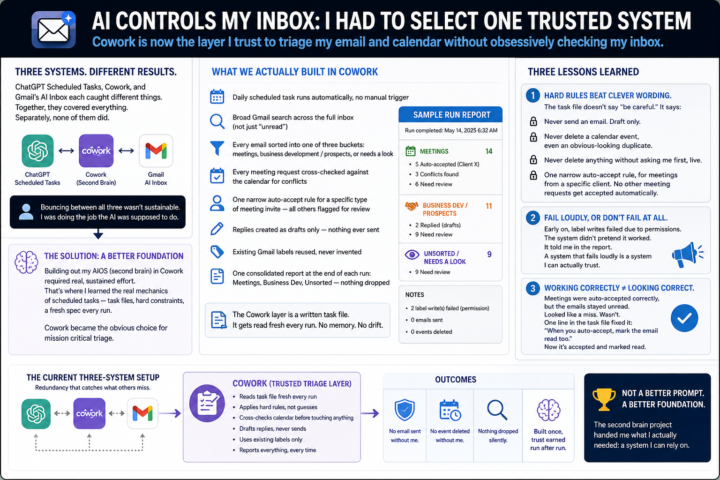
The results across the three systems weren't consistent. ChatGPT Scheduled Tasks, Cowork, and Gmail's own AI Inbox each caught different things. Together, they covered everything. Separately, none of them did. So I found myself doing something I hadn't planned on: bouncing between all three, cross-checking one against another, instead of trusting any single one to just handle it. That's not sustainable. That's a person doing the job the AI was supposed to do. Around the same time, on an unrelated but related project, I started building out my AIOS — what I've been calling my second brain. Getting that set up required real, sustained effort inside Cowork. That's where I actually learned how Cowork's scheduled tasks work. Not the surface version. The real mechanics — task files, hard constraints, a run that reads a fresh spec every time instead of carrying memory forward. It was clear to me that Cowork was the best choice for mission critical triage at this point, and therefore the scheduled task is much more robust. 📝 What we actually built in Cowork - A daily scheduled task that runs the inbox triage automatically, no manual trigger - A broad Gmail search across the full inbox, not just "unread" — misclassified emails don't show up if you only look at unread - Every email sorted into one of three buckets: meetings, business development / prospects, or needs a look - Every meeting request cross-checked against the calendar for conflicts before anything gets touched - One narrow auto-accept rule for a specific type of meeting invite — all other meeting notices get flagged for review, not guessed on - Replies created as drafts only — nothing ever sent automatically - Existing Gmail labels reused, never invented on the fly - One consolidated report at the end of each run: Meetings, Business Dev, Unsorted — nothing dropped silently That's the skeleton. Here's what happened once it actually ran. The Cowork layer is a written task file. It gets read fresh every run. No memory of the last one. Nothing to slowly drift.
1 like • 6d
This is a fantastic example of why reliable AI systems are built on clear rules and iterative refinement but not just the better prompts. I especially liked the distinction between failing loudly and failing silently. That single principle can make all the difference when building AI workflows you can actually trust. Great insights!
1-10 of 57

@md-abdullah-al-mafi-6512
QuickBooks Online Expert | AI Bookkeeping Automation (n8n) | Helping Founders Turn Accounting Data into Profit Decisions | Finance Consultant
Active 52m ago
Joined Jan 20, 2026
Bangladesh
Powered by