Activity
Mon
Wed
Fri
Sun
Apr
May
Jun
Jul
Aug
Sep
Oct
Nov
Dec
Jan
Feb
Mar
What is this?
Less
More
Owned by Kelly Legacy
Private institute for the structured study of law, jurisdiction, record, and procedure. Education only. No legal representation.
Memberships
Free Skool Course
54.4k members • Free
Skoolers
190.3k members • Free
67 contributions to Kelly Legacy Institute
2h •
From the Office
Effective immediately, Kelly Legacy Institute is entering its next phase of institutional expansion. Over the past months, the curriculum, structure, and governance standards of this School have matured significantly. As a result, membership pricing will be adjusted to reflect the institutional depth and structured instruction provided within this Institute. Current members will retain their Founding Member rate of $33/month permanently. New member enrollment will transition to $97/month. This adjustment reflects: • Structured curriculum progression • Weekly institutional briefings • Governance-focused instruction • Ongoing development of fiduciary discipline Kelly Legacy Institute is not built for mass appeal. It is built for institutional competence. Those already inside are positioned well. Capacity determines consequence.
2
0
1d •
THE FIDUCIARY BRIEFING
Kelly Legacy Institute Topic: Standard of Care & Record Preservation From the Office. A fiduciary does not act casually. A fiduciary acts with: • Duty of Loyalty • Duty of Care • Duty of Impartiality • Duty to Preserve Record The Standard of Care is not emotional. It is measurable. When acting as Trustee, Manager, or Authorized Representative: 1. Every transaction must have purpose. 2. Every disbursement must have authority. 3. Every decision must be traceable to governing instrument. 4. Every action must be defensible on record. Maxim: “He who acts in a fiduciary capacity must act in good faith and with reasonable prudence.” Record Preservation Rule: If it is not documented, it did not occur. This week’s focus: Audit your structure. • Is your LLC operating agreement current? • Does your trust reflect actual asset transfers? • Are distributions recorded as distributions — not withdrawals? • Is capacity clearly separated in your signatures? Remember: Individual capacity exposes. Fiduciary capacity administers. Silence creates presumption. Documentation rebuts presumption. Operate accordingly. — From the Office Kelly Legacy Institute
0 likes • 3h
@Kevin Trueman Good question. An LLC Operating Agreement is the internal governing document of a Limited Liability Company. Think of it as the rulebook for how the LLC functions. It defines: • Who owns the LLC (members) • Who manages it (manager-managed or member-managed) • Authority to sign contracts • How profits and losses are allocated • How distributions are approved • Record-keeping standards • What happens if a member exits If a trust owns the LLC, the Operating Agreement becomes critical because it defines how the Trustee exercises authority over that LLC interest. Articles of Organization create the LLC with the state. The Operating Agreement governs how it actually operates. From a fiduciary standpoint: No Operating Agreement = unclear authority. Unclear authority = exposure. Structure protects the beneficiary. Clarity protects the manager. Documentation protects everyone.
0 likes • 3h
@Phoenix Bey Strong articulation. You touched the core of fiduciary discipline commitment to non-frivolous distributions and traceable accounting. A fiduciary’s protection is not personality. It is documentation. When distributions are: • Authorized • Purpose-driven • Properly recorded • Supported by receipts and correspondence • Reflected in updated ledgers — the record speaks for itself. Transparency is not optional in fiduciary administration. It is a duty. And as you stated — the record must be comprehensible. If a neutral third party cannot follow the paper trail, the fiduciary has failed in clarity. Discipline in the small entries preserves integrity in the large matters. Well stated.
9h •
Capacity Determines Consequence
This week’s briefing addresses the single most misunderstood principle in fiduciary administration: Capacity controls liability. The same individual may sign a document. But the capacity in which he signs determines exposure, authority, and protection. Before any institutional action, conduct a Capacity Audit: 1. In what capacity are you acting? • Trustee • Manager • Officer • Individual 2. Does the record reflect that capacity? • Is it written? • Is it dated? • Is the signature block aligned? 3. Is authority documented? • Trust Instrument • Operating Agreement • Board Resolution • Written Delegation 4. Is there separation of roles? • Separate EINs • Separate banking • Separate contracts • Separate decision logs Maxim of the Week: “Equity regards substance rather than form.” Titles do not protect you. Documentation does. If you act as Trustee but operate as owner, substance defeats your label. If you operate as Manager without written authority, protection collapses. Instruction Focus: • Signature Block Integrity • Avoiding Personal Joinder • Preventing Commingling • Why Record Precedes Protection Institutional actors do not move emotionally. They move procedurally. Discussion Prompt: Before your next transaction, ask: What document authorizes this act? Does my signature reflect proper capacity? Is separation preserved in the record? The beneficiary is protected by structure. Structure is preserved by discipline. Discipline is proven by the record.
0
0


1 like • 1d
Phoenix, I receive that. Deliverance is not emotion. It is structure restored. Guidance comes from study. Protection comes from discipline. The pathway is lit because you’re walking it intentionally now not blindly. Stay steady. Stay teachable. Stay procedural. The light isn’t hype. It’s understanding. Welcome to the work.
4d •
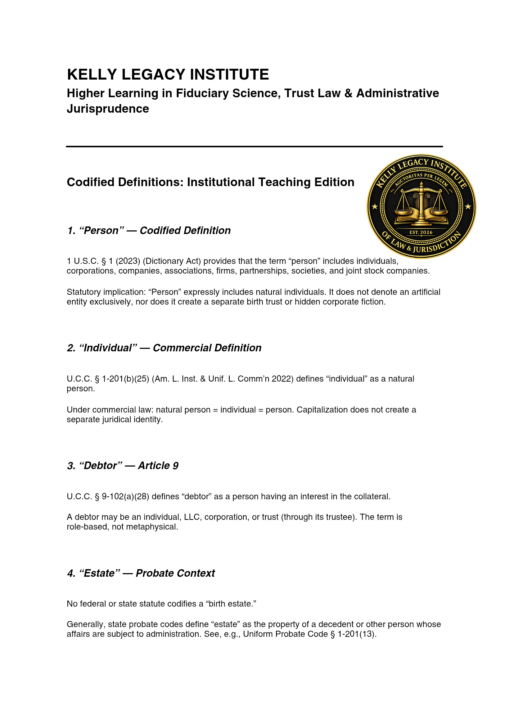
Codified Definitions
Scholars, Before we speak about jurisdiction, equity, secured status, or fiduciary administration, we must first discipline our language. Confusion in law does not begin with oppression. It begins with undefined terms. Today’s release — “Codified Definitions: Institutional Teaching Edition” — is foundational. Inside this document we examine, with citation: • The statutory meaning of “Person” (1 U.S.C. § 1) • The commercial definition of “Individual” (UCC § 1-201) • The role-based meaning of “Debtor” (UCC Article 9) • What an “Estate” actually is in probate law • What legally constitutes a “Trust” (Restatement § 2) • Legal vs. Equitable Title • The actual definition of “Transmitting Utility” • The statutory function of a Social Security number This is not theory. This is codification. If it cannot be cited, it cannot be administered. If it cannot be administered, it cannot be enforced. Many collapse structure because they argue metaphysics instead of statute. In this Institute, we do neither myth nor mysticism. We examine record. We examine code. We examine authority. Assignment: Read the document in full. Then answer in the comments: Where have you previously seen statutory language misinterpreted in a way that altered your understanding of legal identity? We are not here to react. We are here to refine. — Kelly Legacy Institute Higher Learning in Fiduciary Science & Administrative Jurisprudence
1 like • 3d
@Dave Anderson Yes‼️Dave, you can print review and study.
1 like • 1d
@Tony Reynolds That awareness is the turning point. Most people walk into a courtroom thinking it’s about emotion or argument. It’s not. It’s about definitions. It’s about procedure. It’s about record. If you don’t understand the language being used, you can’t measure the authority being exercised. That’s not a knock on you that’s how the system is structured. The fact that you can now see the difference between “what I thought I knew” and “what the record actually requires” means your mind is sharpening. Keep studying. Read slowly. Verify everything. And never confuse confidence with comprehension. We’re building discipline here not hype.
1-10 of 67
@30550893
Founder | Kelly Legacy Institute | Law-based education on status, standing, and jurisdiction
Active 17m ago
Joined Jan 7, 2026