
Aug 18 • Assignments
[Eldara] Histoy Workshop - Birth of a World
Followup of the Core Concept workshop for my main project, Eldara, on which I've been working since mid-may 2014.
I'll preface this one with the fact that Eldara's history is basically endless and largely circular. The so-called "Cycle" is roughly 40000 years long, and is aligned with the natural cycles of magic as well. Because of this, whatever the peoples of Eldara have come up with is entirely fictional, and has a lot of religious, spiritual, and cultural biases in it. I'll be mostly talking about the Erigian Basin and its people, and most prominently about the New Erigian Empire, as that is the main focus of my story.
> Who first recorded or told the origin story? A priest, scientist, AI, alien race, or unknown source?
In the current Cycle, what exists of a creation story is mostly down to state propaganda, invented by religious fanatics around the time of the New Erigian Empire's formation. It was refined and then spread by the Emperor's advisors, priests, and the institute of the church as a whole. It goes something like this:
"At the dawn of time, during the First War two opposing warrior gods met in battle. Kadros and Menit fought relentlessly, so long and brutal that eventually all that was left were the two of them on the battlefield. As they fought eachother, their spilled blood became the oceans and seas, while their discarded bits of armor became the continents, mountains, and islands.
Once the two deities tired of battle, they settled, and, having nobody left to fight, united. Menit soon gave birth two a set of twins; Mirro and Aati, the gods of Hard Times, and embodiments of the suffering inflicted by war. Their second set of twins, Anku and Kerrid are in turn, the gods of good Times, the embodiments of the spoils of war. Together, these six war gods make up the pantheon of the Empire's state religion, the Faith of the Six."
> Is the accepted story widely believed — or only told by certain groups?
This creation myth is only believed by some, even within the confines of the Empire, but those that do believe it, do so with religious zeal. The Empire enforces adherence to it, and the prescribed family structure is to copy that of the gods. The average Erigian citizen doesn't have strong feelings on it either way.
> Does it inspire unity or division?
Mostly division as the Empire's totalitarian stance on near-everything tends to, but the religious core that actually believe in the gods and accept the religion's prescribed tenets, is an extremely strongly united group. Those that believe the creation story also believe that the base nature of reality is war, and will do anything to reinforce it.
> Could it be wrong… and what happens if the truth comes out?
It is definitely wrong, and of anyone is found openly dissenting, they're arrested, disappeared, or even killed if their rhetoric is deemed too harmful (or if the soldiers doing it just feel like it).
Again, due to the Cycle, the actual first ones are lost to history, but in the current Cycle, here's the situation:
The current Cycle started with humans being little more than animals. 25 thousand years went by, and not much progress was made in terms of civilization, but Aquilans were already well-established, mostly minding their own business, off in the Zanian Forest (north-eastern neighbor to the Erigian Basin, and it actually spills into the basin in quite a large area), practicing their own culture, until, one day, they decided to begin the Human Ascension Project.
The first 7000 years of the project went really well. By the end of it, the humans had a well-established republic, advanced magitech, and were opening up their relations to neighboring civilizations.
> Where did they form — fertile plains, asteroid belts, volcanic islands, or floating platforms?
The Erigian Basin is a former seabed, with a relatively thin crust, high geothermal activity, fertile plains, and a massive, now extinct volcano in the middle, supplying them with large amounts of metals and other useful materials. Learning from the Aquilans, they were able to avoid having to till large areas, and were able to utilize the magically enhanced mushrooms as the primary food source, which they could grow in underground caverns eroded by geothermal vents.
> How did geography or environment influence their growth?
The Erigian Basin has pretty much locked them in, with very little options to expand in any direction:
- Their western shore is blocked off from sailing by the Everstorm, a stationary megahurricane that has been raging for millennia, composed off raging air and water elementals. Only specially grown ships can sail through/around it, which they only had a very brief access to due to the fall of the Erigian Republic.
- Their northern border gets way too cold to expand into it on a regular basis, their seasonal outposts getting snowed and frozen over in the winter even within the Basin.
- The entire eastern side of the Basin is basically one big wall of impenetrable terrain, opening into the Zanian Forest in the north-east and the Haraevanean desert in the south-east, both of which are already inhabited and plenty capable of defending themselves.
- The southern border also runs up against the walls of the basin, but before that, a strong, magically empowered, wild forest (think Fangorn) lies, making most habitation impossible.
> What event in your world marks “Year 0”?
For Aquilans and their philosophical successors, it's the beginning of the Human Ascension Project, making it the year 10467 by the time my story starts.
By the Erigian Republic's timekeeping, it would be around years 3500, as they dated it to their official founding around year 7000 of the so-called human era. They still respected the Aquilans' calendar as well, so they double-dated everything, so their calendar format often looked like this: YYYYY/yyyy/mm/dd or YYYY/MM/DD (yyyyy)
By the New Erigian Empire's calendar, it is only year 639, as they date themselves directly from the fall of the posthumously rebranded "Old Erigian Empire" (dubbed "The Collapse") in 9828, when in actual history, they only managed to get their business together by 9986, leading to a 158-year gap at the start of their recorded history.
> Which factions or cultures see the same event differently?
Those that follow the Aquilans in some form, see the Collapse as a great loss, both to the project and to humanity as a whole, and as such, they do not respect the New Erigian calendar, not to mention that in the intervening 158, an entire different kingdom rose and fell, which the Empire is very eager to make everyone forget, because they were just opportunists that took advantage of this fall to establish the Empire.
> What small change from the event ended up having the biggest impact over time?
The Collapse has been rewritten in history books to make the Empire's originators more sympathetic. Originally, they were not allowed any power by the various factions in the immediate aftermath of the Collapse because they were largely seen to be responsible for it. Removing this obstacle from the collective memory has allowed them to put much more of their assets into work and not be seen as the antagonists by most around the time the empire was establishing its current power dynamics.
> Who benefited most from it — and who lost the most?
The empire gained the most, and magic users lost the most. Before the Collapse, the Erigian Republic was a very pro-magic nation, and worked with magic users in designing and building their magitech, which allowed them a pretty equitable society before the Empire's originators started funneling wealth out of the Republic for personal gain. Under the Empire, magic users are faced with genocide, and old magitech is hard to decipher without access to the user manuals.
> Is the event remembered accurately, or has it been altered for political gain?
See above, it has been thoroughly rewritten, and most people can no longer tell that the Empire's hisory books are falsified. Some do remember; those that were alive back then, so mostly just immortals, like Aquilans and dragons.
> Who decides what history is recorded — rulers, scholars, media networks, AI historians?
The Imperial Royal Family, the Emperor's advisors, and high-ranking officials. There is ongoing "research" into the Collapse, and newer editions of history books usually come with more things rewritten, obfuscated, or added to make the Empire look even better.
> What’s the most famous event in your world… and how accurate is the popular version?
The most famous event is perhaps the start of the so-called Everwar, the Empire's ongoing attempt to invade the Haraevaneum, a desert-dwelling, anarchist society living in/under the Haraevanean Desert in a vast network of tunnels and caverns. The empire is facing several disadvantages in this war, including the geography of the frontlines and their own unwillingness to treat magic users as people.
The popular version is a kind of "manifest destiny" situation, wherein the Empire's religious mandate is to conquer everything, which is not far from the truth, except for the part where there are no actual gods to have given them this mandate, so they're just using their pantheon as justification for it. They really wanted to invade something, and so they did.
> What’s the most important forgotten event, and why did it vanish from public knowledge?
That would be the precursor events to the Collapse; the growing corruption, the active sabotage, and the eventual violence (an attempted, failed coup) that precipitated it. It has been rewritten because the ones that did it are the same groups and families that now make up the elite of the Empire.
> How do different groups remember the same event differently?
The immortals that got to live through the Collapse and saw how it happened have a drastically different stance on it, and some of them were even involved in the aforementioned intermediary kingdom's rise and fall (one particular person for the fall).
The Aquilans' followers, who did not live through the Collapse, and only learned about it through the above immortals, see it as an unfortunate event, but are ultimately concerned with the present and future, planning their own coup, and preparing the new system to come.
The Empire, as mentioned above, would rather forget about it all and make up their own history.
> Could a forgotten truth, if uncovered, change the present?
No. The parties involved either don't care that much, or are preoccupied with more important things, so anything that could possibly be uncovered would not really change anything in the current situation.
There are no specific questions in this segment, but there are a few things that reminded me of some, as of yet unmentioned bits connected to this topic:
> A shopkeeper selling goods in a style invented by a long-gone culture.
Eldara's global currency, one that has endured through many Cycles, is the Quell. It is not printed on paper or pressed into coins. Instead, it is cast into chips, each of which is shaped similarly to the Linotype Matrix. Their sides are lined with teeth that can be used to identify the denomination of the chip, as well as using differently colored metals in the casting of these chips to make them visually identifiable.
The technology to both make and check them has survived many Cycle-ending cataclysms because it is particularly well designed, robust, and the chips themselves are durable enough that when new civilizations find old caches of them buried or scattered among the ruins, they have a very easy time adopting them as currency, leading to the Quell being a global currency for the past several Cycles.
> A festival rooted in your origin myth.
Not in the origin myth, but in the cosmogony of the setting.
The Moonfest is a triannual (3 times a year) event, lasting 11 nights each, during which the moon Lua's light turns blue from its more usual silver, and affects the flow of time in areas where it touches matter. There's an entire set of festivals structured around this regular event, where people move under moonshades for the duration, socializing and celebrating the end of the season. This is done mostly so that nobody gets stuck in place for an entire night and attacked by wildlife (some of which has evolved a resistance or immunity to the blue moon's light).
The Moonfest is also the origin of the phrase "once in a blue moon" in Eldara.
> Architecture from your early civilization in the background.
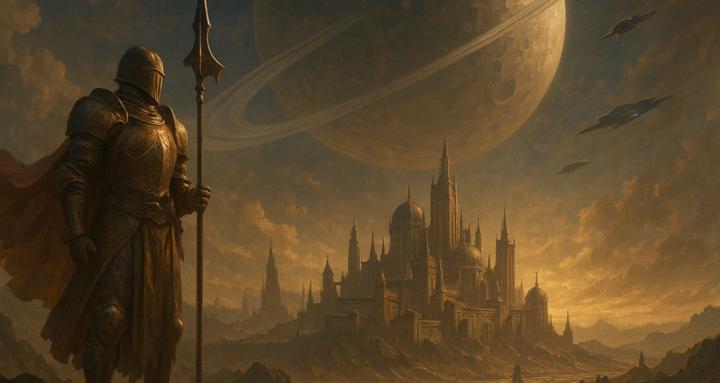
The New Erigian Capital is home to a lot of ancient magitech, mostly in the form of colossal monoliths inscribed with arcane runes and eldritch circuitry that lights up when the structures are struck by lightning. Nobody knows what they do, but they're theorized to be the remnants of weather-controlling systems, or even a sort of supercomputer, though they don't, at present, have the vocabulary to describe them as such. Instead, there are occasional rumors of hauntings around the monoliths, or mentions of a machine spirit living in them, communicating with the odd magic user in hiding.
The Portal Hub Network is also a remnant of older civilizations. Very few of them are operational to this day, , and the ones that are, are mostly sabotaged by the Empire removing the keys they use to function and connect to other hubs to form portals. If a community the Empire is planning on attacking lives near to a working hub, the first step of their occupation is closing off all escape routes, starting with the hub key.
1
0 comments
[Eldara] Histoy Workshop - Birth of a World
powered by
skool.com/the-galactic-foundry-3872
Forge worlds, build lore, and create with others. A community for worldbuilders, storytellers, and creators of realms across space and genre.
Suggested communities
Powered by