
Write something
Pinned

4d •
Adaptability Is the Quiet Advantage
One of the biggest advantages you can build in life isn’t more information. It’s adaptability. Not the dramatic kind. The disciplined kind. The kind that comes from being willing to look at what’s actually working… and what isn’t… without making it mean anything about you. Most people don’t get stuck because they’re incapable. They get stuck because they’re loyal to an old version of themselves. Old rules. Old patterns. Old ways of operating that once served them well. And here’s where it gets tricky. Resistance loves rigidity. It tells you that staying the same is integrity. That changing course means you failed. That letting go means you’re giving up. But adaptability isn’t quitting. It’s professionalism. It’s the ability to face reality as it is today and make a clean decision from there. No drama. No self-judgment. Just honesty and action. Growth doesn’t always ask you to push harder. Sometimes it asks you to release what no longer fits and keep moving. The people who grow aren’t the ones forcing the next step. They’re the ones willing to learn, unlearn, and choose again without turning evolution into a personal indictment. The future doesn’t belong to the most rigid. It belongs to the people who stay open and keep showing up. So my question for you today... where might Resistance be asking you to cling instead of adapt?

5h •
AI Isn’t the Problem. The System Around It Is.
From team workflows to national strategy, the real challenge with AI is how we structure thinking — not how fast we deploy tools. This morning, I found myself reading about the Asia Undercurrent Series session on Building & Securing Asia’s AI Future, moderated by Gregory C. Allen, with insights from Kay Firth-Butterfield, Dr. Ayesha Khanna, and Kyoko Yoshinaga — and it made me pause. We often look at AI through two very different lenses: At a global level - Nations are figuring out governance, security, and how to keep up with rapid development. At a team level (where I spend most of my time) - People are figuring out how to make Tuesday feel a little less chaotic. What struck me is how similar the underlying challenge is. Whether it’s a government or a 10-person team, the real bottleneck isn’t AI. It’s the system around it. How decisions are made. How workflows are structured. How people think about what “good work” even looks like. And that’s where the gap usually shows up. When I walk into an organisation to build AI systems, I’m not just dropping tools into their workflow. I’m helping them redesign the invisible architecture, the part that actually determines whether AI becomes an advantage or another shiny thing everyone ignores after three weeks. Today’s session reminded me that responsible AI doesn’t start at the policy level. It starts at the team level. With clarity. With structure. With people who know why they’re using AI, not just how. Asia’s AI future will depend on how intelligently we build systems at the macro level. But a company’s AI future? That starts with whether its people have room to think instead of firefight. If that’s the direction your team wants to grow into, I’m always open to a conversation. Sometimes the shift begins smaller than you’d expect. HMU for a coffee chat to discuss more for all the AI enthusiasts in the room!


3h •
“Vibe Coding” vs. Guardrails: Why Your Prompts Need a Safety Layer (Not Just Aesthetic)
I know I said I was done posting for this year… but this one I couldn’t let slide 😄 Lately I keep seeing people proudly selling “vibe coding”: “I’ll code your OS / brand / life based on your vibe, not boring logic.” Fun idea on the surface. Terrifying if that system is actually going to touch real people, real data, or a brain that’s already under stress. If you’ve seen my earlier posts, you know I’m in a different camp: • Guardrails 101 (checklist, not vibes) • AI Safety for Non-Tech Builders (driver’s ed, not magic) • Nightmare Scenario Drill (worst case, owner, kill switch) • Emotional Guardrails for Overthinkers (DM safety check) This “vibe coding” trend sits in the opposite corner: ✨ “Trust me, I’ll tune the energy.” 🧠 “Don’t worry too much about the boring details.” 🚫 No mention of: • security • data boundaries • failure modes • what happens if the user is not ok That’s fine for pure art experiments. It’s not fine when you’re building OS-style systems for humans, especially: • people with burnout, grief, ADHD, trauma • tools that shape their decisions, messages, or relationships • flows that have access to files, inboxes, or accounts If someone is selling you “vibe-coded prompts” or “I’ll wire your entire OS to your vibe,” at minimum, ask them: 1. Security & data What data will your system touch? Where does it go? Who can see it? How do you protect keys, accounts, and sensitive info? 2. Failure modes What’s the worst thing this setup could do if it misfires? Who is responsible if it breaks? Is there a kill switch? 3. User state What happens if the user is sleep-deprived, grieving, manic, overloaded? Does this OS slow them down when they’re spiraling, or accelerate the spiral? Because for my niche, this is non-negotiable: I build for people whose brains are already carrying extra weight. ADHD, overload, grief, money stress, family stuff. For them, AI must be a brake + safety net, not just a vibe amplifier. Vibes are great for brainstorming.



14h •
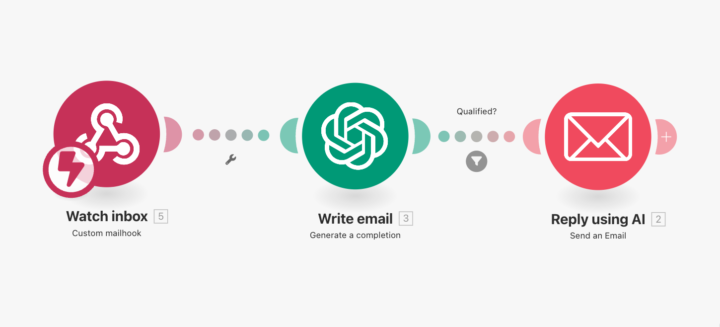
Here’s a simple way to improve your conversion rates by ~391%.
A study by Velocify shows that lead conversion jumps by 391% if you respond immediately. But in reality, nobody can be available 24/7 to respond immediately. I built a workflow in make.com to handle this for less than $10/mo. It acts as a smart responder, so leads get an instant, human-sounding reply even if it's 3 AM locally. The logic looks like this: - Trigger: Email hits the inbox. - Analyze: Send the body text to OpenAI. I use a prompt that checks intent (is this a lead or spam?) and drafts a short, context-aware reply. - Filter: I block spam, so the automation doesn't reply to unqualified emails. - Reply: If it passes the filter, the draft gets sent. This is one of the simplest automations any company can employ, and see a drastic improvement in conversion rates. If anything is unclear, just ask. Hope this provides some value.
1-30 of 10,067

skool.com/the-ai-advantage
Founded by Tony Robbins & Dean Graziosi - AI Advantage is your go-to hub to simplify AI, gain "AI Confidence" and unlock real & repeatable results.
Leaderboard (30-day)
1

🔥
+1299
2

+905
3

+799
4
+772
5

+449
Powered by