
Jun 4 • General discussion
The Evolution of Criminal Statement Analysis in Modern Investigations
On a foggy November morning in 1888, detectives investigating the Whitechapel murders pored over letters allegedly sent by Jack the Ripper. They examined handwriting, word choice, spelling errors and tone, searching for clues about the writer’s identity. More than a century later, investigators would still be analysing language in criminal investigations, but with very different expectations of what words could reveal.
The history of criminal statement analysis is, in many ways, the history of changing beliefs about truth.
For Victorian detectives, a confession was often the ultimate prize. Criminal investigations revolved around extracting admissions, exposing contradictions and identifying suspicious behaviour. Statements were viewed less as sources of information than as tests of honesty. If a suspect hesitated, changed their story or appeared nervous, investigators often interpreted those behaviours as signs of guilt.
The twentieth century brought a more complicated picture. A series of notorious miscarriages of justice demonstrated that innocent people could confess to crimes they had not committed. Cases such as the Birmingham Six and the Guildford Four in the United Kingdom revealed how flawed interviewing practices and investigative pressure could produce unreliable statements. These cases forced police forces and researchers to ask an uncomfortable question: what if a confession was not necessarily the truth?
In response, criminal statement analysis began to evolve. Psychologists turned their attention to memory, communication and credibility. Rather than focusing solely on whether a person appeared deceptive, investigators increasingly examined how an account was constructed. Did it contain specific sensory details? Was the sequence of events coherent? Could independent evidence support the statement?
One of the most significant changes came with the introduction of the PEACE model of investigative interviewing in England and Wales during the 1990s. The goal shifted from obtaining confessions to gathering accurate information. Investigators were encouraged to build rapport, ask open questions and test accounts against evidence rather than assumptions.¹
Today, statement analysis occupies a more cautious position than many television dramas suggest. There is no universally accepted linguistic formula for detecting lies. Researchers have repeatedly found that individual verbal cues are unreliable indicators of deception.² Instead, modern investigators use statement analysis as one tool among many, combining interview evidence with forensic science, digital evidence and witness testimony.
The detective examining a suspect’s statement today is not so different from the detective reading a Ripper letter in 1888. Both are searching for meaning in words. The difference lies in what they expect those words to reveal. Where Victorian investigators sought certainty, modern investigators are more likely to seek corroboration—a shift that reflects more than a century of lessons about memory, truth and human fallibility.
References
- College of Policing. Investigative Interviewing. Available at: https://www.college.police.uk
- Vrij, A. (2008). Detecting Lies and Deceit: Pitfalls and Opportunities. Wiley.
1
0 comments
The Evolution of Criminal Statement Analysis in Modern Investigations
powered by
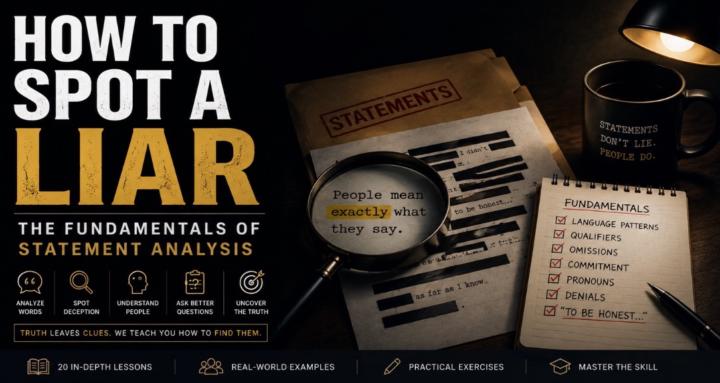
skool.com/how-to-spot-a-liar-6506
Master the fundamentals of Statement Analysis. Spot deception, weak denials, and hidden meaning in everyday language.
Suggested communities
Powered by