May 18 • General discussion
Statement Analysis FAQs
The discipline of statement analysis rests on a deceptively simple premise: that people mean exactly what they say. Even deception, they argue, leaves traces within speech.
A liar may control expression, rehearse a narrative, steady the voice — but language itself remains difficult to govern completely. In this way, a statement becomes less a version of events than a psychological artifact, shaped by guilt, avoidance, fear, or the strain of concealment.
The questions surrounding the method tend to repeat themselves. Is it scientific? Does it work on practiced liars? What about people who simply misspeak? The answers are delivered with striking certainty.
“Do you need to establish a baseline before using statement analysis?”
The question suggests a room with mirrored glass, a detective studying a suspect’s gestures for signs of strain. But the practitioners of statement analysis dismiss this approach almost entirely. A baseline may matter, they concede, when examining body language: one must first know the subject’s ordinary habits before recognising an aberration. Words, however, are treated differently. Language itself is the evidence.
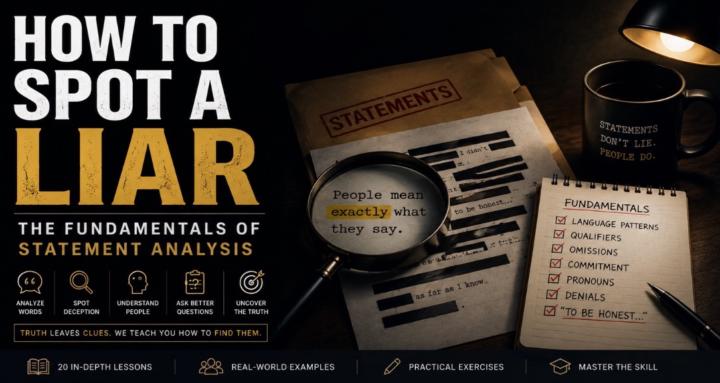
People mean what they say.
Even so, there are qualifications. Certain phrases — “you know,” for example — are regarded with suspicion, as if they were attempts to smuggle belief past scrutiny. Yet, analysts acknowledge that some speakers use such expressions habitually. In those cases, the phrase may reveal less about deception than personality. Speech, like handwriting, develops its own recurring flourishes.
“Is statement analysis a pseudoscience?”
The discipline depends less on scientific experimentation than on the established laws of grammar and meaning. Syntax, in their view, is not speculative. One does not require a laboratory to recognise the evasiveness of a phrase such as Bill Clinton’s “I tried to be truthful.” The weakness lies plainly within the sentence itself.
There is, however, something curiously doctrinal in the certainty of these claims. The analysts speak as though language were incapable of concealing intention completely. A pronoun omitted, a verb tense shifted, an unnecessary qualification inserted — these are treated not as accidents but as disclosures.
“Does education level matter?”
Only to a point. Analysts concede that poor grammar, limited vocabulary, or speaking English as a second language may account for certain irregularities. A mistaken tense may be ignorance rather than evasion. Yet they maintain that most deceptive indicators survive these differences. The structure of concealment, they suggest, is remarkably universal.
“Is statement analysis more accurate than a polygraph?”
The comparison reveals the discipline’s ambition. Polygraphs, they argue, are limited by physiology and by the narrowness of yes-or-no questioning. Words, by contrast, travel everywhere: through telephone calls, written statements, casual conversation. More importantly, language contains what machines cannot detect — hesitation, distancing, omission. The polygraph measures stress; statement analysis claims to uncover thought.
“Will it work on a skilled liar?”
The answer arrives with unusual confidence. “There is no such thing as a good liar,” declares Mark McClish, a former police officer who popularised many of the techniques through seminars, manuals, and televised interviews. “Only bad listeners.” It is the kind of sentence that lingers because it sounds less like instruction than philosophy.
According to this view, deception always leaves a residue in language. Some liars may be more disciplined than others; some may conceal more effectively. But words, they believe, eventually betray the speaker. The analyst’s task is simply to notice where the narrative fractures.
“What about pathological liars?”
Even those who lie habitually are thought incapable of perfect concealment. Indeed, their lies are often described as easier to detect precisely because they become excessive, baroque, detached from ordinary plausibility. The extraordinary nature of the fabrication becomes its own kind of evidence.
“Can people simply misspeak?”
Of course, people can say the wrong thing unintentionally. A name mispronounced, a sentence tangled in haste. But they regard truly accidental speech as rare. More often, they suggest, people regret what they have revealed rather than reveal what they did not mean.
Underlying the discipline is a profound faith in language itself: the belief that speech is never random, that words contain traces of motive even when the speaker wishes they did not. In this sense, statement analysis resembles psychoanalysis more than policing. The hidden truth is assumed to be present from the beginning, waiting quietly inside the sentence.
2
3 comments
Statement Analysis FAQs
powered by
skool.com/how-to-spot-a-liar-6506
Master the fundamentals of Statement Analysis. Spot deception, weak denials, and hidden meaning in everyday language.
Suggested communities
Powered by