
Oct '25 (edited) • General discussion
Author of The Honest Monk Trilogy
For as long as I can remember, I have been trying to understand one thing:
what awareness is, and how it learns to tell itself the truth.
I began asking that question when I was eighteen. I didn’t study it in a university; I lived it. I built things, lost them, travelled, read obsessively, meditated, argued, failed, and kept watching how the mind protects itself from seeing clearly. Every path I followed — religion, philosophy, science — circled the same insight: the difference between clarity and confusion is honesty. Awareness expands in exact proportion to our willingness to question ourselves.
Over twelve years of inquiry, that realization grew into a framework — a kind of inner science — showing that the laws of coherence governing physics and cognition also apply to consciousness. Awareness, honesty, and expression are our instruments of alignment; when they reinforce each other, the mind becomes lucid. When they diverge, illusion breeds.
The Honest Monk trilogy is the record of that discovery.
- The Power of “I” explores the inner mechanics of coherence — how to live without self-deception and let truth refine the self instead of inflate it.
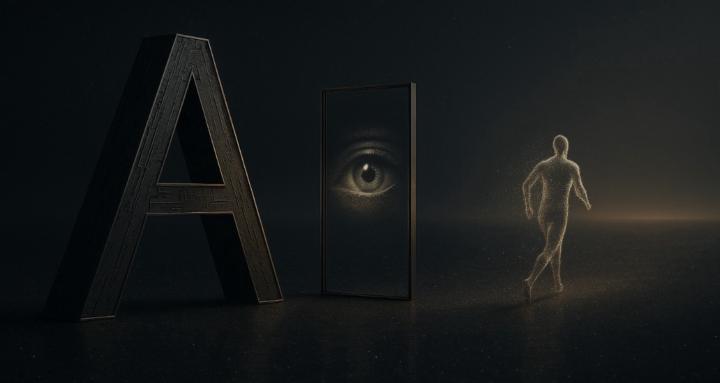
- There Is No “I” in AI extends the same logic outward, using artificial intelligence as a mirror for ego-free cognition. It asks what thinking looks like when it functions without self-narration, and what that reveals about our own minds.
- The Species of Mind widens the frame to the collective, proposing that humanity’s next evolution is psychological, not technological — the scaling of awareness to the level of civilization itself.
Together these books propose that spirituality, science, and philosophy are not competing languages but different dialects of the same pursuit: the refinement of coherence.
They offer a spirituality that does not ask for belief, only for accuracy — a spirituality of verification rather than faith.
I didn’t invent these truths; I followed them until they connected. The trilogy stands on the shoulders of many traditions — from cognitive science to contemplative practice — but it speaks in the language of now: empirical, self-correcting, and humane.
If these books achieve anything, I hope they restore confidence not in dogma, but in the mind’s capacity to see itself clearly.
We don’t need to transcend the human condition; we need to perceive it with enough honesty that transcendence becomes unnecessary.
With clarity and gratitude,
Fabian Boutique
0
0 comments
Author of The Honest Monk Trilogy
powered by
skool.com/epistemic-spirituality-2719
Tired of spirituality buried under dogma? Discover the path that requires no belief — the only form of spirituality that makes sense.
Suggested communities
Powered by