Activity
Mon
Wed
Fri
Sun
Jan
Feb
Mar
Apr
May
Jun
Jul
Aug
Sep
Oct
Nov
Dec
What is this?
Less
More
Memberships
TGE
733 members • Free
Millionaire Mentorship
87 members • $7,000
8 contributions to TGE

23d •
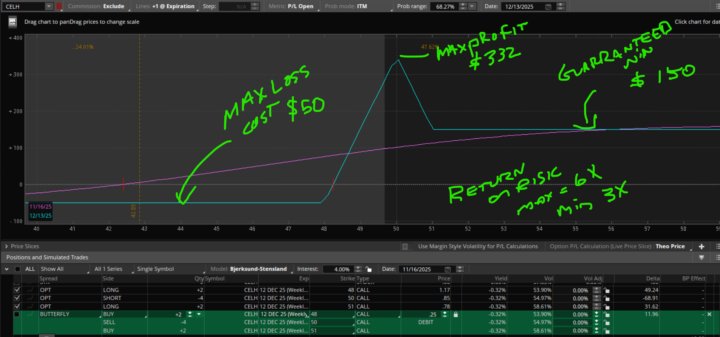
Why I like BWB on Potential and Real upward trending stocks
1. What trade you’ve put on From the image, we’re in CELH with a broken‑wing call butterfly for the 12 Dec 2025 expiry: +2 48 calls (buy) -4 50 calls (sell) +2 51 calls (buy) All same expiration, different strikes, in a 2 : –4 : 2 ratio. This is essentially a 1‑2‑1 call fly centered at 50, but with the upper wing slightly wider (50–51 vs 48–50), so the risk is a bit skewed. 2. How this structure reduces theta decay Compare this to just buying a 48 or 50 call: Long call alone → negative theta: you bleed premium every day if CELH doesn’t move. In your fly: You own 4 calls (2×48, 2×51) but you sell 4 calls at 50. The short 50 calls have the highest extrinsic value and highest theta, so their time decay works in your favor. Net result: Theta is much closer to zero, sometimes even slightly positive when price is near 50. You’re far less exposed to daily time decay than a straight long call. So, as days pass, if CELH hangs around the body (near 50), the position can gain from theta instead of lose. 3. Risk–reward profile & “guaranteed” upside cap Payoff at expiration (simplified, per 1× fly): Below 48: all calls expire worthless → max loss = net debit paid. At 50: 48 calls are 2 points ITM 50 calls are at‑the‑money 51 calls are OTM → This is where you get max profit. Above 51: All calls are ITM and the structure collapses to a small net loss or small gain depending on exact strikes/prices. Your upside is capped – you don’t participate in unlimited upside like a naked long call. Because you’re long wings and short more calls in the middle: Max loss is defined and limited (the debit you paid). Max profit is also defined and higher than the max loss if you priced it well. The risk–reward is attractive if: You pay a relatively small debit. You think CELH will gravitate toward ~50 by expiration, not explode far above. 4. Why this can be attractive vs a simple long call Advantages: Reduced theta drag – short middle calls offset most of the time decay of the longs.

1 like • 22d
I really like the concept of BWB. Especially in these times of difficult markets.

Nov 2 •
Invite Code
Could someone help provide an Invite Code? Just need to sign up the website Gextron. Thanks a lot!
1 like • 27d
@Ruben Leija can I please get a code too?

Oct 13 •
I'm on – Gextron training call NOW
Zoom: https://us06web.zoom.us/j/81083803809?pwd=f58DQCyGy4GzJMEGBZHwgVzhUGU2l2.1

1 like • 28d
Are these training calls recorded? This is all very interesting to me
Jul 21 •
Not every trade has to be a winner
We traded SOUN today. This morning, we were up 10% on the trade. By the end of the day, it gave back all the profits, and we closed at -2%. Here’s how I look at it: When I take a trade, I’m not trying to be right every single time. My goal is to find trades where the reward is worth the risk. For SOUN, I still think it could hit $20–$25 long term, but some short-term signs broke down, so I had to exit. That’s part of my plan — I don’t sit and hope when things change. Think of it like baseball: You don’t need to hit a home run every time. You just need enough good swings to win the game. Some strikes happen, but the big hits cover the misses. Because of this: - My win rate will be lower since I cut trades when they break. - But the big winners cover the small losses over time. This trade? No big deal. We took the shot, it didn’t work, and now we move on to the next setup. Trading isn’t about being perfect. It’s about sticking to the plan and thinking long term.
0 likes • Jul 21
I don't like the price action today. Many tickers gave back profits. I am smelling a market pull back and weakness coming. I lightened up on many positions and will see about buying in Sept/Oct
1-8 of 8

@su-fairchild-7889
I work 2 jobs and am often distracted.
Active 15h ago
Joined Jun 6, 2025
USA
Powered by