Activity
Mon
Wed
Fri
Sun
Jan
Feb
Mar
Apr
May
Jun
Jul
Aug
Sep
Oct
Nov
What is this?
Less
More
Memberships
Simple Takes Work
145 members • Free
Pocket Counsel
50 members • $19/m
Referral-First Brands
12 members • Free
Black Velvet Branding
33 members • $997
The Panther Den
40 members • $47/m
Brand Awakening
1.2k members • $997
25 contributions to Referral-First Brands

4d •
Member Win!!
Shout-out to @Kay Snarr owner of Junamour for stepping into discomfort and locking in her biggest sales day ever. She joined our community stuck where a lot of product businesses get trapped: Running ads that worked… but killing profit. Organic not converting. Feeling unsure what to fix next. Instead of spinning in circles, she took action. She tested her offer in person. She paid attention to real customer reactions. She tweaked her messaging on the fly. And the result? 👉 Her best sales day to date. Plus she got clarity that changes everything moving forward. Junamour earned it by showing up and doing the work. Who’s next? What win are you chasing this week? Drop it below. 👇

0 likes • 9h
Thanks @David Bingham! Incredibly helpful to get clarity and an action plan to implement.
Oct 30 •
Why I'm giving it all for free.
Yesterday I posted about the science behind the Referral-First Growth Formula and the "me" vs "them" frame. And that's been heavy on my heart. And what this group is really supposed to be. And I realized something simple but important: The right thing to do is to give it all away. Starting now, this entire community will be free. You can invite anyone you think needs it. And I’m releasing everything too. The quiz, the workbooks, and the frameworks I’ve spent years building. At no cost. Here’s what’s coming: 1. The Diagnostic Quiz (This week) Take it, and you’ll know instantly whether your business is stuck in GET, HELP, or KEEP So many times we think we know where the problem is, but the data says otherwise. By the end of the quiz you’ll have clarity on: - Where your business is bottlenecked - What system to fix first - Where to focus your time And it’s 100% free. 2. The GET Workbook (releasing next week) I’ve rebuilt it from the ground up. 60+ pages, step-by-step, based on exactly what I’d do if someone hired me to come look at their business. By the end, you’ll have: - Your target market defined - The real pain you solve (not just what you sell) - An offer that matches that pain - Clear positioning using the 4 BESTs - Messaging that connects - A marketing plan built around the 5 Levels of Awareness—from unaware to most aware. Basically, by the time you finish this, you’ll have a full marketing plan and offer suite that actually fits your business. And again... it’s free. Over the next few weeks, I’ll release HELP and KEEP too. Each will walk through the same self-guided process for delivery, profitability, retention, and referrals. 3.The Next Layer: The Roundtables I’m also doing something local (and maybe online, if there’s interest): 6-Week Business Roundtables. Not a “feel good” networking group. Not just a fun chatroom. These are designed to do what I talked about yesterday: take the emotion out of looking at your metrics each week.
1 like • Oct 31
I want in, you are brilliant with avatars and I’m working with new avatars leading up to Black Friday. I don’t need a ton of time spent on me, but getting your opinion on a few things would be invaluable.
Oct 28 •
My confession.
What's the hardest part of your business? Mine? Me. I'm the hardest part. Because Im having to become someone new, to do the things I've never done. And I'm not going lie. I struggle. A lot. The days I wake up knowing I need to call people who will tell me "No." The days I really don't feel like posting another video that only gets 110 views... The Saturday I should miss the kids soccer game... The days I haven't posted in the group... They're all hard. And I'm not perfect... I've let myself off the hook and I didn't do thing I needed to. There's more than that. I wrestle with did I make the right move. Did I do too much... Too little. Will this video turn me into a viral meme (not in the good way.) Did I scare people away. Did I kill my reputation... Did I let people down... Here's the truth: Even though I've built a business that's done all things I say... This business? It's different. I can't hide behind a product I never will wear or use. I'm not selling a product that's sexy or fun. This business requires a different version of me. A version I'm not fully yet. The version of me who can robotically post everyday. Call everyday. Never miss a day. Sometimes, I've needed to be that version. And I didn't have the strength to push myself into the uncomfortable... I almost didn't post this. Heck, I didn't know where to put this post... So "General Help" it is. Maybe it might help. Even if it just helps me to admit. Admit that the hardest part everyday hasn't been the systems. Or knowing what to do. It's been me vs me. And I don't always win. But I sure as hell won't stop coming back for the rematch. And my hope is that neither do you. 🙏
1 like • Oct 28
Moments of self-reflection give clarity on how far we’ve come and where to go next.
Sep 17 •
WITHOUT YOU Wednesday #5: Where Your $ Should Really Go
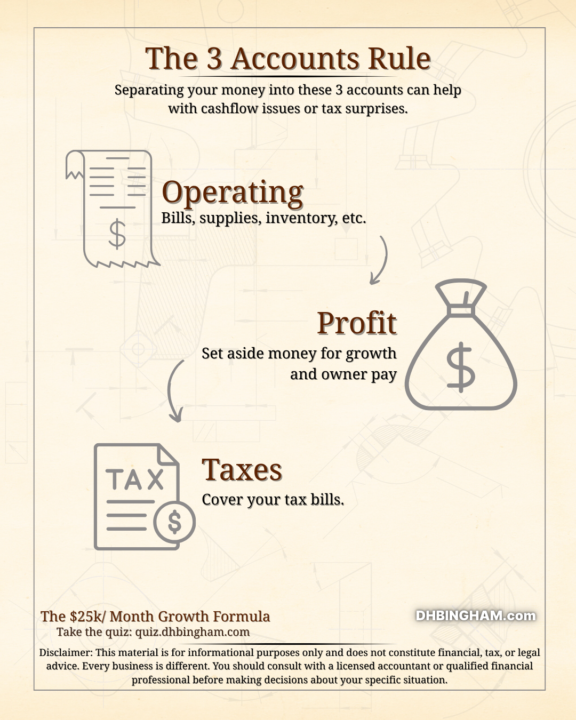
Here’s something I found in my digging into ways of dealing with cash flow issues: (and a little infographic to make it easy to remember.) When you separate your cash into different buckets, it forces discipline. I pulled this from Profit First by Mike Michalowicz and other resources. They teach that when money comes in, you allocate portions to different accounts before you spend it: profit, taxes, owner pay, operating. What the research says: The Profit First system flips the normal formula (Sales − Expenses = Profit) to Sales − Profit = Expenses. That means you take profit first, then run your business with what’s left. They recommend using multiple bank accounts (buckets) so you always know what portion of your cash is profit, what’s for taxes, what’s for you, what’s for bills. Typical starting allocation: maybe 5-10% of revenue goes into profit first, then a chunk for taxes, then your owner pay, the rest is operating expenses. As you grow, you adjust those percentages. Here’s what you can start doing today in your business to make sure you’re not bleeding money and so it can run WITHOUT YOU: 1. Set up three separate accounts at minimum: Operating (for bills, supplies, day-to-day) Profit (set aside a % of every deposit) Tax (to cover your quarterly or annual tax bills) 2. Decide your percentages (even rough ones): e.g. 5-10% to profit, 10-20% or more to tax depending on your situation, rest to operating and owner pay. Doesn’t have to be perfect at first. 3. Each time money comes in, immediately split it into those accounts before spending. Get in the habit like clockwork. 4. Over time, track your numbers. If you find profit account is empty or tax account is short, you’ll see exactly where you priced too low or spent too much. If you don’t separate the money, it’s too easy to spend what you think you have. You end up working crazy hours, worrying about bills, and you don’t build reserves. When you do this splitting, you build breathing room, reserves, and the ability to step away (for a day, for a week) without everything falling apart. That’s part of building your business without you.
0 likes • Sep 18
I’ve never thought about allocating expenses into different accounts. I like it
Aug 19 •
Today’s Quick Q: What's that ONE Task You Wish You Never Had to Do Again?
Your time is the most expensive resource in your business. What’s one task you’d love to never ever have to do again?
0 likes • Aug 19
That’s a hard question to answer. Maybe email marketing?
1-10 of 25

@kay-snarr-3214
I’m a PA, farmer wife, mama to 3, and lover of outdoor adventures and international travel. Goal is to own a multimillion dollar e-commerce brand.
Active 9h ago
Joined May 19, 2025
Idaho
Powered by