Activity
Mon
Wed
Fri
Sun
Jan
Feb
Mar
Apr
May
Jun
Jul
Aug
Sep
Oct
Nov
What is this?
Less
More
Memberships
Solar Operations Excellence
170 members • Free
5 contributions to Solar Operations Excellence

11d •
Grounding,Earthing ?!
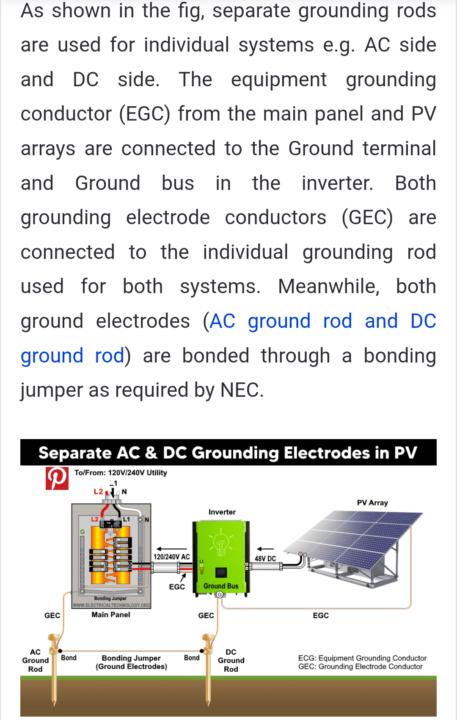
The Rights and Wrongs of Grounding The worst seen in France ( Single Earthing of each PV module ) UAE ,Pakistan ,Netherland (because they seperate Plus and Minus Cabling which means heavy EMF fields ) Ireland ( have No real concept and use Earth from Inverter in some Plants also for structure )is the separation of DC and AC Grounding but than bonding them again later On. I prefer a meshed Earthing approach ,best via a Single Earthing Point or Earthing Rod. The Earthing loop like in UK has also severe problems .....
2 likes • 10d
Interesting. What are the most effective methods to test the earthing system that you would recommend for utility scale PV for both safety and health of the equipment?

26d •
PV + BESS design and monitoring
Hello everyone, I think this is a long shot, but does anyone in this group work with DC coupled PV + BESS? We are interested in the PV + BESS design aspect, but also the operations and monitoring. For example: - What tools does the industry use for designing such systems? Is it a siloed process (e.g., PVsyst for PV and maybe an excel spreadsheet for the BESS) or are there any integrated tools out there? - What about the monitoring? Is that still siloed? - Separate KPIs? Thanks, Marios
3 likes • 25d
I have recently completely construction of an AC-couple large-scale hybrid PV-BESS in Germany, in which the BESS is planned to be charged exclusively from the PV. For the system-wide planning we used an in-house tool to optimize the PV-to-BESS ratio based on estimated PV generation using PVsyst, expected charging/discharge schedules based on long-term electricity price forecasting, among other technical parameters. This allowed us to define target PV and BESS specs. The actual design of the BESS configuration (i.e., number of battery containers, number of battery modules in series, number of DC buses, etc) was done in close contact with the supplier, excluding BoP works (i.e., cable sizing, earthing, etc.). The suppliers limited their scope clearly to their internal setup. For the monitoring, both PV and BESS are integrated into the same SCADA platform. I have heard about commercial software that can be used for the optimization of the BESS, but I am not sure they can handle the hybrid configuration with PV.
3 likes • 24d
@Marios Theristis yes, those are very valid points! We did consider them and approached suppliers to offer both DC- and AC-coupled solutions to assess them at the system level. Something important to remark is that out of top 7 suppliers we approached, only 2 (if I remember correctly) were willing to offer a DC-coupled solution. They were strongly shifting to AC-coupled solutions overall, which reduced the number of options for us. In terms of costs, the AC-coupled solutions offered were slightly cheaper than the DC-coupled but overall comparable. The project has very strict requirements of the energy capacity over its lifetime, and we passed this to the supplier in form of long-term performance guarantees. The AC-couple solution allowed the project to easily track the BESS performance independtly from the PV, while allocating the 2-year performance guarantee in the PV to other party. Besides, due to fire protection requirements, we were requested in the place near the BESS water tanks with a significant volume, whose cost was not insignificant. If we would have had the BESS distributed across se site, the total price for implementing this would have been increasin significantly. Finally, we wanted to leave the door open for being able to operate in the the future the BESS and PV separately to stack additional revenues streams, so the AC-coupled offered a more future-proofed alternative for the project. We did looked into the additional electrical losses, but they didn't have any major impact on the business case when compared against each other to make this a red flag for the AC-coupled solution.
3 likes • 26d
@Călin Sas yes, fully agree. I have seen this both during construction and operations of the plants, often due to excessive "trust" from personnel during repetitve tasks. I would also change the "trust me, everything will be fine" mentality of many contractors, when confronted about technical solutions. I feel there is a lack of technical thoroughness by certain important parties that can lead to unnecessary system inefficiencies, higher efforts and costs during operations or health and safety risks.
3 likes • 26d
Fully agree with the need of harmonization among all the phases. One factor playing a key role on this is ensuring that from the development phase the project is planned with a realistic timeline. Unreallistic or very aggressive timeliness at Development to extract additional points on the project business case are passed further to the EPC. This extra pressure on the EPC can lead to "compromises" on quality assurance, easy-ways around construction or the involvement of less skilled workers to "get the work done". Ultimately these issues are passed to Operations / Asset Management, who will need to deal with these issues. So for me, starting from a proper project planning at Development, and having strong contractual agreements with clear technical specifications provides a good basis to smoothen some common issues across these interfaces. Happy to hear what others would recommend on this 👌

27d •
Is overrating of solar modules a problem for O&M?
Overrating means that the actual power output of a solar module is lower than its rated value. Measurements by SecondSol and Fraunhofer CSP show deviations of up to three watts below the nominal power – officially mentioned in the power production tolerance, but in practice often systematically undercut due to price pressure. Have you already observed this issue in field?
3 likes • 27d
I have had only one of such a case in the past 10 years, in which the modules had in average ca. 2% less power than presented in its expected specifications. We commonly conduct pre-shipment factory tests, including flash tests to confirm early enough that the modules can deliver the expected power.
Nov 3 •
Leakage current
https://www.linkedin.com/posts/andreas-iliou-ab921b10_sustainabiliy-alternativeenergy-activity-7391022448957366272-H1B9?utm_source=share&utm_medium=member_android&rcm=ACoAAAIq-W0B9doX5ZyoUdW0LH1OIL-04-rauPY
1 like • 29d
@Călin Sas this is a very interesting topic indeed and agree that not many pay attention to this. What would be a right approach during commissioning? Taking measurements of the leakage current to draw a baseline for the operational phase of the project? Maybe adding a kind of soft pass/fail criteria based on suppliers recommendation for leakage current that can trigger further assessments if failed? The variability of the leakage current due to weather conditions and type of systems might complicate making this practical. I am looking forward to any practical tips for how to address this with larger Inverters (+200kW) under normal EU conditions.
1-5 of 5
@fredy-canizares-7251
Electrical engineer experienced in the design and construction of utility-scale solar PV plants.
Active 1d ago
Joined Oct 23, 2025
Berlin
Powered by