Activity
Mon
Wed
Fri
Sun
Aug
Sep
Oct
Nov
Dec
Jan
Feb
Mar
Apr
May
Jun
Jul
What is this?
Less
More
Memberships
Real Estate Investment Club
191 members • Free
Wholesaling Inner Circle
3.1k members • Free
Investor's Edge
26 members • $97/m
32 contributions to Real Estate Investment Club

Jun '25 •
What are your thoughts?
https://www.instagram.com/p/DLDS6tStEFb/?igsh=MWE5NDh3amVxdDZzMg==
2
0
1 like • Jun '25
Also, any agreements should be in writing, not just a handshake.

Jun '25 •
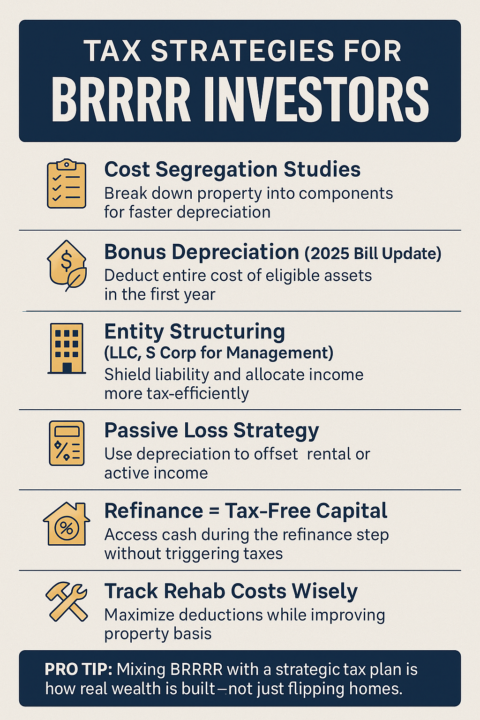
Top Tax Strategies for BRRRR Method!
When using the BRRRR method (Buy, Rehab, Rent, Refinance, Repeat) in real estate investing, smart tax strategies are key to maximizing cash flow, reducing taxable income, and protecting long-term wealth. Below are the top tax strategies BRRRR investors should implement: 🔑 1. Cost Segregation Studies Breaks down your property into components (e.g. appliances, flooring, lighting) so you can: - Depreciate non-structural elements over 5, 7, or 15 years (instead of 27.5) - Unlock larger depreciation deductions in year 1 (especially with bonus depreciation)✅ Result: Massive write-offs even with little cash in the deal after refinance 🔑 2. Bonus Depreciation (2025 Bill Update) If the proposed bill passes, 100% bonus depreciation would be extended again (effective for property placed in service after Jan 19, 2025). - This lets you deduct the entire cost of eligible assets (from cost seg studies) in the first year✅ Result: Offset rental income, active income (if qualified), or carry forward losses 🔑 3. Entity Structuring (LLC, S Corp for Management) Use proper legal entities to: - Shield liability - Allocate income more tax-efficiently - Separate rental income from management income for better planning✅ Result: Control over how income flows and is taxed 🔑 4. Passive Loss Strategy - If you qualify as a real estate professional, losses (including depreciation) can offset active income (W-2, 1099) - If not, losses may offset only passive income—but can still carry forward indefinitely✅ Result: Use depreciation to reduce or eliminate tax burden across portfolios 🔑 5. Refinance = Tax-Free Capital When you pull cash out during the refinance step: - It’s not taxable because it’s a loan—not income✅ Result: Access capital to repeat the process without triggering taxes 🔑 6. Track Rehab Costs Wisely Some rehab expenses can be: - Capitalized and depreciated - Expensed immediately (materials, labor not tied to permanent improvements)✅ Result: Maximize deductions where possible while improving basis for cost seg
2 likes • Jun '25
I'm sending this to myself so I can pull it up when I need it
1 like • Jun '25
Thank you @Jimmy Pauris
1-10 of 32

Active 99d ago
Joined Nov 28, 2024