Activity
Mon
Wed
Fri
Sun
Aug
Sep
Oct
Nov
Dec
Jan
Feb
Mar
Apr
May
Jun
Jul
What is this?
Less
More
Owned by Hilbert
You're capable You work hard But you're no longer sure where to focus — or what's still yours to carry Clarity. Direction. Action. At work and in life
Memberships
Skool Gameplan
2.1k members • Free
The Relationship Reset Lab
38 members • Free
LinkedIn Leads for Founders
545 members • Free
CLUES
230 members • Free
Synthesizer: Free Skool Growth
44.5k members • Free
CrewFusion HOP Academy
39 members • Free
11 contributions to CrewFusion HOP Academy

Apr 28 •
Catching up
Hey everyone 👋 I've been off the grid for a little while, and not by choice. Work has been loud. The kind of loud where you look up and realise it's been a fortnight since you did anything that wasn't urgent. I don't dig that at all. But it happens to all of us, doesn't it? The community, the posts and the Wednesday calls have taken a back seat. And if you noticed the silence, I appreciate your patience. Even when I wasn't showing up here, I was collecting things I wanted to bring back. A few moments that made me stop and think. So I'm here now, but before I dive into any of that, I'd love to hear from you first. What's been happening? Fill in the blank: In the last two weeks, I've been busy doing__________.

1 like • May 8
@David East In the last two weeks, I’ve been busy doing deep work with people and systems — less visible, more foundational.
Apr 7 •
New High Performance Modules Added
I've had some success tonight and added a few more modules to the High-Performance Teams package within the classroom. You'll find active listening, emotional intelligence and well-being packages that are an awesome baseline for building high-performance teams within your workplace. The added bonus of these skills is that they're really relatable within the family environment as well. I mean, who doesn't like an emotionally intelligent partner that actually listens to you? It's a win-win for everybody. Once again, if you're interested in looking into these modules, I'd be more than happy to offer free access to the first few people who put their hand up.
1 like • Apr 24
wow .. gladly everybody else is sleeping 🤣 I gladly put my hand up 🙌
Apr 4 •
New High Performance Classroom Package
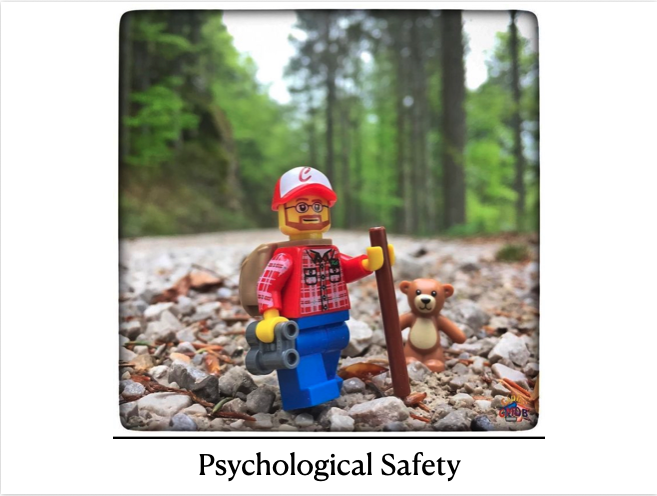
I’ve had a little bit of fun over the last couple of days putting together a high-performance training package in my classroom. What’s high-performance training about, I hear you ask? Well, in a nutshell, it’s just some ideas on how to behave within teams so that you get the best out of each other. I find it super interesting, and I get a massive thrill when teams take some of the ideas on and do really well as a result. A quick shout-out to @Daniel Halls . You mentioned you were putting your own high-performance stuff together, particularly around psychological safety. You inspired me to put what I had into my classroom. Now you can use what you need for your own course structure. I hope it helps you mate. It might at least point you in the right direction. I made this package up a couple of years ago when I was going through a Star Wars photography phase. The course is within my premium classroom. I’ll offer a free preview to 3 of you who are interested in taking a look.
1 like • Apr 4
@David East would like to have a free preview 😅
Apr 1 •
How Do We Call On A Visionary Mindset?
When something really incredible is happening, how do we call on a visionary mindset for our children? Artemis II is launching today. It’s a massive rocket launching four people on a mission to orbit the moon. It’s been 53 years since man has ventured beyond earth orbit and headed towards the moon. The whole world was watching back then. Well, they watched Apollo 11 land on the moon with Neil Armstrong. They became interested when Apollo 13 had a failure and the astronauts only barely made it back to earth. Following that no one really cared. So how do we get the children of today interested in such a visionary adventure? With the amount of noise out there and options of things to do and watch, it’s very easy to not even care what this actually really means. Or am I the only one that’s excited?

1 like • Apr 3
@David East I don’t think you’re the only one excited — but I do think excitement today competes with a lot more noise. For me, a visionary mindset for children doesn’t start with the rocket itself, but with the story behind it: - people daring to think long‑term, - to fail, - to persevere, - and to build something bigger than themselves. In work and in life, I see the same challenge. If everything is instant, comfortable, and entertaining, curiosity fades. Vision comes back when adults model wonder, patience, and purpose, and when we connect big achievements to human values: courage, teamwork, responsibility. Moments like this are invitations — not just to watch history happen, but to talk with our children about why it matters.
Mar 29 •
The Potomac Collision (systemic silence)
One of my roles within Defence is HF/ NTS facilitator (Human Factors / Non-Technical Skills). It means working with aircrew, maintenance, ATC and support agencies to understand the human nature behind serious accidents. I'll share some with you. I hope the tone isn't too dark. Nobody crashes a plane with one mistake. In the Potomac collision, an American Airlines passenger aircraft and a US Army Blackhawk helicopter crashed into each other, resulting in 67 fatalities. The airliner was on final approach to land at Reagan International Airport, a stone's throw from the White House. The helicopter was on a military training flight. The NTSB didn't find a cause. They found a chain. A faulty altimeter. Separate radio frequencies. A controller managing two jobs at once. A missed instruction. A course correction that didn't happen. A helicopter route that left 75 feet between military and civilian aircraft on final approach. Seventy-five feet. In the busiest airspace in the world. Here's what makes this so hard to catch in real time. Each of those factors, assessed on its own, looks manageable. They sit comfortably below the line. None of them a showstopper. Together, they bulk up as aggregate risk: the point where individually acceptable conditions stack into collectively catastrophic ones. The risk isn't in the single piece. It's in the accumulation. And the accumulation happens quietly. Nobody sounds the alarm because at each step, nothing looks alarming. The system appears to be coping. Work is getting done. The checks are passing. "We've always done it this way." "It'll be right." "No one said anything last time." That's not reassurance. That's a whole lot of aggregate risk building. The question isn't whether your workplace has these stacking conditions. I can assure you, it does. Every workplace does. The question is whether anyone is trained to see the pattern forming. To look across the whole picture, not just their piece of it. Human Factors gives you that view. Throwing a HOP lens over the top gives you that view. They’re not just courses you attend. They’re a way of looking at the world that makes you dangerous to complacency.

1 like • Mar 30
@David East What you describe is something I recognise completely. Major incidents almost never come from one mistake; they come from silent accumulation. And that’s not just aviation — every operational environment works the same. I often use the 1‑degree example to make it practical: A one‑degree deviation on the runway is nothing. Nobody sees it. But over 10,000 km, that same one degree puts you in a completely different country. Not because of one dramatic error, But because a small deviation stayed uncorrected for a long time. It’s the same with organisations: - small shortcuts - small assumptions - small gaps in communication - small “it’ll be fine” moments Each one is harmless on its own. Stack them, and you have a problem. Human factors and Human & organisation performance help you see exactly that: - Not the individual moment, but the pattern underneath it. And that’s what I see in my own work as well. Professionals get significantly stronger once they stop looking only at their individual task and start recognising system behaviour — how their actions interact with the bigger picture. That shift creates safer operations, better decisions, and stronger leadership. It’s the foundation of real professional growth. How do you apply this in your own environment? Where do you correct that 1‑degree deviation before it becomes a different destination? Where do habits replace awareness? I’m curious how you see it in your world.
1-10 of 11
@hilbert-monsuur-2988
An experienced manager known for his hands‑on leadership style and deep commitment to operational excellence.
Active 25d ago
Joined Mar 9, 2026
ISTJ
Belgium