Activity
Mon
Wed
Fri
Sun
Aug
Sep
Oct
Nov
Dec
Jan
Feb
Mar
Apr
May
Jun
Jul
What is this?
Less
More
Owned by Jacob
The home for Claude Architects, aspiring architects — and everyone building with Claude.
Memberships
Skoolers
164.9k members • Free
71 contributions to Anthropic Claude Architects

31m •
07/15 Question of the Day
A Multi-Agent Research team wonders whether SDK applications can run Claude Code in a server with concurrent client requests. Which characterization is MOST accurate? A. Yes, applications can run multiple SDK sessions concurrently, but must manage isolation, throttling, and resource usage B. SDK sessions are single-threaded per process, so a server can only ever run one Claude Code session at a time within a given application instance C. The SDK forbids server deployments outright, so exposing Claude Code to concurrent external clients through a web service is not a supported use case D. All concurrent sessions share one common context window, so requests from different clients end up reading and writing the same accumulated history Drop your answer (A / B / C / D) in the comments 👇 I'll reveal the correct answer and the why tomorrow.

21h •
07/14 Question of the Day
A Code Generation orchestrator delegates to a tests-subagent and a refactor-subagent. Each subagent owns a focused tool set. The orchestrator also has a read_file tool registered. Which is the BEST description content for read_file at the orchestrator level? A. 'Reads any file path.', keep it minimal and let the orchestrator freely decide when to read and when to delegate on its own B. 'Reads any file path. Use for general inspection; for test-related reads delegate to tests_subagent, for refactor-related reads delegate to refactor_subagent' C. Remove read_file from the orchestrator entirely, only subagents should have file access D. 'Reads any file path. Always prefer this over delegating', keep the read work in the orchestrator for low latency, since calling the file tool directly avoids the round-trip cost of dispatching to a subagent for every inspection Drop your answer (A / B / C / D) in the comments 👇 I'll reveal the correct answer and the why tomorrow.

0 likes • 32m
✅ Answer: B When an orchestrator shares a tool with its subagents, the orchestrator-level description should explicitly route subdomain uses to the appropriate subagent. This keeps the partitioning boundary visible to the routing layer and prevents the orchestrator from absorbing work that should be delegated.
2d •
07/13 Question of the Day
A Customer Support Agent team is asked to implement password resets. The flow is verify-identity, generate-token, send-email, always in that order. Which architectural class fits BEST? A. A multi-agent system with one agent per step B. An agent because password resets fundamentally involve security-sensitive runtime decisions to make C. A conversational system that asks the user step-by-step D. A deterministic workflow because the three steps are fixed and ordered Drop your answer (A / B / C / D) in the comments 👇 I'll reveal the correct answer and the why tomorrow.

2 likes • 2d
I see what you diD there...
1 like • 21h
✅ Answer: D Fixed-sequence operational flows — verify, generate, send — fit the workflow class. Security sensitivity, user interaction patterns, and step count do not push the architecture toward agentic or multi-agent when the sequence is predetermined.
3d •
07/12 Question of the Day
A Data Extraction parent agent must map an unfamiliar 600-table warehouse before generating queries. Probing each table's schema floods the parent's context with verbose DDL it will never reuse, yet auditors later require proof of which columns informed each query. Which design keeps the parent lean while preserving an auditable record? A. Have the parent probe every table itself and retain all raw DDL in context. B. Delegate probing to a subagent but have it return the complete DDL for every probed table to the parent. C. Delegate probing to a subagent that returns only relevant columns and writes the inspected DDL to a scratchpad file. D. Skip the subagent and let the parent compact its history when the DDL no longer fits. Drop your answer (A / B / C / D) in the comments 👇 I'll reveal the correct answer and the why tomorrow.
3 likes • 3d
You may have noticed that the QOTD hasn't been quite as consistent on timing. My process failed and I have had to post these when I have time instead of posting staged questions. Should be back to a consistent daily release in about a week.
1 like • 2d
✅ Answer: C A subagent absorbs verbose discovery in its own context and returns only the distilled result, keeping the parent lean, while a scratchpad file preserves the full inspected detail as an auditable claim-to-source record. Probing in the parent floods context; returning full output or compacting destroys either leanness or provenance.
3d •
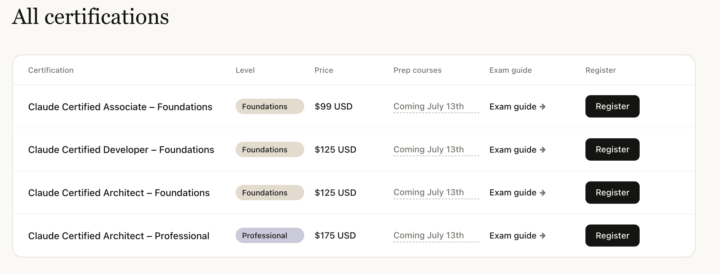
Which new Anthropic cert will you go for?
Of the Anthropic certifications that were just released, which are you most interested in earning?
Poll
28 members have voted
0
0
1-10 of 71

@jacob-bushong-5234
Instructor promoting deep learning in AI, Agentic Solutions, and IT Security Certifications
Online now
Joined May 25, 2026
United States
Powered by