Activity
Mon
Wed
Fri
Sun
Aug
Sep
Oct
Nov
Dec
Jan
Feb
Mar
Apr
May
Jun
What is this?
Less
More
Memberships
Million Dollar Knockers
776 members • Free
Clief Notes
40.9k members • Free
8 contributions to Clief Notes

4d •
Building out my first real ICM use case for someone else - starting close to home.
My mum works in corporate America and is stretched thin. Spreadsheet analysis she has to run manually, a constant pile of emails to draft, life admin on top. She also maps out her processes with mind maps and flowcharts already - the raw material for a second brain is there. The use cases are obvious. She just needs the cognitive load cut. The plan is to wrap her an ICM system she can actually use - one interface on her Claude Enterprise subscription, so she doesn't have to think about what's underneath. I'm 18, built this for myself, and I'm starting to look at consulting for local businesses. This is the first test of translating what I know into something that works for someone else. The scoping process I'll sit with Claude and design the approach. What I'm after is the specific stuff: what would you actually tell someone [me] doing this for the first time with a non-technical user who's already process-minded?

1 like • 21h
Hey Alex lets connect
1d •
My ICM Folders + Loops + AI Infrastructure - Video Walkthrough
Everyone building agents hits the same wall: the system only really exists inside a context window, and the moment that window rolls over you rebuild it from scratch in a fresh chat. So I moved the entire system state onto disk and built a loop that keeps it consistent. The maps layer is the part I would point at first. Five product maps plus a workflow map, every line anchored to a path-and-line citation. A job never mutates a map. It emits a structured flag, and a separate interactive pass re-verifies that flag against the live tree before it is promoted to a map line. Isolating that verification is what stops the maps drifting into the exact thing they exist to catch. The payoff is a queryable index over the whole system that I actually trust, and that trust is most of the sanity. The loop runs on two clocks. A deterministic kickoff fires once per task: registers the active worker, regenerates the tree, assembles its context. Zero model judgement, identical every run. Independently, a continuous harvest loop runs on a thirty-minute cycle, routing each job's record into the right surface, retiring finished workers, and flagging where a folder's own contract came up thin. Those surfaces are flat markdown, and that is the point. LIVE_STATE.md is the active set. ISSUES.md, PENDING_MAP_UPDATES.md and CONTEXT_FEEDBACK.md sit alongside it, each a single-writer file with one job, committed and fully diffable. Every executor reads the folder map before it touches anything, so it grounds its working set and writes to the right path instead of inferring one. It only works because the loop can read its own state back on every pass, and that state is the filesystem, not a window that forgets. Full video walkthrough below. How have you all layered on top of your ICM setups? Curious what you've added, what extra routers or surfaces you run, anything specific to your own structure you think is worth sharing.
2 likes • 21h
Incredible content, the bees analogy is a great way to frame it and it really clicked for me. Would love a deeper look at how the loop itself is structured, and the reasoning. The screen setup walkthrough is brilliant too, it really illustrates how you're orchestrating everything like the conductor of the Claude choir ! haha😃

4d •
Your ICM works. So why is it getting expensive to run?
Quick recap, because this is "part 3" following @Bas Rosario 'cake' post and my first follow up. Thank you @Brendan Tucek. Your post is what got me thinking about this 3rd part. Bas taught us to break the cake into ordered steps, one instruction per folder. My follow up post zoomed in on the step that checks the cake — the toothpick, the gate. This one is about the part nobody warns you about until it shows up on the bill: cost. Here's the symptom. Someone in here recently posted a folder system that genuinely works, doing real work in their business, and then admitted the part most people don't: it burns a lot of tokens just figuring out where to look. 🪙 If you've built anything past a toy, you've felt this. The structure is fine. It's getting slow and expensive anyway. 💸 Here's where it comes from. In most ICM setups there's one file the AI reads before every single task. The map. The "you are here" file. Every word in it gets paid for on every interaction, whether the task needed it or not. And that file has a way of growing. You add a rule, then a note, then the whole folder tree, then some history, and one day your always-open page is a 3,000-word document. Now the model re-reads a small book before it cracks the first egg. Every time. 🥚 The fix is the oldest trick in any real kitchen: 'mise en place'. 🧑🍳 You don'tdrag the whole pantry onto the counter to make one cake. You bring out what this step needs, and everything else stays in the cupboard until it's called. For your folders, that means the always-loaded file is an index, not the recipe. It points. "Buyers live here. Follow-ups here. Voice guide here." 📇 One glance, then jump. The actual detail lives down in the step folder that only opens when the AI is standing in it. Whoever needs the frosting technique walks to the frosting folder. They don't carry the frosting instructions around all day in case it comes up. So the through-line of all three posts is one discipline pointed at three different things.
3 likes • 4d
wow this is great! Thanks for sharing, currently now trying to decifer what I can cut and move into folders + routers 😶🌫️ I need a vivance
1 like • 3d
@Alex Brown holy smokes thank you!

4d •
Video Generation Workflow 🎬
👋For the last 2 months, I've been heads-down exploring ai image & video generation as my new personal project. I was shock by the capabilities of current ai image/video space. But every ai creators face a common pain point.. this sh*t is hard. Haha. Thats why all youre seeing are ai slops. Then about 1 month ago, I sent the kids to my relative for few weeks and lock myself in a room and went nerd out to build a tool that lets me take an idea and turn it into a profession cinematic video. I recorded it working on a real project and wanted to share what it actually does — and why I'm pouring everything into it. The idea in a nutshell: Instead of guessing what makes a video great, my tool studies one: → I give it an original video as a study case (here's the one I used: [youtube]) → It analyzes that video and pulls out its DNA — the small details in every component that make it work: the shots, the pacing, the sound, the transitions, the feel. → Then it reverse-engineers that DNA into something completely new and my own — and carries it all the way through, even into the editing, mostly automatically. The Unfolded short film bellow received the same DNA treatment, as you will see, the context is similar ..however, it produced a very unique animation perspective using origami. Every user who analyzes a film makes the library richer for the next one. That's a network effect — the rare thing that actually compounds. GitHub for film DNA: fork a look, make it yours, push it back. I have tried to use it to branch off ideas from Game of Thrones series. It is very complex to keep track of all the different kingdoms, characters, props, and story development. But i think i got it figured out. Theres no one size fit all approach for different type of contents. Horror dna cant get mix up with cartoon 😂. But this is the closest thing to a “reusable” end to end video generation. Correct me if im wrong but there isnt a product out there that can solve this yet. This is a foundation to a full content creation pipeline - you re using a proven video as a reference for your own video. Once you figured out your winning format, automate it to create video daily/weekly is the easy part.
1 like • 4d
UNREAL!!!! Can i be your test dummy, Ive got some clips
1 like • 4d
@Danney Trieu dont give it for free! I can share my clips in a folder
5d •
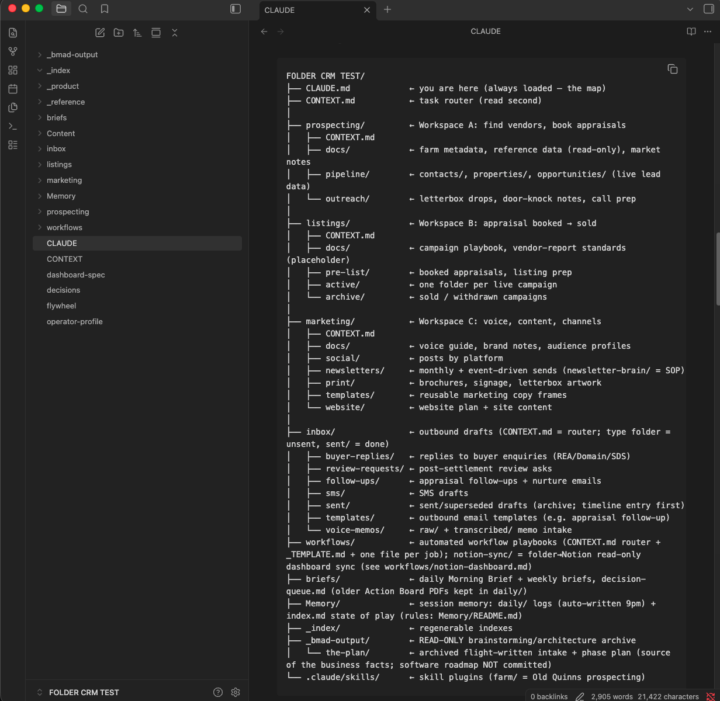
Real Estate Agent - Local Folder ICM CRM
For many years, there's been so many CRMs for real estate agents, but what I've found is it's only as good as you use it. Because real estate agents are so reactive and proactive, there isn't enough time to update the CRM yourself (well, there is, but you can use your time better elsewhere) so, from my learnings, I've tried to make an internal CRM using Claude and the ICM folder structure. I've been building this over about two months. I just had my PB month of listings, 8 listings! previous 5 PB. The thing I found most helpful is that Claude would find leaks in leads, and give suggestions on who of my buyers could be a seller. Claude obviously has a better memory than I do and can remember who I should be following up with and who I spoke to. The current stack is Claude + Plaud (Ai note taker) and just getting into Hermes. Plaude would note take conversations in home opens and on phone calls, I've set up an N8N automation that would mirror the transcription and put it into my folder structure, and Claude would transcribe it and place things where they need to, buyers / addresses / follow ups ect. As much as it's helpful, I feel like I need to give an ICM folder update, tend to use a lot of tokens to figure out what im saying and where to look. Maybe I need more Routers / folders within? Would love some suggestions from the community on where they think I could improve, enhance, or streamline the folder structure. PS. Anyone a Hermes lord? Would love some help on how I can best utilise as my robot arm. Love from Australia!!🇦🇺
0 likes • 4d
@Danney Trieu wow wtf this is premo - great stuff!
0 likes • 4d
@Danney Trieu impressed
1-8 of 8

Active 9h ago
Joined Apr 6, 2026
ENFP
Powered by