Activity
Mon
Wed
Fri
Sun
Feb
Mar
Apr
May
Jun
Jul
Aug
Sep
Oct
Nov
Dec
Jan
What is this?
Less
More
Owned by Mischa
Join KubeCraft to go from Stuck to Hired ♾️ Upskill with job-ready projects, expert coaching and a proven system to land 6-figure roles.
Memberships
295 contributions to KubeCraft (Free)

👑
⭐
11d •
FREE Live Event This Week! Sign up NOW [Limited Spots]
Hello friends! This Wednesday I'm hosting a FREE live event where I'm going to share the latest strategies to land DevOps jobs based on the latest market data. There are only 50 spots left so you have to go and register RIGHT NOW if you want to join: CLICK HERE TO SIGN UP (FREE) How to Land a DevOps Job in 2026 5 years ago, I went from nurse to DevOps engineer in less than a year. No CS degree, no bootcamp, no insider connections. Now I make multiple six-figures a year and work fully remote. In this live session, I'll show you why 2026 might be your best window to make this move, and why your background (whatever it is) could actually be your edge. What we'll cover: Why DevOps in 2026. Remote work, real autonomy, and salaries that change your life. I'll share the actual market data. What companies are hiring for. It's not another certification. I'll show you what actually matters. The portfolio-first approach. How a homelab beats a resume, whether you're starting fresh or leveling up. Why you can do this. Some people make this shift in weeks, others in months. I'll show you what separates them. You'll leave knowing not just how to break in, but believing you actually can. Can't make it live? Register anyway for the replay. CLICK HERE TO SIGN UP (FREE)
![FREE Live Event This Week! Sign up NOW [Limited Spots]](https://assets.skool.com/f/159c2bc77db2417caba992421643ccae/ec8854f2410f429d97d542120bb8db7ed5e9c4ce0a3540b9988df7b3d6bab6b8-md.png)
👑
⭐
22d •
How To Land A DevOps Job in 2026
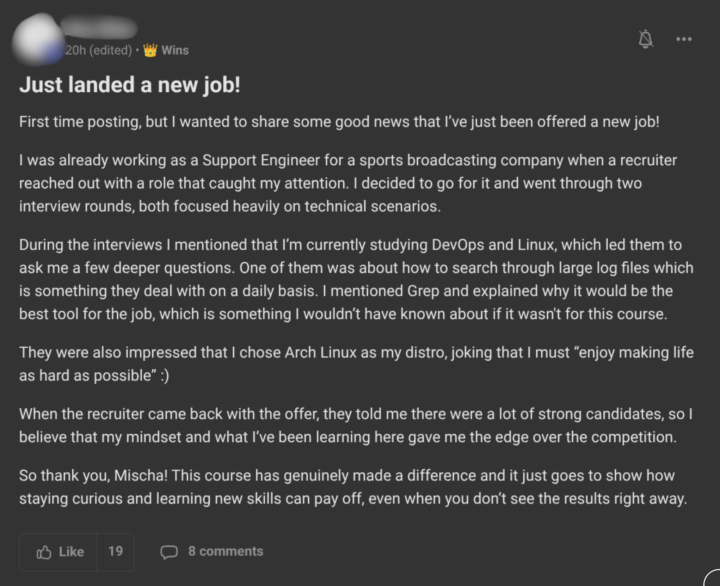
Dear KubeCrafters, Happy New Year! Let’s make 2026 the year you land that job. One of my students did it yesterday. No CS degree. No DevOps experience. Just the right skills at the right time. Full post attached to this post! 2026 is going to be one of the most interesting years in tech so far. AI is booming, and I’m being asked for contracts I don’t have time to take. Instead, I focus on helping people achieve the same result: making multiple six-figures a year and not needing to apply for jobs anymore. For the past 2 months I’ve been spending an outrageous amount of time researching the current DevOps market. I know exactly what’s going on, what trends are booming, and which tools are going to crush it this year. I compiled this into a complete game plan for landing DevOps jobs in 2026. And I’m going to give it to you for free. I’m presenting this complete game plan during an exclusive live event on January 14th. There are only 100 spots available for this FREE event, and as a member of this community you’re the first to know about it. I have a few extra gifts to give away at this event too. You don’t want to miss this. >>> Click here to reserve your right now <<< See you there! Mischa P.S. If you can’t make it on that day or time, register anyway. I’ll send the recordings after the event. CLICK HERE to claim your spot before they run out!
👑
⭐
7 likes • 21d
@Diego Santos Yes it is definitely possible. DevOps is practiced all over the world, also in your native language. English isn't my first language either!
👑
⭐
25d •
What to expect in 2026
Sunday, Dec 28 05:30:09 AM CET 2025 2025 has gone by so fast. It was the first year where I had 0 income from being an employee. All of the money I’ve made in 2025 has come from my own businesses, and it feels amazing. And I want as many people as possible to experience the same. This will be my guiding light for the next year. In this newsletter I will share my plans for what is coming, and I think you will like it. I’m going to help a lot of people for free. Autonomy Many of you have heard me talk about the importance of autonomy in my recent video called “Why I Refuse to Use Windows”. That video has received 85.000 views at the time of writing of this email. Eighty five thousand people have spent a few minutes watching me talk about Linux and the importance of autonomy in life. Some of those people watched the video from beginning to end. And they commented. These comments have had a profound effect on me. You see, when I made this video, I had no expectation that this would get so much attention. I had no idea that it would resonate on a deep level with so many people. In that video I wanted to do something different from what I’ve been doing so far. I wanted to share more of the WHY behind everything that I do. The results surprised me. The comments I received on this video were of a completely different nature. People sharing their stories and expressing their deep appreciation for what I was teaching them. Several people made the commitment to become a DevOps engineer and joined KubeCraft after watching that video. It became clear to me that I had more to give to the world than Kubernetes tutorials. The Sovereign Craftsman On January 1st 2025 my YouTube channel had 32.000 subscribers. As I write this, I have 72.000 subscribers. That means I have more than doubled my subs, and I’m getting close to 100K subscribers. When I combine the counts from all platforms, I now have 115.000 followers.
👑
⭐
8 likes • 25d
@Kelvin Perez thanks , fixed https://mischavandenburg.com/zet/the-sovereign-craftsman/
👑
⭐
Dec '25 •
The Skill That Separates $50K Admins From $200K Engineers
I’ve interviewed DevOps candidates who couldn’t rename 30 files at once. They had AWS certifications. They had Kubernetes experience. They had years on their resume. But when I asked them to automate a simple task without Google, they froze. Here’s the truth most people won’t tell you: Many "DevOps engineers" today are just professional button clickers. They know where the buttons are in the AWS console. They can copy-paste commands from Stack Overflow. But they don't know how to use Bash properly. They are not able to write shell scripts. This single weakness is keeping them stuck at $80K while others make $200K doing the same job title. You Are Using Your Computer Wrong Think about how you interact with your computer right now. You point. You click. You drag. You drop. You repeat the same 47-step process every time you need to do something. Computers were invented to free humans from repetitive labor. Instead, we’ve turned them into elaborate pointing-and-clicking machines. Every time you click something, you’re doing a computer’s job for it. Every time you manually repeat a task, you’re trading your time for laziness. Every time you can’t automate something, you reveal a fundamental gap in your skill set. And hiring managers see it immediately. The Power That Cannot Be Faked When I was a Junior DevOps Engineer, I watched a senior solve in 10 seconds what took me 2 hours. He didn’t install a special tool. He didn’t use a fancy GUI application. He typed a single line of bash. My jaw dropped. I asked him immediately if he could teach me. That moment changed my career. The command line provides capabilities that no graphical interface can match. Rename 500 files based on patterns? One line. Find every log file containing a specific error across 20 servers? One line. Transform data, filter it, and pipe it to another tool? One line. Automate a deployment that takes 45 minutes by hand? One script. This kind of power cannot be replicated in a GUI. Ever. Once you experience it, you can never go back to clicking.
👑
⭐
Dec '25 •
This Is Why Real DevOps Skills Beat Tutorials Every Time
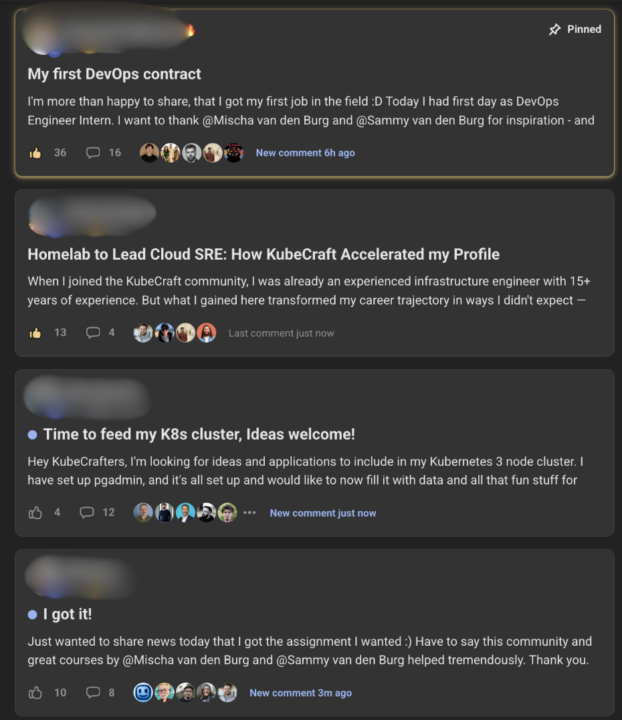
In a single day 3 KubeCraft Career Accelerator members shared landing roles. From Junior all the way to Lead SRE. Here's what they had in common so you can learn from it: - None of them relied on watching tutorials, asking ChatGPT for quick answers, or copying examples. - They built real environments. Real clusters. Real problems to fix. - When interviewers asked about Kubernetes troubleshooting or GitOps workflows, they didn’t speak in theory. They walked through actual incidents from their own setups. What broke. Why it broke. How they fixed it. - They knew in advance what would happen, how it would go and what to respond. - They followed a proven, system-backed structure. This cuts results to weeks instead of years of confusion and stress. The same mindset you use in production is the one you develop when you’re building your own systems from scratch. One member said: “The homelab helped me land interviews, but the lifestyle of constant improvement is what changed me.” Some people think the homelab is 'just' for the resume.. It’s not. It rewires how you think. A way of thinking thats actually valued by the job market. For those who missed it, Here's how you can build a Kubernetes Homelab in 30 minutes: https://youtu.be/NkM6wQL2UvM Want to ride the next hiring wave coming up next month? We have 4 spots left for this month. You can apply at www.kubecraft.dev
1-10 of 295

👑
⭐
@mischa
I help people land six figure DevOps jobs with a proven system. Owner of KubeCraft.
Active 4h ago
Joined May 8, 2024
INTJ
Powered by