Activity
Mon
Wed
Fri
Sun
Nov
Dec
Jan
Feb
Mar
Apr
May
Jun
Jul
Aug
Sep
Oct
What is this?
Less
More
Owned by Sarah
Oils, Wellness and Motherhood. Essential oil support for women. Taking control of your health naturally to build a strong, resilient family.
The Skool Psychologist
28
$3/m
🎮 OnlyLANs Gaming Group
165
5.0
$7/m
Mrs. Sourdough University
675
Free
Soulfully Authentic
164
5.0
Free
NewTubers YouTube Skool
220
$7/m
Connected Through Play
316
Free
Constant Clients Club
166
Free
Spiritual Awakening Academy™
976
5.0
Free
5 contributions to Connected Through Play

🔥
Apr 4 •
The Bouncy Egg Lab
Are you ready? In today’s play prompt we are going to make an egg "bounce" without breaking it. Gather Your Gear: One raw egg, a tall glass, and enough white vinegar to cover the egg. Note: Inspect the egg, you don’t want any cracks. Get Started: 1. Place the raw egg in the glass and pour vinegar over it until it's completely submerged. 2. Ask your kids if they notice tiny bubbles forming. This usually happens right away. Then you can ask, I wonder what those bubbles are made of? (Hint: It’s Carbon Dioxide!) 3. This is "Long-Game Play." Leave the egg for 24–48 hours. 4. Gently rinse the egg under cool water. The shell will be gone, leaving a translucent, rubbery egg. The Twist: The "Glow Test." Take your "naked" egg into a dark room and shine a flashlight through it. You can see the yolk floating inside like a little planet. Options for Older Kids: For Ages 12–14: The Osmosis Audit Once the shell is gone, place the "naked" egg in a glass of corn syrup or very salty water for 24 hours. The egg will "shrivel." Then place it in plain water. It will "plump" back up. Ask: "How does the egg 'decide' to move water in and out?" (This is the foundation of cellular biology!) For Ages 15–17: The Pressure Point Test Before the egg "bounces," have them research how much weight a regular eggshell can actually hold if the pressure is distributed evenly. Challenge them to see if they can balance a book on four upright eggs. Discuss how "structure" changes everything. Your Turn Did your egg survive the "Bouncy Test"? How many bubbles did you see in the first 5 minutes?


2 likes • May 20
@Mary Nunaley he said "yes! Definitely!" 😁 We like 'science experiments'. And I like them when they don't require too many ingredients lol. Ooh is that in here somewhere? I'll have to look for it
1 like • May 20
@Mary Nunaley awesome! Thank you
May 17 •
An hour of fun
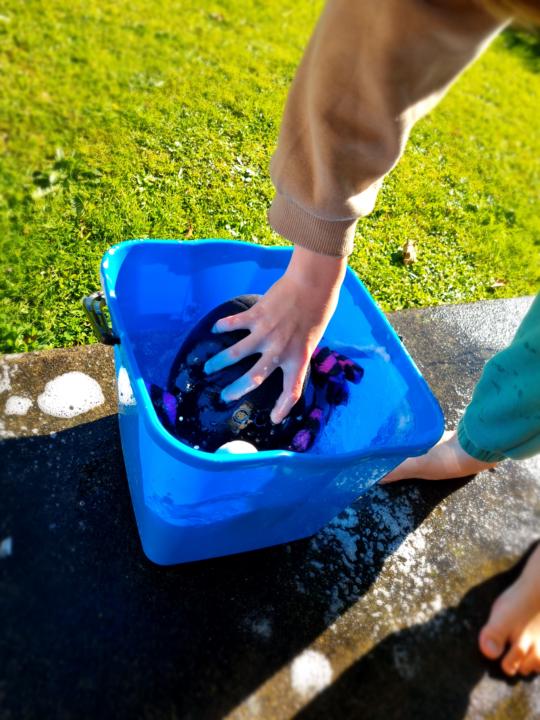
My son threw one of his toys the other day and it landed in a bowl of icecream. Toys landing in things they shouldn't happens a lot in our house as we have a very small house😂 ADHD and tiny spaces don't mix well😆 Because I had gotten tired of washing his toys each time this happened I came up with a great idea😁 I got him to do it himself! (I use a natural laundry detergent that is safe for him to have his hands in.) I set him up outside and he spent a whole hour 'washing' his toy spider🥳🕷
0
0
🔥
May 12 •
Shifting Focus: Movement vs Screen Time
As I spend more time with a toddler, I’ve been thinking a lot about how to interpret his cues. What I’m noticing is a lot of what looks like “bad behavior” is actually a movement need. The next time you’re near a toddler, just watch them, they are constant motion machines. As kids grow, go to school, have more structured lives, I think we forget that they are not designed to sit still for long stretches of time while their brains quietly absorb information all day. Their nervous systems are built for motion, sensory input, exploration, risk-testing, and physical interaction with the world around them and sometimes when kids seem loud, wiggly, emotional, distracted, or completely unable to focus, what they actually need is movement. Not punishment. Not another lecture. Not another educational activity. Movement. Research in child development and occupational therapy consistently shows connections between movement, attention, emotional regulation, and learning. Physical play activates systems in the brain connected to focus, memory, coordination, and self-regulation. Stuart Brown’s work on play even points to movement play as one of the foundations for social and emotional development. And honestly, most of us have felt this ourselves too. You know that feeling after sitting too long at a desk when your brain turns to soup? Kids hit that wall much faster than adults do. The tricky part is that movement needs often show up right before adults are least able to handle them. - Right before dinner. - During bad weather. - When you are tired. - When the house already feels chaotic. That’s usually the moment a child starts jumping off furniture, spinning in circles, wrestling the dog, or turning the hallway into a racetrack. Instead of seeing that moment as “everything is falling apart,” I encourage you to start asking: “What is the body asking for right now?” Sometimes five or ten minutes of purposeful movement changes the entire emotional temperature of the house. Not because kids suddenly become perfectly calm little robots.But because their nervous systems finally got what they were asking for.
1 like • May 15
@Mary Nunaley thank you🙂
1 like • May 15
@Mary Nunaley 🥰 that's such a special thing to say
🔥
May 15 •
My Child is Bored- Now What?
I’m in a reflective mood this morning and as I’ve been prepping for our upcoming “The Playful Shift” coffee chat Sunday, I’ve been doing more research. Here’s some of my thoughts, I’d love to hear yours. There is a phrase I hear from parents all the time when I’m working at vendor or school events: “My child is always bored.” Usually what follows is a list of frustrations. They have toys. They have books. They have art supplies. They have options. Yet somehow, ten minutes into a free afternoon, they are back in the kitchen announcing that there is “nothing to do.” For a long time, I believed that boredom meant a child needed more stimulation. More activities. More ideas. More enrichment. I watched as my friends and I became activity coordinators without even realizing it. We stepped into the role because we loved our children and genuinely wanted to help. None of us enjoys watching a child wander around unhappy and restless. The more I have observed families, though, the more I wonder if we sometimes misunderstand what children are actually asking for. I don’t think boredom is always a request for entertainment. I think, at least some of the time, it is a request for participation. Modern childhood has changed in ways we do not always notice. Kids today often spend much of their time moving between experiences designed for them. They attend activities created around their interests. They consume media tailored to their age. They are offered entertainment at a pace no previous generation experienced. Yet despite having access to more stimulation than ever before, many families still describe their children as disconnected, restless, or unsatisfied. There is an interesting tension there. Psychologists Edward Deci and Richard Ryan spent decades studying motivation and human behavior. Their work suggests that people thrive when three needs are present: connection, competence, and autonomy. We want to feel close to others, capable of meaningful action, and trusted with real ownership over parts of our lives. Those needs do not suddenly appear in adulthood. Children need them too.

2 likes • May 15
Yes! I often think that when my son is saying he is bored it is usually that he is looking for connection (sometimes it's just an 'excuse' he tries on to see if I'll give in to more screen time.) But more often then not he is looking for connection. Sometimes i'll invite him to join in with what I'm doing, or sometimes we will play a game of some sort. Usually after that, he is quite happy to go off and do his own thing for a while
🔥
May 14 •
Poll: What Household Object Has Taken on New Importance
What random object has become weirdly important in your house lately? Not the expensive thing. Not the thing you carefully researched. The completely random thing your kid decided was suddenly the center of their universe. I’ve been spending a fair bit of time with my grandson and I’d say tissue paper is currently high on the list. However, when my kids were younger, it would have been cardboard boxes. I’m convinced kids (and let’s be real, cats) see a cardboard box and immediately think: “Yes. This has potential.” What about your house? Drop your answer because honestly, these comments are usually the best parenting reality check on the internet. PS: Want to see how these at tie together? Join the Playful Shift, live on Sunday. Time and link in the calendar.
Poll
8 members have voted
1 like • May 15
@Mary Nunaley a Knerf Knight! Oh i love this term. I'll have to tell him about it. He basically has. And his armor works very well🙂
1 like • May 15
@Mary Nunaley it could be! One that he may even enjoy writing 🤔
1-5 of 5

@sarah-cooper-5887
Former Pharmacy Professional turned Holistic Health Advocate. Empowering women to take control of their health naturally to build resilient families
Active 29d ago
Joined May 15, 2026
INFP
Powered by