Activity
Mon
Wed
Fri
Sun
Sep
Oct
Nov
Dec
Jan
Feb
Mar
Apr
May
Jun
Jul
Aug
What is this?
Less
More
8 contributions to Connected Through Play
🔥
May 11 •
Why Boredom is Good for You!
There’s a moment you probably know well. Your kid walks into the room and says, “I’m boooored.” And almost instantly, you feel pressure to solve it. This week’s Playful Shift will be all about boredom, the science, some strategies, and more. Check the calendar for details. When I was growing up, I quickly learned saying, “I’m bored” usually meant “here come some chores!” So, growing up in an era where self-entertainment was key, I discovered how to keep boredom at bay. Today, the pendulum has shifted, maybe those of us who lived through the “bored = chores era” thought we were being helpful. Can you relate? We answer the cry by suggesting activities, or we offer screens. Maybe we throw out craft ideas. We mentally scroll through every possible option trying to “fix” the boredom before it turns into whining, fighting, or chaos. Raise your hand if you can relate. 🙋🏻♀️ But here’s the thing I’ve been re-learning. Boredom is often the space right before creativity wakes up. Researchers studying the brain’s “default mode network” have found that when the brain is not locked onto a task or flooded with stimulation, it starts connecting ideas, replaying experiences, imagining possibilities, and building internal narratives. In simpler terms, the brain starts wandering on purpose. That wandering matters. Let me say that again, the wandering matters! It’s where pretend games are born. It’s where inventions begin. It’s where kids suddenly decide to build a fort, write a comic, make up a dance, or turn a cardboard box into a dragon cave. The hard part is that boredom usually does not look magical at first. It looks uncomfortable. A lot of modern parenting culture has quietly convinced us that we should constantly enrich, entertain, optimize, and supervise childhood. But childhood was never designed to run on nonstop stimulation. Kids need some empty space. Not endless empty space. Not neglect. Not “figure it out completely alone while I disappear for six hours.” But enough room for their own ideas to start bubbling up instead of always receiving ideas from us.


3 likes • May 11
I like the bordem busting, as you can see I used it in my book years Ago. This is a great subject people under utilize. When my daughter says I am bored Ive come to learn she wants to play alongside me, & try to play along side her. But as a male, working out or doing something physical cures my bordem almost instantly everytime
🔥
Apr 25 •
The Playful Shift
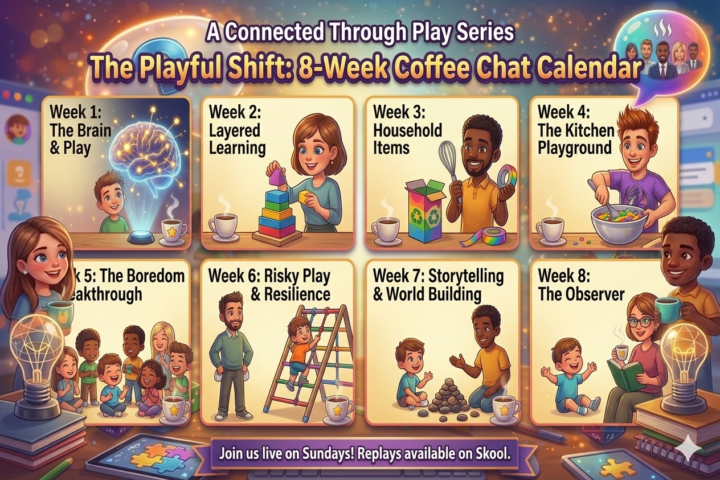
Come join me tomorrow as we talk about one of my favorite topics when it comes to kids and playful learning. It’s something you may not know officially but probably apply with your kids. Layered Learning. Intrigued? Join me. Interested but busy? I’ll post the replay. Who will join the Playful Shift Chat tomorrow?
Poll
2 members have voted
1 like • Apr 26
Unfortunately I will be busy, I look forward to a replay.
🔥
Apr 23 •
Welcome
Let’s extend a warm welcome to our newest community members @Adam Cyster @Natasha Bryant @Amy Grantham @Maryna Tempalova and @Dannielle McAuliffe Please don’t be shy! Say hi! Quick Tips: you’ll find play ideas under Play Prompts or Games and many are designed by age. Sunday is coffee chat- you can see the topics in the calendar and recordings are shared within 24 hours. I’m excited to be on this adventure with you.

3 likes • Apr 23
Welcome everybody! Glad to see the group of you made it!
🔥
Apr 19 •
The Brain and Play
I'm working on the classroom content but for those who missed today's session, here's the recording. I'm babysitting today so I'll be offline most of the day. Let's start the conversation- what questions do you have about the brain and play? What tips do you have? Where do we need to go deeper?

2 likes • Apr 19
Skimmed through it quick, love it! Looking to come back to this soon❤️🔥
🔥
Apr 18 •
Reading and Favorite Books
Today is Saturday and that means we have fun and share about ourselves. What was your favorite book or books as a child? Were you drawn to a specific genre or author? What about now as an adult? Do you find yourself still drawn to similar book genres or have you left those childhood stories behind. I loved mysteries, of course, it might be due to that was all my grandma kept at her house. I started with the Bobbsey Twins, then Nancy Drew or the Hardy Boys (I preferred them), and graduated to Ellery Queens Minute Mysteries. At home, we had lots of magazines and trips to the library. Your turn.

1 like • Apr 18
@Mary Nunaley I have a multitude, but it really depends on the subject of the individual. I dont have one to just throw out there, but maybe expert secrets by russell brunson since I named him abive
1 like • Apr 18
@Mary Nunaley Do I ever got a list! Highly recommend that one from Russell for those who want to share their message.
1-8 of 8
