Activity
Mon
Wed
Fri
Sun
Jan
Feb
Mar
Apr
May
Jun
Jul
Aug
Sep
Oct
Nov
What is this?
Less
More
Memberships
Rooted Alchemy
108 members • $40/month
7 contributions to Rooted Alchemy

13d •
A Gentle sign
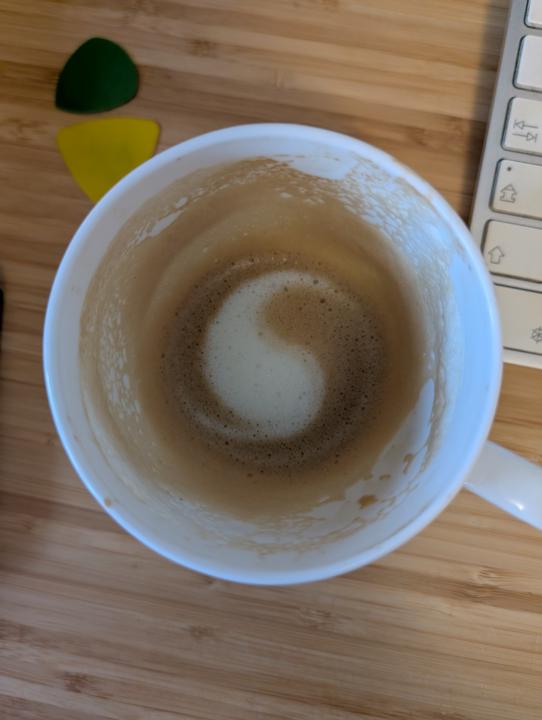
On Saturday, I decided to practice yin‑yang Qi Gong on my own — no video, nothing, just me. I began with a warm‑up, as we do here at Rooted Alchemy, and I managed to complete the whole practice with each movement repeated 9 times — a full cycle of 9. I felt grateful to have done it fully, on my own. Afterwards, I had breakfast. I poured myself an espresso and, before taking the last sip, I gave the cup a little circular spin to gather all the crema flavors. Just before bringing it to my lips, I looked down… and there it was: a perfect yin‑yang in the foam. For me, it's a gentle sign, a synchronicity encouraging me to keep playing with presence and energy.
1 like • 13d
@Adam S Indeed!

19d •
Hello !
Hi I am joining in from a little Island at the bottom of the UK, the Isle of Wight. I used to do Tai Chi many years back and been called back. Looked at many on line teachers etc, but when I found here it was like coming home. Looking forward to settling in here in the mornings soon! 🙏
2 likes • 19d
Welcome Steve!

22d •
Silk Reeling
We can use the term silk reeling to help us refer to, and study, the concepts of blending and weaving as we practice. The production of silk is deeply embedded in Chinese culture and society throughout the ages. The term is used in martial arts, tai ji and qi gong and comes from the Chen style of Tai Chi, but has been adopted, and possibly independently developed by numerous styles. Analogy and metaphor are the language of tai ji and qi gong, it creates space for us to build our own understanding in our own way and in our own time. Some silk reeling concepts we can take into our practice. -Like reeling raw silk from a cocoon, our movement should be relaxed, focused and unbroken. -Like creating thread, the harmonization of the joints should move and 'string' together as you move. Each joint is its own cocoon. Move from center, as center. -Each movement weaves another thread into our experience and creates a stronger connection throughout. -Movements weave and blend together creating contrast, intersection and separation. This can be related to the idea of 'brocade' as in the "8 Pieces of Brocade" Fun fact, silk worms create a single thread to make their cocoons which can reach up to almost a mile long!
4 likes • 22d
Your posts are always meaningful. Thank you
Nov 4 •
Posture
There is much that we can discuss and study when it comes to posture, but first we want to understand that posture is as much reaction as it is intention. It is something we have present when we stand, sit, and walk which is one of the reasons we discuss the Three Treasures of walking, standing and sitting so much in qi gong and tai ji. Posture is also intrinsically connected to our breath and sense of our space(internal and external). For these reasons we want to develop a more accepting, logical and practical understanding of posture as we study these arts. Certain aspects of our posture we can affect right away, like our focus, tongue to pallet, and grounding the feet. Others will take time, like core stability, leg strength, and greater awareness of center(of mass). Qi gong training improves all of these qualities naturally so postural improvements are part of the "rising tide" as well as one of the ships being risen. So what are some important, real time cues you can make to improve posture across all areas. Yi Dao Xian | Awareness finds the horizon - Lift gently from the crown of the head and suspend the head top. Eyes rest at level that should be able to rest in your space as if reading a book as well as glancing out to find the horizon as if on a plain, ship or peak. Head on a swivel. Like walking backwards, a lot of new information can come from the panorama. Tongue to pallet -internal postural awareness connected to breath, neck and jaw health. This is an ongoing aspect of our practice. Greater awareness to this area will bring benefits in both the short and long term. In taoist physical theory, tongue gently, yet firmly suctioned to the pallet was the neutral resting place of the tongue at all times. Don't over worry about the challenge this may or may not present in your practice. The body is deeply aware of how to manage these inputs. Simply allow that intention to become part of our practice in its own way. And as always, Relax, Be Present, Listen, Follow & Flow.
5 likes • Nov 4
For me, tongue to palate is easy on inhale. On exhale, it is more natural to let the tongue down. Like the analogy of gently blowing on my tea, it is easier. If my intention is to exhale by the mouth I mean. Otherwise it is ok.
Oct 27 •
似停非停 "Appears to stop, but does not stop"
This is another of my favorite sayings from the arts. It is meant to evoke an internal awareness as well as an external expression. From the outside at times it might seem like the tai ji or qi gong practitioner has come to a complete rest, and there are times when you should, and it is in those moments you continue to observe and listen for the subtler rhythms of the body and motion taking whatever time is needed to occupy your space. This is the permission to find your own rhythm with a movement once you feel the body, mind, and breath harmonize. This is the space between the breaths where there is no need to rush into the next moment. It is the ending and beginning of movements. It is your practice from one day to the next:)
3 likes • Oct 28
Very well said. In this space of stillness, that's where tai chi and meditation become one. Thank you for this wonderful pointing.
1-7 of 7

Active 21m ago
Joined Oct 14, 2025
Powered by