Activity
Mon
Wed
Fri
Sun
Aug
Sep
Oct
Nov
Dec
Jan
Feb
Mar
Apr
May
Jun
Jul
What is this?
Less
More
Memberships
Kingdom University
2.3k members • Free
16 contributions to Kingdom University

8d •
Bible Study With Us🧡
We are 42 parents strong on the YouVersion Bible App Also this week starting Monday on Instagram I will be teaching these steps in real time… My house has taken a shift to chaos due to summer schedule… So let’s rebuild together https://bible.com/reading-plans/72620/together/81083635/invitation?token=AVVzNZlPCDsk_e3PVuP5rg&source=share

1 like • 8d
Thank you for this study
28d •
Meltdowns, Shutdowns & Explosions — What Is Actually Happening & What To Do
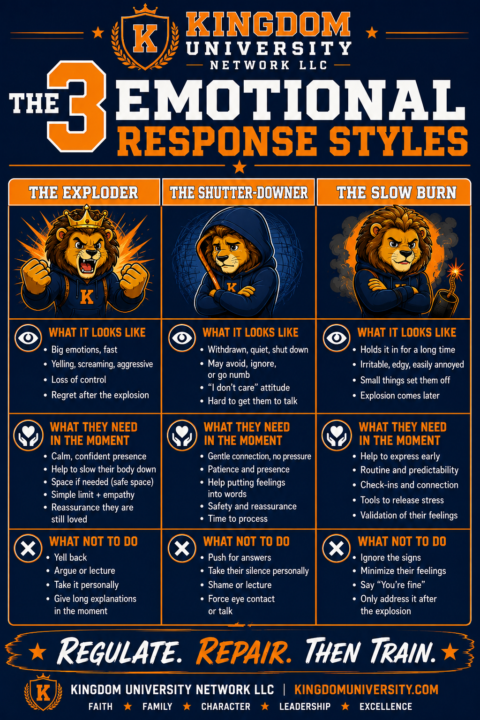
Your child just lost it. Full meltdown. Tears. Screaming. Or maybe the opposite, complete shutdown. Won't speak. Won't move. Blank face. And you are standing there trying to figure out what just happened and what do I do right now. Today we are going to break down what is actually happening in your child's brain and body when they hit that wall. And then I am going to give you a real plan for what to do in the moment AND after. Because how you respond in that moment either builds the bridge or burns it. WHAT IS ACTUALLY HAPPENING IN THEIR BRAIN When your child hits emotional overload their brain does something called an amygdala hijack. The amygdala is the part of the brain that processes threat and emotion. When it gets flooded it takes over. And the prefrontal cortex, the part responsible for reasoning, decision making, and self control — goes offline. In plain language: when your child is in a full meltdown they literally cannot think clearly. The rational brain has left the building. This is not an excuse. But it IS important information. Because trying to reason with a child in the middle of a meltdown is like trying to have a conversation with someone who is underwater. They cannot hear you the way you need them to. You have to help them surface first. Then you teach. THE THREE RESPONSE STYLES — WHICH ONE IS YOUR CHILD? THE EXPLODER: Everything comes out. Loud. Physical. Tears. Screaming. Sometimes throwing things. This child has big feelings and a low threshold for containment. The feeling hits and it comes right out. What they need: A parent who stays regulated. Calm, firm, present. Not matching their energy. Not shutting them down with force. Steady. THE SHUTTER-DOWNER: Goes completely quiet. Checks out. Won't respond. Blank face. This is not calm, this is a nervous system that has decided connection is unsafe and has gone into protection mode. What they need: Gentle, patient presence. No pressure to talk immediately. 'I'm right here. Take your time. I'm not going anywhere.' This child needs to know safety is still available before they can re-engage.
0 likes • 27d
Thank you for this. I feel like I’m learning and sometimes like a failure. My oldest is only 5 and I feel I can be to harsh on her and I want to teach her without yelling back
Jun 11 •
Can I Pray??
I don't know who needs this tonight, but I'm going to pray for you the same way I'm praying for myself.Father God, Lord, I'm not asking for the easy route. I know that's not how growth works.I know that's not how faith is built.I know that's not how You shape us. But Father, I am asking You to keep my mind. Don't let me lose my way in the middle of the battle. Don't let disappointment make me bitter.Don't let waiting make me wander.Don't let loneliness make me settle.Don't let exhaustion make me quit. Keep me. Your Word says You will keep in perfect peace those whose minds are stayed on You. So tonight, I'm seeking what You promised. You promised to lead me beside still waters. Lead me there. Because my mind has been Loud. My heart has been heavy.And my soul is tired. But You promised to restore my soul. And I believe You. Even when I don't see it yet. Even when the evidence hasn't shown up yet. Even when my circumstances are trying to tell a different story. I choose Your Word over what I see. I stand on Your Word for myself. I stand on Your Word for my children. I stand on Your Word for my finances. I declare that lack is not my portion. I declare provision over my household. I declare wisdom over every financial decision. I declare that my barns are full and my cup is running over. I thank You that You are teaching me how to steward what You place in my hands. And Father, when loneliness tries to visit me, remind me of Your promise. You said You would never leave me. You said You would never forsake me. So even when the room feels empty, I am not alone. Even when I feel unseen, I am not forgotten. Even when I feel weak, I am still carried by You. Tonight I lift my eyes to the hills. My help is not coming from people. My help is not coming from circumstances. My help is not coming from my own strength. My help comes from the Lord. The Maker of heaven and earth. The God who has never failed. The God who has never broken a promise. The God who is writing a story bigger than what I can currently see.
3 likes • Jun 11
Amen I receive
Jun 2 •
Hard Conversations: Divorce & Family Separation
Your child is not okay. I know that is hard to read. Because you have been working so hard to keep things as normal as possible. You have been civil. You have been careful. You have been trying. But your child is not okay. Not because you are failing. But because divorce and family separation are one of the most destabilizing things a child can experience. And children do not process it out loud. They process it in their behavior. In their body. In the quiet of their bedroom at night. Here is what your child may be carrying right now that they have never said out loud: "Is this my fault?" More children than you know believe their parents split up because of something they did or something they are. "If I am good enough will they get back together?" Children will silently perform for years trying to fix something that was never theirs to fix. "Which one do I have to choose?" Even when you've never asked them to choose they feel the pressure every single day. "Am I going to be abandoned too?" A parent leaving the home plants a seed of fear that the other parent might leave too. None of this is your fault for getting divorced. But it is your responsibility to address it. Your child needs to hear out loud, directly from you that none of this is their fault. That both parents still love them. That love does not require a shared address. That conversation might be the most important one you ever have. 💬 Have you ever asked your child directly how they feel about the family separation? What happened or what has stopped you from asking? Our next post will talk about How to talk to your child about divorce without making them carry your pain. Real language. Real boundaries. Real healing.
2 likes • Jun 3
I am not separated. But it has definitely crossed my mind one or 2 times. Me and my husband never seem to be in the same page and aren’t spiritually in the same page either. It’s hard feeling like we don’t connect on anything and can’t communicate or have a conversation about seeking help. Marriage counseling is a HARD no for him. I started seeing someone on my own because he never agreed to join no matter how many times I asked. Idk what to do sometimes
2 likes • Jun 3
@Virginia Kuria as a daughter that grew up watching my mom go through domestic violence. Getting out of it is the best thing you can do. They may not understand now. ( I didn’t) but eventually they will thank you. I wasn’t raised in Christian home though. Them having a mother seeking God in this is season is so important ❤️
Jun 1 •
Hard Conversations: Death
Nobody wants to be the parent who sat their child down and explained that people die. It feels like stealing something. Like the moment you say it you've taken their innocence and you can never give it back. So most parents wait. They change the subject. They say grandma "went to sleep." They say the dog "went to a farm." They deflect, delay, and distract hoping the question goes away on its own. But here is what happens when we never talk about death: Our children experience it for the first time without any framework. Without language. Without God in the conversation. In the middle of a crisis when they are already devastated they have to figure out what death means all by themselves. And what they figure out on their own is almost never accurate. Almost never peaceful. And almost never anchored in faith. Here is the truth Talking about death does not traumatize your child. Being unprepared for it does. A child who has been taught what death is in a calm, age-appropriate, God-centered way is a child who has something to hold onto when it actually happens. They know where believers go. They know it is not the end. They know they can grieve AND still have hope. That is a gift. And it starts with a conversation you have before you need to. Did anyone ever talk to you about death growing up? How did that or the absence of it shape how you've handled it with your own children? Drop it below. 🌙 Tonight — Im am giving you the actual words to use. What do you say when your child asks "What happens when you die?" We're breaking it down by age.
3 likes • Jun 1
The first time I was told “everybody dies” I was terrified. It came from my Dad. I believing he was having a tough time, bad day and I happened to walk in in the middle of his conversation. And he looked at me and said. We’re all gonna die one day. And it scared me so much that it’s something that I have had to heal as an adult. He gave no further explanation. That was it He has passed away. It’s been 12 years. And didn’t get to meet my children but my daughter is 4 and the only thing I did say when she asked was. “Did he die?” Was yeah he did but he’s with God now. And she seemed ok with my answer. But im not sure if she even understood
1-10 of 16

@adriana-perez-2113
Mom to a beautiful daughter and a handsome son.
Active 3d ago
Joined Apr 24, 2026
Powered by